Formulation and Evaluation of Herbal Hair Oil Prepared from Garlic Leaves
Article Sidebar
Main Article Content
Abstract
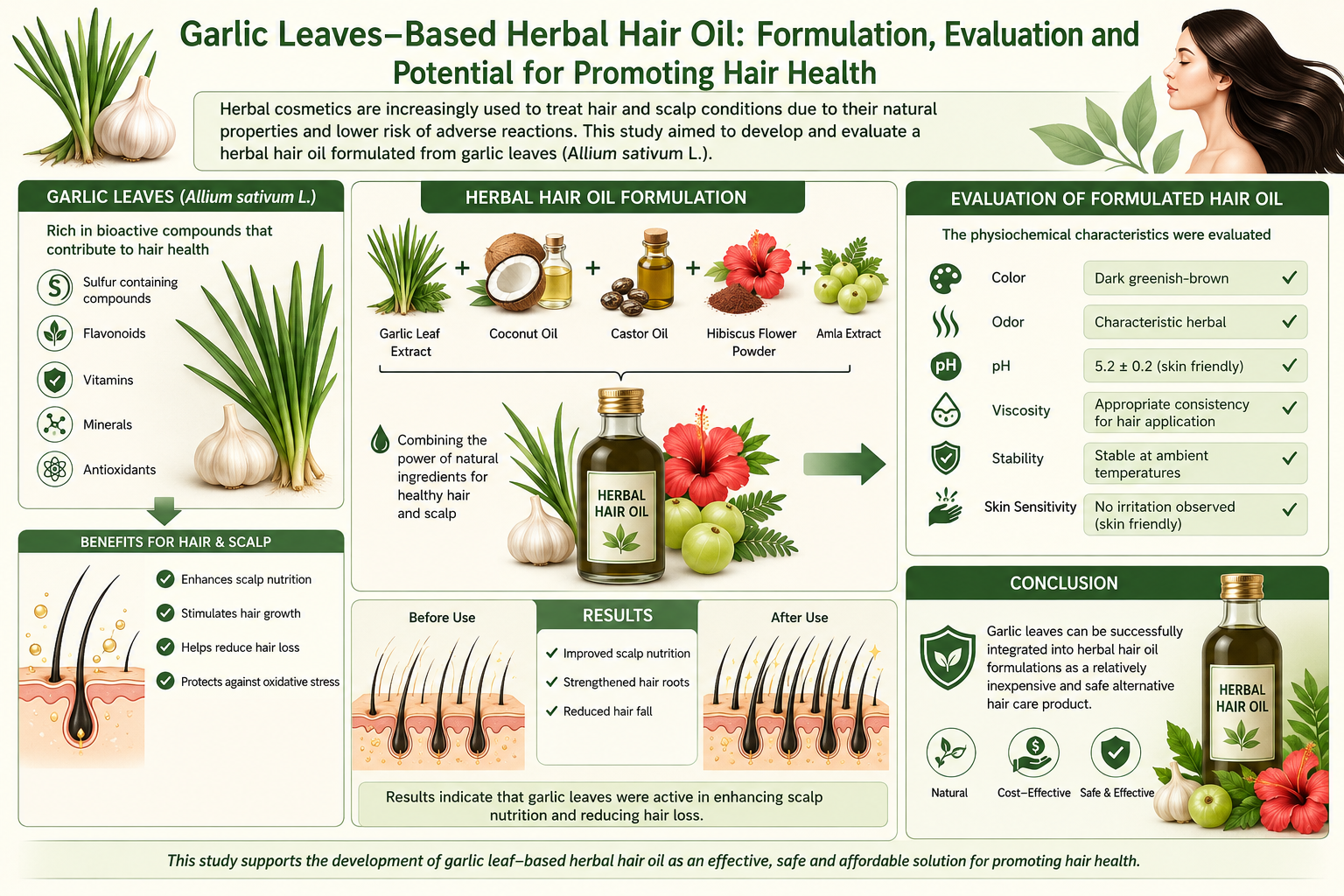
Herbal cosmetics have been increasingly utilized to treat a variety of hair and scalp conditions due to their naturally occurring properties and lower risk of adverse reactions. Herbal hair oils provide essential nutrients to the scalp while stimulating hair growth and protecting against hair loss. This current study is focused on developing and evaluating a herbal hair oil formulation derived from garlic leaves (Allium sativum L.) The chemical constituents in garlic leaves consist of; sulfur containing compounds, flavonoids, vitamins, minerals, and antioxidants all of which contribute positively toward hair health. A formulation of herbal hair oil was developed by combining the garlic leaf components with coconut oil, castor oil, hibiscus flower powder and amla extract. The formulated product was tested to evaluate its physiochemical characteristics including; color, odor, pH, viscosity, stability, and skin sensitivity. Results indicated that the formulated herbal oil had favorable aesthetic attributes, displayed appropriate stability at ambient temperatures and exhibited suitable consistency for use as a hair application. The results of this study also indicate that garlic leaves were active in enhancing scalp nutrition and reducing hair loss. In conclusion, garlic leaves may be successfully integrated into herbal hair oil formulations as a relatively inexpensive and safe alternative hair care product.
Article Details
Section

This work is licensed under a Creative Commons Attribution-NonCommercial 4.0 International License.
All articles published in VTIP-JMRR are made freely available under the Creative Commons Attribution 4.0 International License (CC BY 4.0). Under this license, others may freely share, distribute, and adapt the published work, provided appropriate credit is given to the original authors.
By signing the copyright form, the author(s) warrant and represent that:
✓ The manuscript is original and has not been published previously in any journal, conference, or book (in whole or in part).
✓ The manuscript is not currently under consideration for publication elsewhere.
✓ All authors have read and approved the final manuscript and have agreed to this copyright transfer.
✓ The manuscript does not infringe upon any existing copyright, trademark, patent, or other intellectual property right of any third party.
✓ All data, figures, and tables presented are accurate, authentic, and have not been fabricated or falsified.
✓ Proper permissions have been obtained for any third-party material (images, figures, tables, text) included in the manuscript.
✓ The work complies with all applicable ethical guidelines, including those related to human and animal research.
✓ All sources of funding and conflicts of interest have been disclosed in the manuscript.
How to Cite
References
[1] Kokate, C. K., Purohit, A. P., & Gokhale, S. B. (2017). Pharmacognosy (54th ed.). Nirali Prakashan.
[2] Khandelwal, K. R. (2019). Practical Pharmacognosy: Techniques and Experiments (26th ed.). Nirali Prakashan.
[3] Bayan, L., Koulivand, P. H., & Gorji, A. (2014). Garlic: A review of potential therapeutic effects. Avicenna Journal of Phytomedicine, 4(1), 1–14.
[4] Yamani, N. S., Sudha, Jyotsna, Pratyusha, K., Pratyusha, J., & Kartheeka. (2018). Formulation and evaluation of polyherbal hair oil. Journal of Pharmacognosy and Phytochemistry, 7(3), 3254–3256.
[5] Adhirajan, N., Ravi Kumar, T., Shanmugasundaram, N., & Babu, M. (2003). In vivo and in vitro evaluation of hair growth potential of Hibiscus rosa-sinensis Linn. Journal of Ethnopharmacology, 88(2–3), 235–239. https://doi.org/10.1016/S0378-8741(03)00231-9
[6] Sharma, P. P. (2008). Cosmetics: Formulation, Manufacturing and Quality Control (4th ed.). Vandana Publications.
[7] Shang, A., Cao, S. Y., Xu, X. Y., Gan, R. Y., Tang, G. Y., Corke, H., Mavumengwana, V., & Li, H. B. (2019). Bioactive compounds and biological functions of garlic (Allium sativum L.). Foods, 8(7), 246. https://doi.org/10.3390/foods8070246
[8] Trüeb, R. M. (2006). Pharmacologic interventions in aging hair. Clinical Interventions in Aging, 1(2), 121–129. https://doi.org/10.2147/ciia.2006.1.2.121
[9] Rele, A. S., & Mohile, R. B. (2003). Effect of mineral oil, sunflower oil, and coconut oil on prevention of hair damage. Journal of Cosmetic Science, 54(2), 175–192.
[10] Trease, G. E., & Evans, W. C. (2009). Pharmacognosy (16th ed.). Elsevier/Saunders.
[11] Marwat, S. K., Rehman, F., Khan, E. A., Baloch, M. S., Sadiq, M., Ullah, I., Javaria, S., & Shaheen, S. (2017). Review – Ricinus communis: Ethnomedicinal uses and pharmacological activities. Pakistan Journal of Pharmaceutical Sciences, 30(5), 1815–1827.
[12] Adhirajan, N., Dixit, V. K., & Chandrakasan, G. (2001). Development and evaluation of herbal formulations for hair growth. Indian Drugs, 38(11), 559–563.
[13] Mirunalini, S., & Krishnaveni, M. (2010). Therapeutic potential of Phyllanthus emblica (amla): The ayurvedic wonder. Journal of Basic and Clinical Physiology and Pharmacology, 21(1), 93–105. https://doi.org/10.1515/JBCPP.2010.21.1.93
[14] Harborne, J. B. (1998). Phytochemical Methods: A Guide to Modern Techniques of Plant Analysis (3rd ed.). Springer.
[15] Kashid, S. U. (2021). A bucolic remedy of formulation and evaluation of polyherbal hair oil. Asian Journal of Pharmaceutical and Clinical Research, 14(12), 87–92. https://doi.org/10.22159/ajpcr.2021v14i12.42963