
Development and Physicochemical Evaluation of Herb-Infused Functional Cookies
Article Sidebar
Main Article Content
Abstract
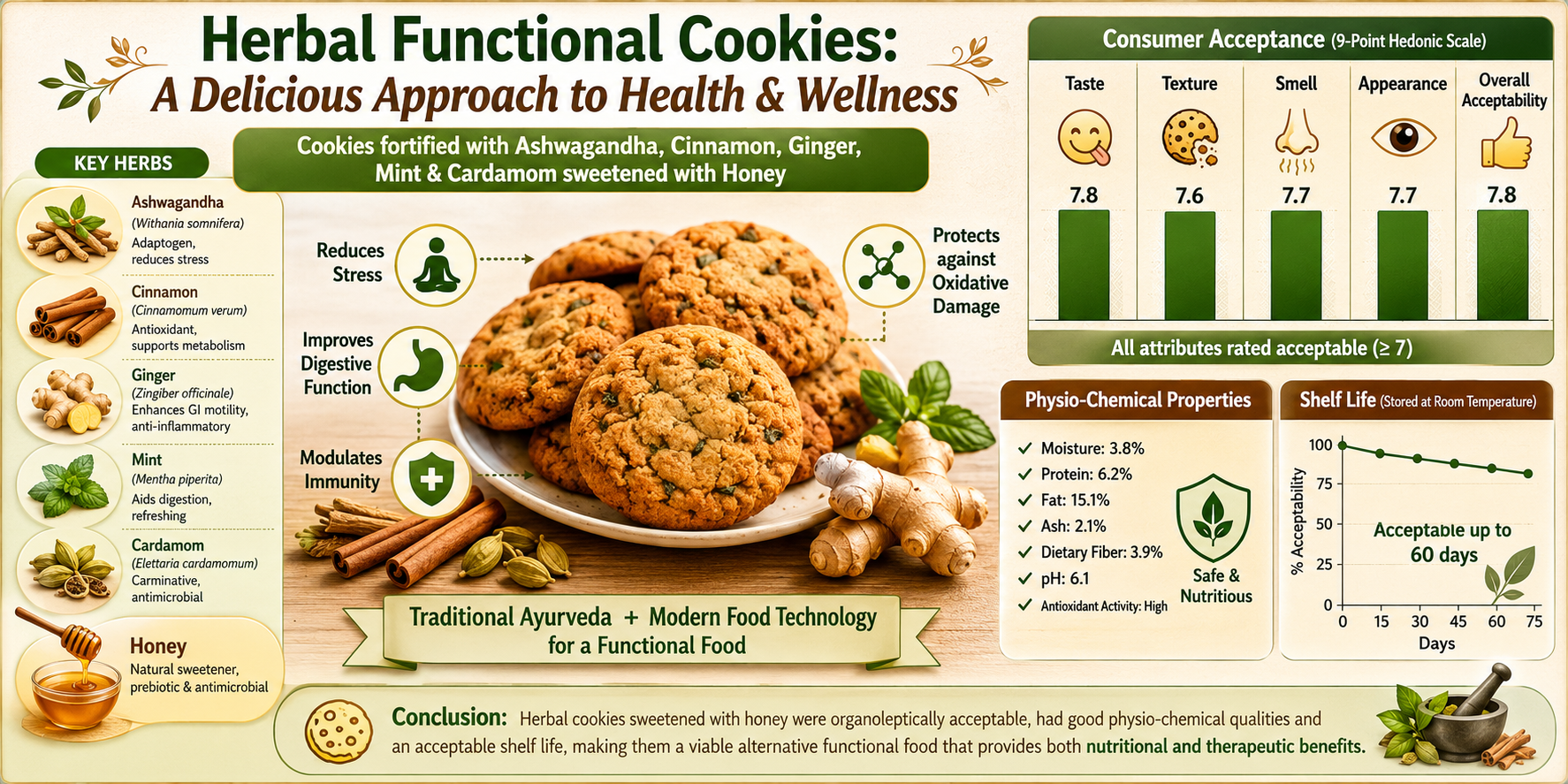
The purpose of this investigation was to create and assess functional cookies made with Ashwagandha (Withania somnifera), Cinnamon (Cinnamomum verum), Ginger (Zingiber officinale), Mint (Mentha piperita) & Cardamom (Elettaria cardamomum). The growing number of individuals affected by lifestyle-related illnesses has led consumers to seek out functional foods which provide some type of health benefit in addition to fulfilling their nutritional needs. Cookies prepared from herbs are an exciting example of how modern food technology can combine the knowledge from traditional Ayurvedic pharmacology. The suggested formula will help prepare a cookie base that satisfies sensory requirements while providing the therapeutic effect associated with reducing stress through the use of the Ashwagandha as an adaptogen; enhancing digestive function through enhanced GI motility; stimulating or modulating immune response; and protecting against oxidative damage. Due to its proven prebiotic activity and antimicrobial properties honey was chosen for use as the natural sweetener and because it provided the fat component in the homemade butter. Consumer panel acceptance assessments of the organoleptic characteristics of each cookie were performed using a 9 point hedonic scale for measuring taste, texture, smell, appearance, and overall acceptability. Results indicated that consumer panels found cookies made with the specified proportions of herbs acceptable. Assessments were also completed on physio-chemical properties as well as shelf life. Overall, results from the assessment support the idea that cookies prepared from herbs are a viable alternative as a functional food that provides both nutritionally as well as therapeutically.
Article Details
Section

This work is licensed under a Creative Commons Attribution-NonCommercial 4.0 International License.
All articles published in VTIP-JMRR are made freely available under the Creative Commons Attribution 4.0 International License (CC BY 4.0). Under this license, others may freely share, distribute, and adapt the published work, provided appropriate credit is given to the original authors.
By signing the copyright form, the author(s) warrant and represent that:
✓ The manuscript is original and has not been published previously in any journal, conference, or book (in whole or in part).
✓ The manuscript is not currently under consideration for publication elsewhere.
✓ All authors have read and approved the final manuscript and have agreed to this copyright transfer.
✓ The manuscript does not infringe upon any existing copyright, trademark, patent, or other intellectual property right of any third party.
✓ All data, figures, and tables presented are accurate, authentic, and have not been fabricated or falsified.
✓ Proper permissions have been obtained for any third-party material (images, figures, tables, text) included in the manuscript.
✓ The work complies with all applicable ethical guidelines, including those related to human and animal research.
✓ All sources of funding and conflicts of interest have been disclosed in the manuscript.
How to Cite
References
[1]. Mukherjee, P. K. (2002). Quality control of herbal drugs. Business Horizons Pharmaceutical Publishers.
[2]. Shah, B., & Seth, A. K. (2010). Textbook of pharmacognosy and phytochemistry. Elsevier Publications.
[3]. Kokate, C. K., Purohit, A. P., & Gokhale, S. B. (2017). Pharmacognosy (52nd ed.). Nirali Prakashan.
[4]. World Health Organization. (2003). WHO guidelines on good agricultural and collection practices (GACP) for medicinal plants. WHO Press.
[5]. Food and Agriculture Organization. (2007). Functional foods and nutritional evaluation. FAO Corporate Document Repository.
[6]. Sharma, P. V. (2005). Dravyaguna vijnana (Vol. 2). Chaukhambha Bharati Academy.
[7]. Kaur, G., Sharma, M., & Sharma, N. (2017). Development of herbal fortified bakery products and their sensory evaluation. International Journal of Food Science & Nutrition, 68(4), 428–435.
[8]. Gupta, R., & Sharma, S. (2019). Functional foods: Role in health promotion and disease prevention. Journal of Food Technology Research, 6(2), 71–85.
[9]. Indian Pharmacopoeia Commission. (2018). Indian pharmacopoeia (8th ed.). Ministry of Health and Family Welfare, Government of India.
[10]. World Health Organization. (2004). Guidelines on safety monitoring of herbal medicines in pharmacovigilance systems. WHO Press.
[11]. American Association of Cereal Chemists International. (2000). Approved methods of analysis (10th ed.). AACC International.
[12]. Aggarwal, D., Sabikhi, L., & Kumar, M. S. (2016). Formulation of reduced-calorie biscuits using artificial sweeteners and fat replacer with dairy–multigrain approach. NFS Journal, 2, 1–7.
[13]. Ajibola, C. F., Oyerinde, V. O., & Adeniyan, O. S. (2015). Physicochemical and antioxidant properties of whole-wheat biscuits incorporated with Moringa oleifera leaves and cocoa powder. Journal of Scientific Research and Reports, 7(3), 195–206.
[14]. Ajila, C. M., Leelavathi, K., & Rao, U. J. S. (2008). Improvement of dietary fiber content and antioxidant properties in soft dough biscuits with the incorporation of mango peel powder. Journal of Cereal Science, 48(2), 319–326.
[15]. Bala, M., Pratap, K., Verma, P. K., Singh, B., & Padwad, Y. (2015). Validation of ethnomedicinal potential of Tinospora cordifolia for anticancer and immunomodulatory activities. Journal of Ethnopharmacology, 175, 131–137.
[16]. Chandrasekara, K., & Kumar, T. J. (2016). Roots and tuber crops as functional foods: A review on phytochemical constituents and their potential health benefits. International Journal of Food Science, 2016, 1–15.
[17]. Singh, N., Singh, M., & Khare, L. (2012). Ashwagandha (Withania somnifera): Mechanisms and clinical implications. Journal of Ethnopharmacology, 143(2), 291–298.
[18]. Lesgards, M., Baldovini, N., Vidal, N., & Pietri, S. (2014). Antioxidant activities of phenol-rich extracts from 26 spices consumed in India. Food Chemistry, 157, 303–310.
[19]. Rao, A., & Ye, V. (2014). Cinnamon: A multifaceted medicinal plant. Evidence-Based Complementary and Alternative Medicine, 2014, 1–12.
[20]. Prasad, S., & Aggarwal, B. B. (2011). Ginger (Zingiber officinale): Anti-inflammatory, antioxidant and anticancer activities. In I. F. F. Benzie & S. Wachtel-Galor (Eds.), Herbal medicine: Biomolecular and clinical aspects (2nd ed., Chapter 7). CRC Press.
[21]. Sampath Kumar, P., Paramesh, C., Saravanan, K., & Divya, G. (2015). Cardamom (Elettaria cardamomum) — A spice with multi-functional medicinal properties: A review. International Journal of Pharmacognosy and Phytochemical Research, 7(1), 145–150.
[22]. Sharma, I., Gusain, V., & Dixit, V. P. (1996). Hypolipidaemic and antiatherosclerotic effects of Zingiber officinale in cholesterol-fed rabbits. Indian Journal of Experimental Biology, 34(7), 689–692.
[23]. Baliga, B., Shivashankara, C., Haniadka, R., Dsouza, J., & Bhat, H. P. (2011). Phytochemistry, nutritional and pharmacological properties of Artocarpus heterophyllus (jackfruit): A review. Food Research International, 44(7), 1800–1811.
[24]. Manohar, S., & Rajasekaran, K. (2021). Sensory and nutritional profiling of functional biscuits incorporating medicinal plant extracts. Journal of Food Quality, 2021, 1–9.
[25]. Sharma, R., Kumar, A., & Bhatnagar, P. (2018). Development and quality evaluation of value-added herbal cookies incorporated with Tulsi, Brahmi, and Ashwagandha. Asian Journal of Dairy and Food Research, 37(3), 244–249.