Formulation and Evaluation of Herbal Anti-Acne Gel Containing Argemone Mexicana Leaf Extract
Article Sidebar
Main Article Content
Abstract
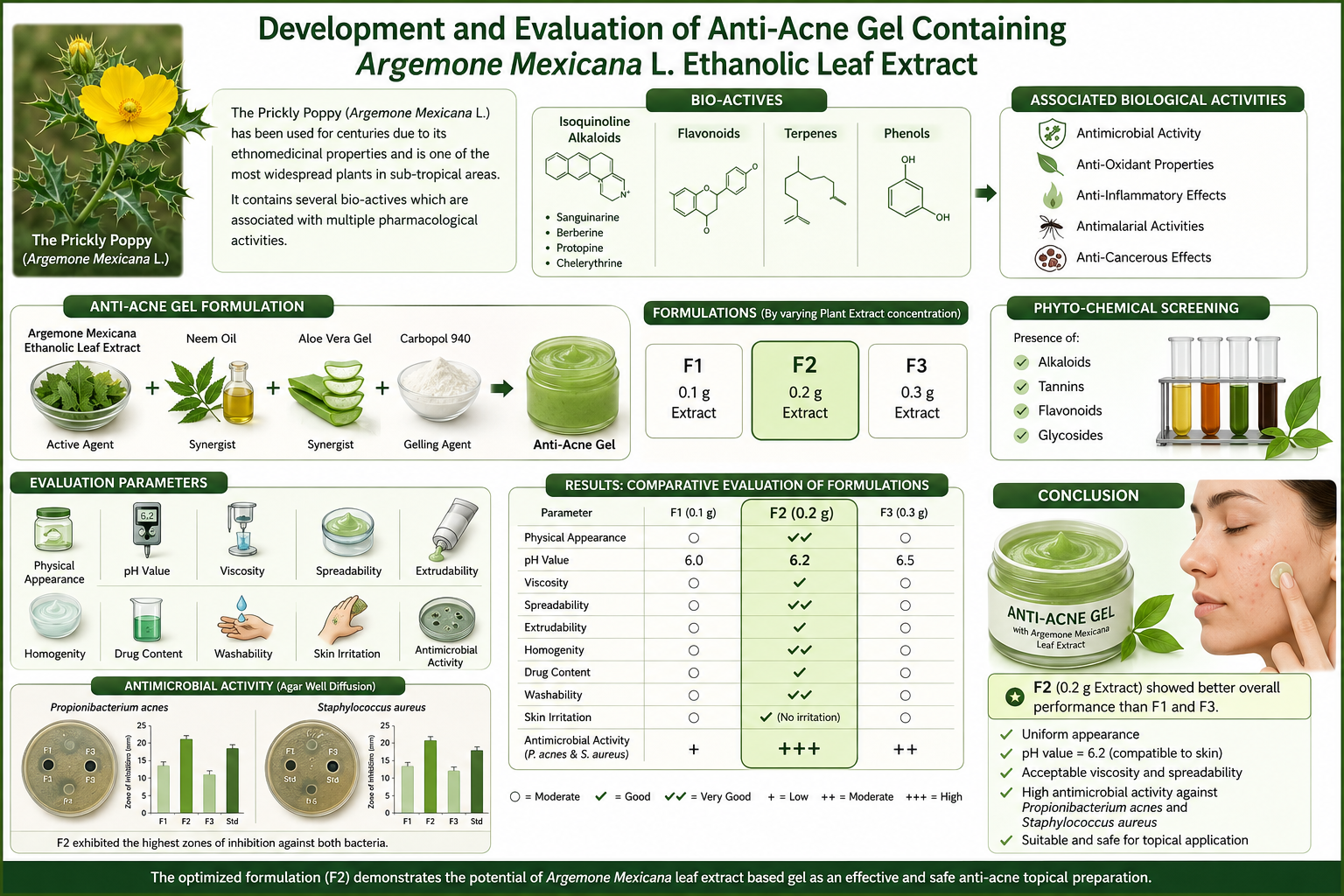
The Prickly Poppy (Argemone Mexicana L.) has been used for centuries due to its ethnomedicinal properties, being one of the most widespread plants in sub-tropical areas. It contains several bio-actives such as Isoquinolines Alkaloids (Sanguinarine, Berberine, Protopine and Chelerythrine), Flavonoids, Terpenes and Phenols, which are associated with Antimicrobial Activity, Anti-Oxidant Properties, Anti-Inflammatory Effects, Antimalarial Activities, and Anti-Cancerous Effects. The purpose of this research was to create and assess an Anti-Acne Gel that includes the Ethanolic Leaf Extract of A. Mexicana as the main Active Agent; Neem Oil and Aloe Vera Gel as Synergists, while utilizing Carbopol 940 as the Gelling Agent. Three different formulations (F1-F3) were developed at three different levels of concentration of the Plant Extract (0.1g, 0.2g and 0.3g respectively). Phyto-Chemical Screening confirmed the presence of alkaloids, tannins, flavonoids and glycosides in the extract. The evaluation parameters included Physical Appearance, pH Value, Viscosity, Spreadability, Extrudability, Homogenity, Drug Content, Washability, Skin Irritation and Antimicrobial Activity. F2 showed better than all the other formulations when it came to its Characteristics, these include a uniform appearance, pH value = 6.2 (compatible to skin), acceptable viscosity, good spreadability, high antimicrobial activity against Propionibacterium Acnes and Staphylococcus Aureus.
Article Details
Section

This work is licensed under a Creative Commons Attribution-NonCommercial 4.0 International License.
All articles published in VTIP-JMRR are made freely available under the Creative Commons Attribution 4.0 International License (CC BY 4.0). Under this license, others may freely share, distribute, and adapt the published work, provided appropriate credit is given to the original authors.
By signing the copyright form, the author(s) warrant and represent that:
✓ The manuscript is original and has not been published previously in any journal, conference, or book (in whole or in part).
✓ The manuscript is not currently under consideration for publication elsewhere.
✓ All authors have read and approved the final manuscript and have agreed to this copyright transfer.
✓ The manuscript does not infringe upon any existing copyright, trademark, patent, or other intellectual property right of any third party.
✓ All data, figures, and tables presented are accurate, authentic, and have not been fabricated or falsified.
✓ Proper permissions have been obtained for any third-party material (images, figures, tables, text) included in the manuscript.
✓ The work complies with all applicable ethical guidelines, including those related to human and animal research.
✓ All sources of funding and conflicts of interest have been disclosed in the manuscript.
How to Cite
References
[1] Ansong, J. A., Asante, E., Johnson, R., Boakye-Gyasi, M. E., Kuntworbe, N., & Owusu, F. W. A. (2023). Formulation and evaluation of herbal-based antiacne gel preparations. BioMed Research International, 2023, Article 7838299. https://doi.org/10.1155/2023/7838299
[2] Aulton, M. E., & Taylor, K. (2018). Aulton's pharmaceutics: The design and manufacture of medicines (5th ed.). Elsevier.
[3] Bhaskar, G., Arshia, S., & Priyadarshini, S. R. B. (2010). Formulation and evaluation of topical polyherbal antiacne gels containing Garcinia mangostana and Aloe vera. Pharmacognosy Magazine, 5(19), 93–99.
[4] Brahmachari, G., Gorai, D., & Roy, R. (2013). Argemone mexicana: Chemical and pharmacological aspects. Revista Brasileira de Farmacognosia, 23(3), 559–575. https://doi.org/10.1590/S0102-695X2013005000031
[5] Deshpande, T., Shivam, P., Sadaf, S., Sanjana, N., & Prince, Y. (2024). Formulation and evaluation of herbal anti-acne gel containing extracts of Tabernaemontana divaricata and Psidium guajava. International Journal of Ayurveda and Pharma Research, 12(11), 23–28.
[6] Gaur, P. K., Mishra, R., Kaushik, R., Verma, K. K., Kumar, N., & Lata, K. (2024). Polyherbal antiacne gel: In vitro antibacterial activity and efficacy evaluation against Cutibacterium acnes. Assay and Drug Development Technologies, 22(7), 373–386. https://doi.org/10.1089/adt.2024.010
[7] Gobato, R., Fedrigo, D. F. G., & Gobato, A. (2015). Molecular geometry of alkaloids present in seeds of Mexican prickly poppy. arXiv. https://arxiv.org/abs/1510.07031
[8] Gurjar, N. B., Barot, B. S., & Shelat, P. K. (2012). Development and evaluation of cinnamon and Aloe vera containing herbal anti-acne gel. International Journal of Pharmacy and Industrial Research, 2(4), 446–451.
[9] Indian Pharmacopoeia Commission. (2022). Indian pharmacopoeia. IPC.
[10] Kumar, D., Sahu, T., & Sahu, Y. (2024). Review on herbal antiacne gel. International Journal of Progressive Research in Science and Engineering, 5(03), 47–50.
[11] Lachman, L., Lieberman, H. A., & Kanig, J. L. (2013). The theory and practice of industrial pharmacy (4th ed.). CBS Publishers.
[12] Nancy, A., & Praveena, A. (2017). Argemone mexicana: A boon to medicinal and pharmacological approaches in current scenario. Current Bioactive Compounds, 13(3), 248–256. https://doi.org/10.2174/1573407212666160601160147
[13] Rakesh, S. A., Anusha, B. N., Prathiksha, C. C., Nisarga, K., Gagan, H. S., & Bhumika, B. C. (2025). Phytotherapeutic face wash gel: Formulation and evaluation for acne treatment. Journal of Pharmacognosy and Phytochemistry, 14(3), 635–638.
[14] Remington, J. P. (2013). Remington: The science and practice of pharmacy (22nd ed.). Pharmaceutical Press.
[15] Sen, N., Rakesh, S., Kotrike, R. K., Kulkarni, G. T., & Babu, P. V. (2023). Formulation and evaluation of topical poly herbal gel consisting of natural antimicrobials for the activity against acne vulgaris. Recent Trends in Pharmaceutical Sciences and Research, 5(2).
[16] Tiwari, P., & Bhadauria, R. S. (2021). Phytochemical and pharmacological evaluation of Argemone mexicana. Journal of Drug Discovery and Therapeutics, 9(2), 1–7.