
Formulation and Evaluation of Herbal Oral Care Products Using Alum and Clove Oil (Mouthwash)
Article Sidebar
Main Article Content
Abstract
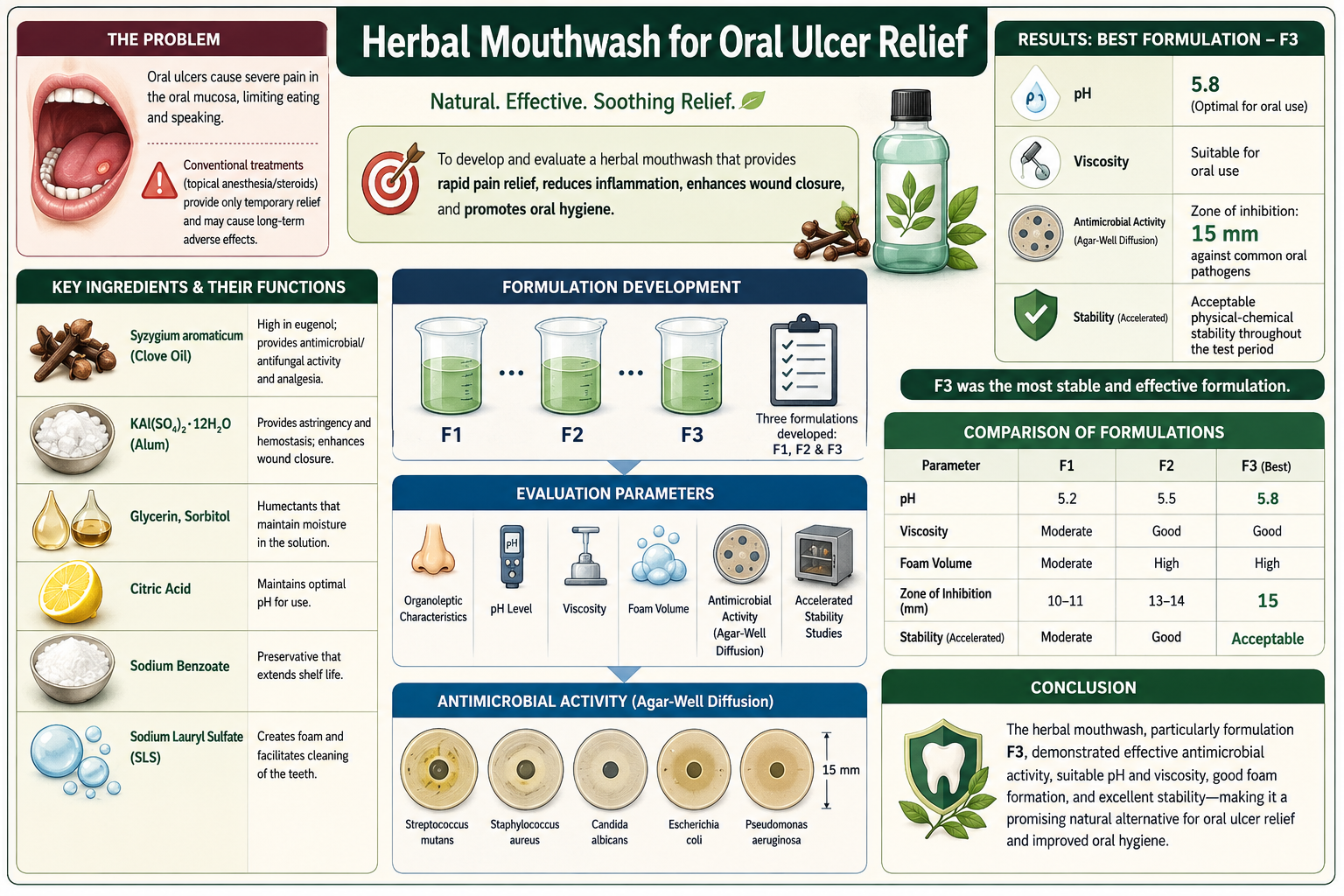
Oral ulcers create severe pain in the oral mucosa and will severely limit eating and speaking. While conventional treatment of oral ulcers through topical anesthesia or steroid application can provide temporary symptom relief, these applications have the potential for long term adverse effects. This article describes the development of a herbal mouth wash comprised of Syzygium aromaticum (clove oil), KAl(SO₄)₂·12H₂O (alum), glycerin, sorbitol, citric acid, sodium benzoate, and sodium lauryl sulfate (SLS) designed to provide rapid relief from pain; reduce inflammation; enhance wound closure and facilitate oral hygiene. Syzygium aromaticum has been shown to be effective in providing significant antimicrobial/antifungal activity and analgesia due to its high eugenol content. Alum was chosen because it provides both astringency and hemostasis which enhance wound closure. Sorbitol and glycerine function as humectants to maintain moisture within the solution. Citric acid ensures the solution remains at an optimal pH for its intended use. Sodium benzoate functions as a preservative extending the shelf life of the product. SLS creates the foam component of this product and facilitates cleaning the teeth. Three different formulations (F1, F2 & F3) were developed, tested for their organoleptic characteristics, pH level, viscosity, foam volume created by each formula, and tested for antimicrobial properties utilizing the agar-well-diffusion technique. Additionally, all three formulas underwent accelerated-stability studies. The most stable formula (F3) had a pH level of 5.8, sufficient viscosity for oral use, created a zone of inhibition of 15mm around it when tested against several common pathogens found on the oral cavity and showed acceptable physical-chemical stability throughout the test period.
Article Details
Section

This work is licensed under a Creative Commons Attribution-NonCommercial 4.0 International License.
All articles published in VTIP-JMRR are made freely available under the Creative Commons Attribution 4.0 International License (CC BY 4.0). Under this license, others may freely share, distribute, and adapt the published work, provided appropriate credit is given to the original authors.
By signing the copyright form, the author(s) warrant and represent that:
✓ The manuscript is original and has not been published previously in any journal, conference, or book (in whole or in part).
✓ The manuscript is not currently under consideration for publication elsewhere.
✓ All authors have read and approved the final manuscript and have agreed to this copyright transfer.
✓ The manuscript does not infringe upon any existing copyright, trademark, patent, or other intellectual property right of any third party.
✓ All data, figures, and tables presented are accurate, authentic, and have not been fabricated or falsified.
✓ Proper permissions have been obtained for any third-party material (images, figures, tables, text) included in the manuscript.
✓ The work complies with all applicable ethical guidelines, including those related to human and animal research.
✓ All sources of funding and conflicts of interest have been disclosed in the manuscript.
How to Cite
References
[1] Upadhye, K., Charde, K., Dixit, G., & Bakhle, S. (2021). Formulation and evaluation of herbal gel for management of mouth ulcers. Indian Journal of Pharmacy and Pharmacology, 8(3), 226–230. https://doi.org/10.18231/j.ijpp.2021.042
[2] Kilor, V., Sapkal, N., & Shaikh, S. (2025). Review of clinical studies of herbal products as a treatment option in recurrent aphthous stomatitis. Research Journal of Pharmacy and Technology, 18(3). https://doi.org/10.52711/0974-360X.2025.00215
[3] Sridevi Anjuga, E. P., & Aravindha Babu, N. (2020). Guidelines for diagnosis and treatment of recurrent aphthous stomatitis for dental practitioners. Indian Journal of Forensic Medicine & Toxicology, 14(4), 1099–1104. https://doi.org/10.37506/ijfmt.v14i4.11688
[4] Ghodake, U. S., Tiwari, N., Markad, S., & Gosavi, K. (2025). Alum: An updated review on its water purification, application, toxicity and properties. International Research Journal of Modernization in Engineering Technology and Science, 7(11). https://doi.org/10.56726/IRJMETS85700
[5] Rote, S., Tandale, K., Dhonde, P. S., & Kolhe, S. D. (2025). A research paper on formulation and evaluation of herbal mouthwash. Journal of Pharmacognosy and Phytochemistry, 14(2), 583–589. https://doi.org/10.22271/phyto.2025.v14.i2g.15335
[6] Patil, A. P., Khan, M. Z., & Chaudhari, H. K. (2025). Formulation and evaluation of herbal oral care products using guava leaves and alum (mouthwash). Journal of Advance and Future Research, 3(11), 876–880.
[7] Thomas, A., Thakur, S., & Mhambrey, S. (2015). Comparison of the antimicrobial efficacy of chlorhexidine, sodium fluoride, fluoride with essential oils, alum, green tea, and garlic with lime mouth rinses on cariogenic microbes. Journal of International Society of Preventive and Community Dentistry, 5(4), 302–308. https://doi.org/10.4103/2231-0762.161759
[8] Hussein, A. A. (2019). The effects of different concentrations of alum solutions on plaque and bleeding levels. Journal of Pharmaceutical Sciences and Research, 11(3), 1078–1081.
[9] Teke, P. P., Lakule, S. D., Apate, T. R., Thube, D. D., Tandle, A. S., & Rahane, R. D. (2025). Formulation and evaluation of a guava leaf-based mouth freshener incorporated with peppermint oil. International Journal of Innovative Research in Technology, 12(1), 3613–3619.
[10] Chilev, C. P., & Peshev, D. (2025). Hydro-distillation versus steam distillation for clove oil production. Journal of Chemical Technology and Metallurgy, 60(2), 201–210.