Formulation and Evaluation of Clitoria ternatea Based Herbal Lotion for the Management of Psoriasis
Article Sidebar
Main Article Content
Abstract
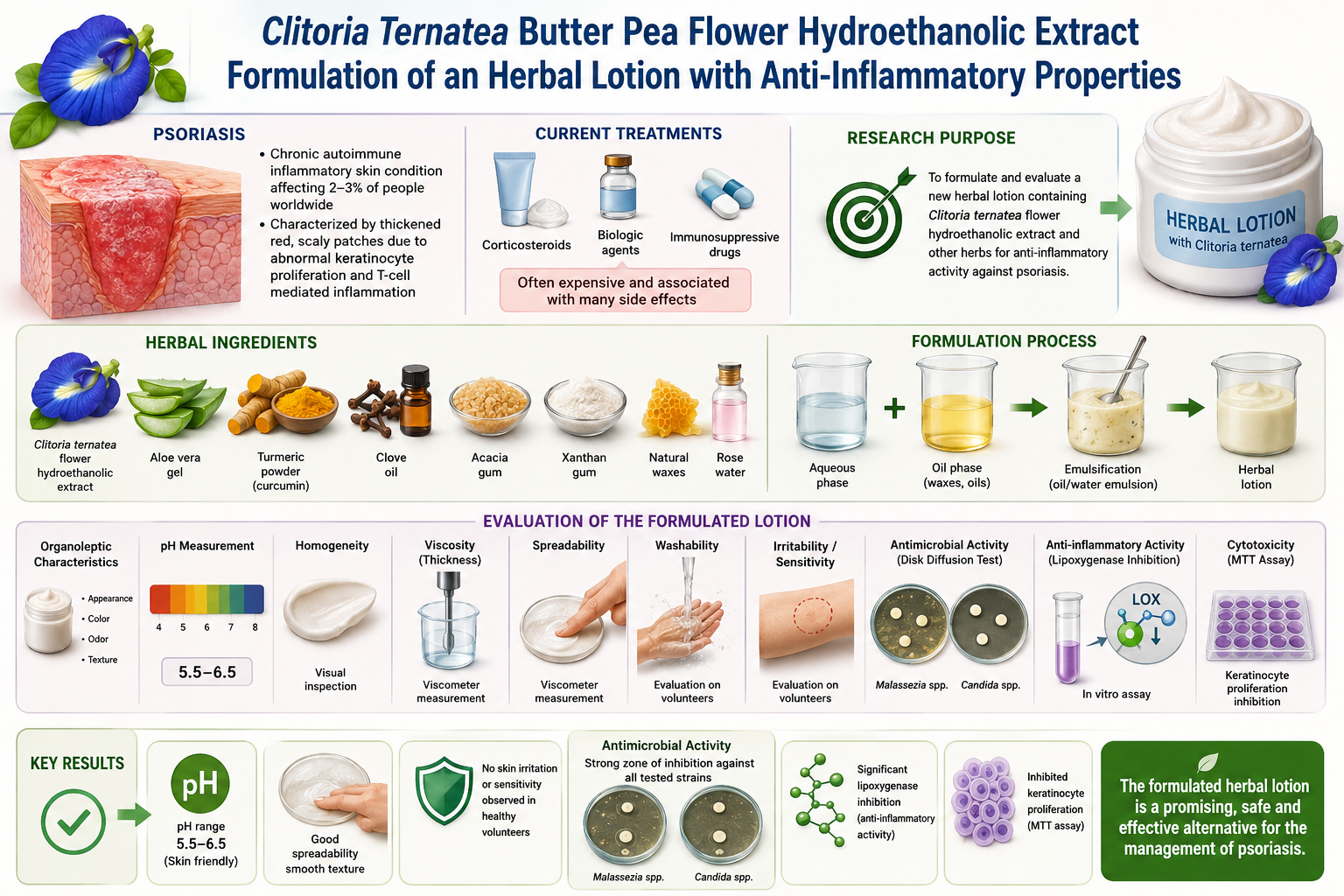
Clitoria Ternatea Butter Pea Flower Hydroethanolic Extract Formulation of an Herbal Lotion with Anti-Inflammatory Properties Against Psoriasis is a chronic autoimmune inflammatory skin condition that affects about 2-3% of people around the world. It is characterized by thickened red, scaly patches on the body due to abnormal multiplication of skin cells and T-cell mediated inflammation. Current treatments such as corticosteroids, biologic agents and immunosuppressive drugs are often expensive and come with many side effects. This has led researchers to seek out safer alternatives. The purpose of this research was to formulate and evaluate a new herbal lotion containing hydroethanolic extract of Clitoria ternatea flower (also known as butterfly pea) along with other herbs such as aloevera gel, turmeric powder (containing curcumin), clove oil, acacia gum, xanthan gum, natural waxes and rose water. The lotion was created by mixing the various ingredients together in an oil/water emulsion and then evaluating its physical properties. Organoleptic characteristics were evaluated which include appearance, color, odor and texture; pH level was measured; homogenity was examined through visual inspection; viscosity (thickness) and spreadability were determined through viscometer measurements; washability and irratibility/sensitivity testing were performed on healthy volunteers; antimicrobial activity was tested against Malassezia spp. and Candida spp. using the disk diffusion test; lipoxygenase inhibiting activity (anti-inflammatory activity) was assayed in vitro; and finally MTT cytotoxic assays were conducted to determine if the lotion would inhibit keratinocyte proliferation. Results indicated that the pH levels of the lotion ranged from 5.5-6.5, it had good spreadability, a smooth texture and did not cause any skin irritation or sensitivity reactions in healthy volunteers. Furthermore, the lotion exhibited a strong zone of inhibition against all tested strains of bacteria.
Article Details
Section

This work is licensed under a Creative Commons Attribution-NonCommercial 4.0 International License.
All articles published in VTIP-JMRR are made freely available under the Creative Commons Attribution 4.0 International License (CC BY 4.0). Under this license, others may freely share, distribute, and adapt the published work, provided appropriate credit is given to the original authors.
By signing the copyright form, the author(s) warrant and represent that:
✓ The manuscript is original and has not been published previously in any journal, conference, or book (in whole or in part).
✓ The manuscript is not currently under consideration for publication elsewhere.
✓ All authors have read and approved the final manuscript and have agreed to this copyright transfer.
✓ The manuscript does not infringe upon any existing copyright, trademark, patent, or other intellectual property right of any third party.
✓ All data, figures, and tables presented are accurate, authentic, and have not been fabricated or falsified.
✓ Proper permissions have been obtained for any third-party material (images, figures, tables, text) included in the manuscript.
✓ The work complies with all applicable ethical guidelines, including those related to human and animal research.
✓ All sources of funding and conflicts of interest have been disclosed in the manuscript.
How to Cite
References
[1] Boehncke, W.-H., & Schön, M. P. (2015). Psoriasis. The Lancet, 386(9997), 983–994. https://doi.org/10.1016/S0140-6736(14)61909-7
[2] Griffiths, C. E. M., & Barker, J. N. W. N. (2007). Pathogenesis and clinical features of psoriasis. The Lancet, 370(9583), 263–271. https://doi.org/10.1016/S0140-6736(07)61128-3
[3] Nestle, F. O., Kaplan, D. H., & Barker, J. (2009). Psoriasis. New England Journal of Medicine, 361(5), 496–509. https://doi.org/10.1056/NEJMra0804595
[4] Lowes, M. A., Suárez-Fariñas, M., & Krueger, J. G. (2014). Immunology of psoriasis. Annual Review of Immunology, 32, 227–255. https://doi.org/10.1146/annurev-immunol-032713-120225
[5] Menter, A., Korman, N. J., Elmets, C. A., Feldman, S. R., Gelfand, J. M., Gordon, K. B., … Bhushan, R. (2010). Guidelines of care for the management of psoriasis and psoriatic arthritis. Journal of the American Academy of Dermatology, 62(1), 114–135. https://doi.org/10.1016/j.jaad.2009.08.040
[6] Pradhan, M., Singh, D., & Singh, M. R. (2013). Novel colloidal carriers for psoriasis: Current issues, mechanistic basis and herbal alternatives. Expert Opinion on Drug Delivery, 10(12), 1725–1742. https://doi.org/10.1517/17425247.2013.827170
[7] Rathi, N. M., Sirsat, S. V., Tayade, S. S., Khot, A. S., & Deshmukh, A. C. (2022). Formulation and standardization of herbal lotion. International Journal of Creative Research Thoughts, 10(4), 604–610.
[8] Salunkhe, P. S., Korade, V. S., & Lokhande, G. S. (2024). Formulation and evaluation of herbal lotion. International Journal of Scientific Research and Engineering Development, 12(2), 112–118.
[9] Mukherjee, P. K., Nema, N. K., Maity, N., & Sarkar, B. K. (2013). Phytochemical and therapeutic potential of cucumber. Fitoterapia, 84, 227–236. https://doi.org/10.1016/j.fitote.2012.10.003
[10] Kamkaen, N., & Wilkinson, J. M. (2009). The antioxidant activity of Clitoria ternatea flower petal extracts and eye gel. Phytotherapy Research, 23(11), 1624–1625. https://doi.org/10.1002/ptr.2832
[11] Roowi, S., & Asmah, R. (2012). Anthocyanins in tropical plants. Journal of Food, Agriculture & Environment, 10(3–4), 1421–1426.
[12] Shankar, N. L. G., Manavalan, R., Venkappayya, D., & David, R. C. (2008). Hepatoprotective and antioxidant effects of Clitoria ternatea leaf extract in CCl4-treated rats. South African Journal of Botany, 74(4), 623–629. https://doi.org/10.1016/j.sajb.2008.07.001
[13] Jain, N. N., Ohal, C. C., Shroff, S. K., Bhutada, R. H., Somani, R. S., Kasture, V. S., & Kasture, S. B. (2003). Clitoria ternatea and the CNS. Pharmacology Biochemistry and Behavior, 75(3), 529–536. https://doi.org/10.1016/S0091-3057(03)00130-1
[14] Nair, V., Bang, W. Y., Scovronski, A., Kim, Y.-S., & Jeon, J.-W. (2013). Anti-inflammatory activity of Clitoria ternatea root extract. Journal of Ethnopharmacology, 149(3), 816–819. https://doi.org/10.1016/j.jep.2013.07.040
[15] Chithra, R., Sajithlal, G. B., & Chandrakasan, G. (1998). Influence of aloe vera on collagen characteristics in healing dermal wounds in rats. Molecular and Cellular Biochemistry, 181(1–2), 71–76. https://doi.org/10.1023/A:1006819506600
[16] Ahluwalia, B., MacFarlane, J. K., Mahony, J. B., & Dent, D. (1998). Effect of curcumin on NF-κB activation in keratinocytes. Molecular and Cellular Biochemistry, 200(1), 19–26.
[17] Verma, P., Sharma, R., & Singh, A. (2024). Formulation and evaluation of aloe vera herbal lotion. International Journal of Advanced Research in Science, Communication and Technology, 4(1), 215–221.
[18] Ashish, A., Mohini, K., & Abhiram, R. (2013). Preparation and evaluation of polyherbal cosmetic cream. Der Pharmacia Lettre, 5(1), 83–88.
[19] Nishadevi, Kumar, A., Garg, A., & Hussain, A. (2018). A review of herbal cosmetics. World Journal of Pharmaceutical Research, 7(12), 451–467.
[20] Saudagar, R. B., & Sisodiya, M. H. (2018). Review on herbal cosmetics. World Journal of Pharmaceutical Research, 7(7), 573–591.
[21] Kang, H., Hua, L., & Jeon, H. (2019). Curcumin-loaded nanostructured lipid carriers for skin delivery. International Journal of Pharmaceutics, 559, 360–369. https://doi.org/10.1016/j.ijpharm.2019.01.056
[22] Agero, A. L. C., & Verallo-Rowell, V. M. (2004). A randomized double-blind controlled trial comparing extra virgin coconut oil with mineral oil as a moisturizer for mild to moderate xerosis. Dermatitis, 15(3), 109–116. https://doi.org/10.2310/6620.2004.04006
[23] Sajjad, A., & Sajjad, S. S. (2014). Aloe vera: An ancient herb for modern dentistry—A literature review. Journal of Dental Surgery, 2014, 1–6. https://doi.org/10.1155/2014/210463
[24] Yadav, S., Patel, R., & Sharma, M. (2025). Formulation and evaluation of herbal moisturizing lotion containing aloe vera and coconut oil. World Journal of Pharmaceutical Research, 14(7), 1915–1925.
[25] Mali, B., Moharil, S. N., Mhasal, V., & Narkhede, M. B. (2017). Drug–excipient interaction study of tramadol hydrochloride with polymers. World Journal of Pharmaceutical Research, 6(7), 1020–1032.
[26] Shinde, V., & Tiwari, K. (2020). Formulation and evaluation of lemongrass lotion. International Journal of PharmaO2, 2(6), 45–50.
[27] Tiwari, S., Prakash, K., Jaiswal, P., & Rajpoot, H. (2023). Pharmaceutical assessment of body lotion: A herbal formulation and its potential benefits. International Journal of Pharmacy and Pharmaceutical Science, 5(2), 32–38. https://doi.org/10.33545/26647222.2023.v5.i2a.41
[28] Kumar, G. P., Lakshmi, N. V. V. S. S., Deena, C., Bhavani, B., & Kumar, P. R. (2018). Facts about virgin copra oil: Chemistry, production, and its applications. Haya: The Saudi Journal of Life Sciences, 3(10), 624–633.