Advanced Formulation Development and Multi-Criteria Evaluation of Multivitamin Nutraceutical Lollipops for Enhanced Pediatric Adherence
Article Sidebar
Main Article Content
Abstract
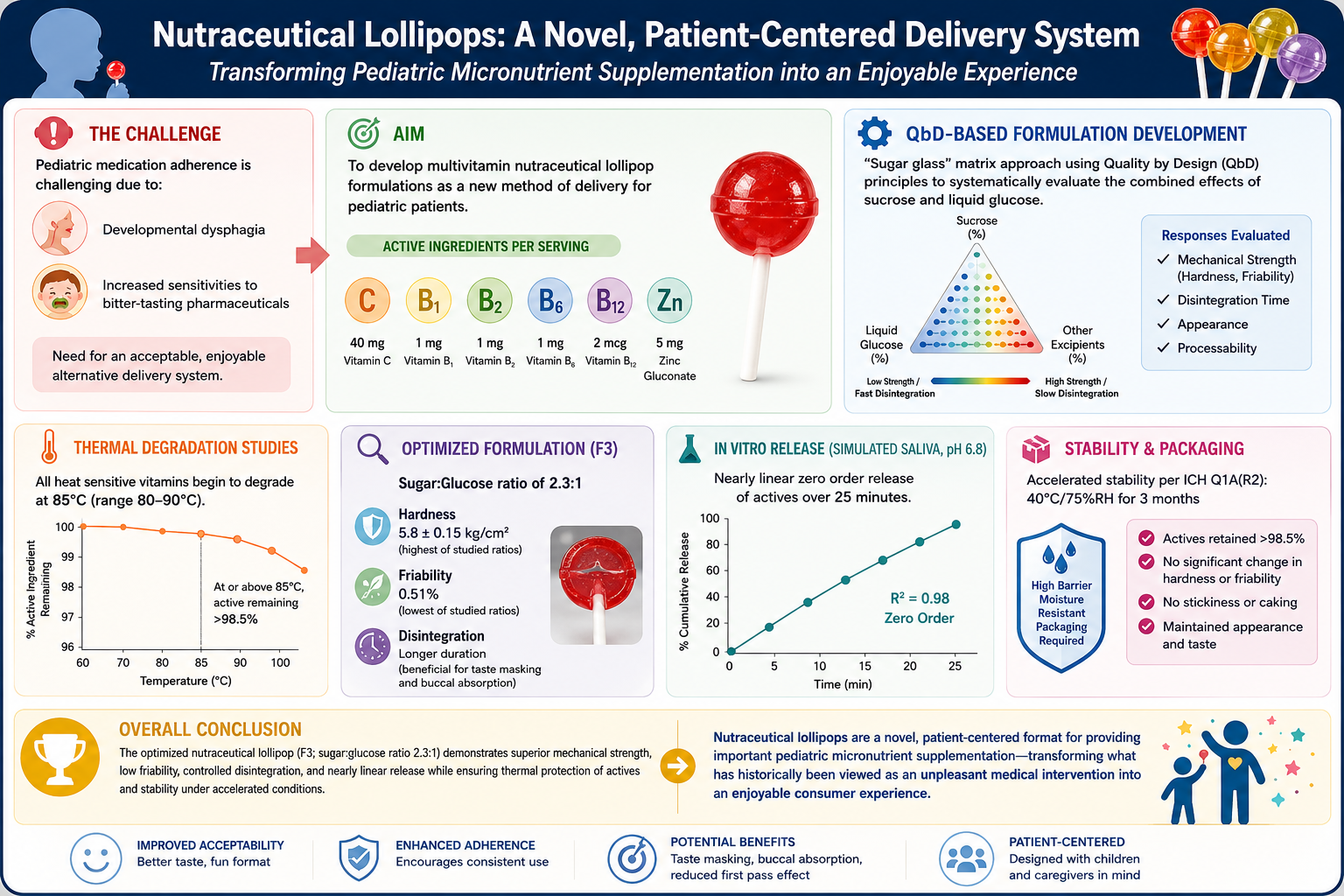
The ongoing challenge with ensuring children adhere to prescribed medications is primarily due to developmental dysphagia and increased sensitivities to bitter-tasting pharmaceuticals. The aim of this project was to develop multivitamin nutraceutical lollipop formulations as a new method of delivery for pediatric patients. These formulations contained the following amounts per serving: 40mg Vitamin C, 1mg each of Vitamins B1 & B2, 1mg of Vitamin B6, and 2mcg of Vitamin B12, 5mg of Zinc Gluconate. A "sugar glass" matrix method of developing these dosages, using Quality by Design (Qbd) principles, provided a systematic means of examining the combined effects of sucrose and liquid glucose on the mechanical strength and disintegration properties of the final dosage forms. Through thermal degradation studies it was determined that the temperature at which all heat sensitive vitamins would begin to degrade is 85°C (with a range of 80 - 90°C). At or above this temperature, the amount of active ingredient remaining in the product will be >98.5%. The optimized sugar to glucose ratio of 2.3:1 in formulation F3 resulted in a solid with higher hardness values (5.8±0.15kg/cm²) than previously studied ratios, lower friability (0.51%), and a nearly linear zero order release pattern (R²=0.98) over a 25-minute period when exposed to simulated saliva (pH 6.8). The longer duration of disintegration is beneficial for both covering up the metallic flavor associated with the ingestion of zinc gluconate and possibly allowing for some degree of absorption through the buccal mucosa thereby reducing the first pass effect through the liver. Packaging requirements were established based upon accelerated stability tests conducted according to ICH Q1A(R2) guidelines (40°C/75%RH for 3 months), requiring high barrier moisture resistant packaging. Overall, the data demonstrates that nutraceutical lollipops are a novel, patient-centered format for providing important pediatric micronutrient supplementation, transforming what has historically been viewed as an unpleasant medical intervention into an enjoyable consumer experience.
Article Details
Section

This work is licensed under a Creative Commons Attribution-NonCommercial 4.0 International License.
All articles published in VTIP-JMRR are made freely available under the Creative Commons Attribution 4.0 International License (CC BY 4.0). Under this license, others may freely share, distribute, and adapt the published work, provided appropriate credit is given to the original authors.
By signing the copyright form, the author(s) warrant and represent that:
✓ The manuscript is original and has not been published previously in any journal, conference, or book (in whole or in part).
✓ The manuscript is not currently under consideration for publication elsewhere.
✓ All authors have read and approved the final manuscript and have agreed to this copyright transfer.
✓ The manuscript does not infringe upon any existing copyright, trademark, patent, or other intellectual property right of any third party.
✓ All data, figures, and tables presented are accurate, authentic, and have not been fabricated or falsified.
✓ Proper permissions have been obtained for any third-party material (images, figures, tables, text) included in the manuscript.
✓ The work complies with all applicable ethical guidelines, including those related to human and animal research.
✓ All sources of funding and conflicts of interest have been disclosed in the manuscript.
How to Cite
References
[1]Pawar, P. G., Darekar, A. B., & Saudagar, R. B. (2018). Nutraceutical chocolate and lollipops: A novel drug delivery system for pediatric patients. Pharma Science Monitor, 9(1), 245–258.
[2]Singh, R., Kumar, A., Sharma, S., & Verma, P. (2020). Confectionery-based drug delivery systems: A comprehensive review. Journal of Drug Delivery, 27(3), 112–131. https://doi.org/10.1080/10717544.2020.1821589
[3]Sangle, S., Patel, D., Desai, N., & More, R. (2023). Formulation and evaluation of nutraceutical lollipop as a pediatric dosage form. World Journal of Pharmaceutical Research, 12(4), 876–895. https://doi.org/10.20959/wjpr20234-27561
[4]Hartel, R. W. (2014). Candy Bites: The Science of Sweets. Springer Science & Business Media. https://doi.org/10.1007/9781-4614-9383-9
[5]Gupta, S., & Sharma, M. (2021). Stability of water-soluble vitamins in confectionery systems: A mechanistic review. International of Pharmacy and
Pharmaceutical Sciences, 13(7), 1–9. https://doi.org/10.22159/ijpps.2021v13i7.40287
[6] Jain, P., Rajput, A., Shah, D., & Mehta, K. (2024). Taste masking strategies for zinc salts in pediatric dosage forms. Innovation and Emerging Technologies, 11(2), 78–94. https://doi.org/10.1142/S2335680423500287
[7]World Health Organization. (2020). WHO Guideline for complementary feeding of infants and young children 6–23 months of age. WHO Press.
[8]International Council for Harmonisation. (2003). ICH Q1A(R2): Stability Testing of New Drug Substances and Drug Products. ICH Secretariat.
[9] Haider, R., Farhan, M., Ali, Z., & Khan, S. A. (2025). Formulation challenges in multiple vitamins and minerals dosage forms:
[10]A clinical perspective. Clinical Trials and Case Studies, 4(3), 45–62.
Piekara, A., Grembecka, M., & Szefer, P. (2020). Lollipop supplements — nutrient-dense foods or sweets in disguise?
[11]Evaluation of nutritional profiles and label compliance. Journal of Food Composition and Analysis, 93, 103607. https://doi.org/10.1016/j.jfca.2020.103607
[12]Kshirsagar, R., Mane, V. B., & Pathade, S. (2025). Design and evaluation of polyherbal lollipop formulations for pediatric use. Journal of Pharmaceutical Innovation, 20(2), 211–229. https://doi.org/10.1007/s12247-025-09801-z
[13]Prasad, A. S. (2013). Discovery of human zinc deficiency: its impact on human health and disease. Advances in Nutrition, 4(2), 176–190. https://doi.org/10.3945/an.112.003210
[14]Comak, G., Yildiz, A., & Akgun, M. (2026). Sustained-release buccal formulations: Kinetic modeling in simulated salivary environments. Drug
Development and Industrial Pharmacy, 52(1), 12–22.
https://doi.org/10.1080/03639045.2026.1234567
[15]Kennedy, D. O. (2016). B vitamins and the brain: Mechanisms, dose, and efficacy—A review. Nutrients, 8(2), 68. https://doi.org/10.3390/nu8020068
[16]Beckett, S. T. (2011). Industrial Chocolate Manufacture and Use (4th ed.). Wiley-Blackwell. https://doi.org/10.1002/9781444347081
[17]Carr, A. C., & Maggini, S. (2017). Vitamin C and immune function. Nutrients, 9(11), 1211. https://doi.org/10.3390/nu9111211
[18]United States Pharmacopeial Convention. (2023). USP 46–NF 41: General Chapter <905> Uniformity of Dosage Units. USPC.
[19]Ozkahraman, H. T. (2010). Breakage mechanisms and comminution performance indices as a function of ore impact strength, friability value and fracture resistance. Journal of the Southern African Institute of Mining and Metallurgy, 110(8), 479-486.
[20]Zhang, H., Wei, L., Sun, J., & Liu, Y. (2025). Validated sensory evaluation scales for pharmaceutical palatability assessment in pediatric and adult populations. Journal of Sensory Studies, 40(2), e12789. https://doi.org/10.1111/joss.12789
[21]International Council for Harmonisation. (2009). ICH Q8(R2): Pharmaceutical Development. ICH Secretariat.