
Formulation and Evaluation of Flaxseed as Hair Mask
Article Sidebar
Main Article Content
Abstract
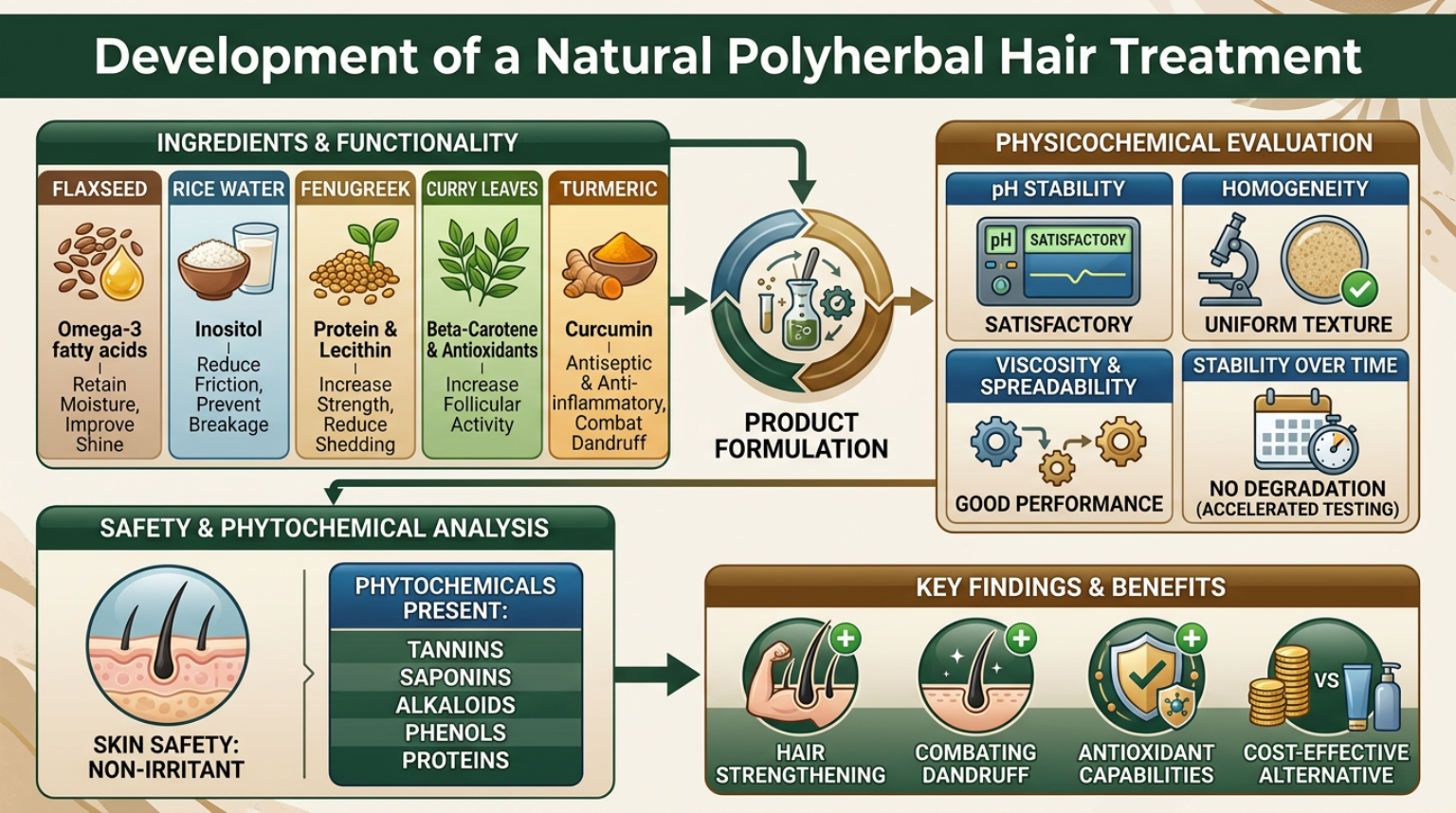
Natural treatments are increasingly used around the world because they are safer than chemical products and create fewer side effects. The purpose of this study is to report on the development of a natural hair conditioner (mask) that incorporates several herbs. These include flaxseed gel; rice water; fenugreek seed extract; curry leaf extract; and turmeric extract. Flaxseed contains Omega-3 fatty acids, which will help retain moisture and improve the shine of the hair. Turmeric extracts contain curcumin, which acts as an antiseptic and anti-inflammatory to protect against infection of the scalp and combat dandruff. Fenugreek seed extracts have high levels of protein and lecithin, which will increase strength at the base of each strand of hair and reduce shedding. Curry leaves are rich in beta-carotene and antioxidants which will increase follicular activity. Rice water has inositol which helps reduce friction and prevent damage from breakage. The new product was tested for pH, viscosity, spreadability, extrudability, homogeneity, skin irritation potential and for stability over time. Results were satisfactory in terms of pH, physical characteristics and no notable degradation occurred when the product was stored under accelerated testing conditions. Phytochemicals present within the new product included tannins, saponins, alkaloids, phenols and proteins. All these components contribute to hair strengthening, combating dandruff and providing antioxidant capabilities. The results demonstrate that the natural hair treatment can be both cost effective and serve as a viable alternative to commercially available chemical based hair care products.
Article Details
Section

This work is licensed under a Creative Commons Attribution-NonCommercial 4.0 International License.
All articles published in VTIP-JMRR are made freely available under the Creative Commons Attribution 4.0 International License (CC BY 4.0). Under this license, others may freely share, distribute, and adapt the published work, provided appropriate credit is given to the original authors.
By signing the copyright form, the author(s) warrant and represent that:
✓ The manuscript is original and has not been published previously in any journal, conference, or book (in whole or in part).
✓ The manuscript is not currently under consideration for publication elsewhere.
✓ All authors have read and approved the final manuscript and have agreed to this copyright transfer.
✓ The manuscript does not infringe upon any existing copyright, trademark, patent, or other intellectual property right of any third party.
✓ All data, figures, and tables presented are accurate, authentic, and have not been fabricated or falsified.
✓ Proper permissions have been obtained for any third-party material (images, figures, tables, text) included in the manuscript.
✓ The work complies with all applicable ethical guidelines, including those related to human and animal research.
✓ All sources of funding and conflicts of interest have been disclosed in the manuscript.
How to Cite
References
[1]. Ahn, K. Y., Song, H. J., & Kim, D. C. (2023). Effects of hair essence containing vitamin E, vitamin A, and phytantriol on hair quality. Asian Journal of Beauty and Cosmetology, 21(4), 699–707.
[2]. Bhaskar, A., Nithya, V., & Vidhya, V. G. (2011). Phytochemical screening and in vitro antioxidant activities of the ethanolic extract of Hibiscus rosa-sinensis L. Annals of Biological Research, 2(5), 653–661.
[3]. Brennan, M., & Bhatt, P. (2022). Natural plant-based surfactants in personal care products: A review. Industrial Crops and Products, 185, Article 115175.
[4]. Chaudhari, M. G., Malge, T. G., Shirbhate, D., & Potdar, V. (2025). A review of a hair-care formulation for hair health. Asian Journal of Pharmaceutical Research and Development, 13(5), 44–59.
[5]. Datta, R., & Henry, A. (2006). Lactic acid: Recent advances in products, processes and technologies—A review. Journal of Chemical Technology and Biotechnology, 81(7), 1119–1129.
[6]. Daun, J. K., Barthet, V. J., Chornick, T. L., & Duguid, S. (2003). Structure, composition, and variety development of flaxseed. In S. C. Cunnane & L. U. Thompson (Eds.), Flaxseed in human nutrition (2nd ed., pp. 1–40). AOCS Press.
[7]. Draelos, B. (2010). Hair cosmetics. Dermatologic Clinics, 9(1), 19–27.
[8]. Goyal, A., Sharma, V., Upadhyay, N., & Gill, S. (2014). Flax and flaxseed oil: An ancient medicine and modern functional food. Journal of Food Science and Technology, 59(9), 1633–1640.
[9]. Hanaa, M. H., Ismail, H. A., Mahmoud, M. E., & Ibrahim, H. M. (2017). Antioxidant activity and phytochemical analysis of flaxseeds (Linum usitatissimum L.). Minia Journal of Agricultural Research and Development, 37(1), 129–140.
[10]. Kapoor, V. P. (2005). Herbal cosmetics for skin and hair care. Natural Product Radiance, 4(4), 306–314.
[11]. Kaur, P., & Guleri, T. K. (2013). Topical gel: A recent approach for novel drug delivery. Asian Journal of Biomedical and Pharmaceutical Sciences, 3(17), 1–5.
[12]. Kharde, M. A., Omkar, M. K., Shrikant, M. K., Kakde, M., & Bankar, S. (2021). Rice water: A natural remedy for hair health. International Journal of Creative Research Thoughts, 9(4), 1–8.
[13]. Lambros, M., Tran, T., Fei, Q., & Nicolaou, M. (2022). Citric acid: A multifunctional pharmaceutical excipient. Pharmaceutics, 14, Article 972.
[14]. Manjula, D., Jenita, J. J., Premakumari, K. B., & Shanaz Banu, S. B. (2020). Formulation and evaluation of flaxseed hair gel: A natural hair tamer. International Journal of Pharmacy and Pharmaceutical Sciences, 12(7), 54–58.
[15]. Mohanty, G. R., Majhi, P. K., Samantaray, S., Ray, M., Mallik, S. K., Swain, A., & Kumar, A. (2018). Flaxseed: The marvel of nature for humanity. International Journal of Recent Scientific Research, 9(4), 25867–25872.
[16]. Mohebitabar, S., Shirazi, M., Bioos, S., Rahimi, R., Malekshahi, F., & Nejatbakhsh, F. (2017). Therapeutic efficacy of rose oil: A comprehensive review of clinical evidence. Avicenna Journal of Phytomedicine, 7(3), 206–213.
[17]. Natarelli, N., Gahoonia, N., & Sivamani, R. K. (2023). Integrative and mechanistic approach to the hair growth cycle and hair loss. Journal of Clinical Medicine, 12(3), Article 893.
[18]. Praveen, S., Vinod, M., Karnakumar, V., Chandrashekhar, B., & Sreenivasa Rao. (2011). Development and evaluation of antidandruff hair gel. International Journal of Pharmaceutical Sciences Review and Research, 1(4), 936–949.
[19]. Ramakrishna, S., & Gopikrishna, U. V. (2022). Formulation and evaluation of herbal hair gel. Scholars International Journal of Traditional and Complementary Medicine, 5(2), 28–32.
[20]. Singh, K. K., Mridula, D., Rehal, J., & Barnwal, P. (2011). Flaxseed: A potential source of food, feed and fiber. Critical Reviews in Food Science and Nutrition, 51(3), 210–222.
[21]. Tyagi, N., Tyagi, A., Rastogi, R., Singh, B., & Nagarajan, K. (2023). Unlocking radiance: The dynamic duo of flaxseeds and aloe vera in hair mask for bioactive brilliance. Proteins, 22, 29–32.
[22]. Yuan, W., & Li, H. (2012). The applications of glycerol in pharmaceutical formulation. In Glycerol: Production, structure and applications (pp. 287–291). Nova Science Publishers.
[23]. Yousefi, S., & Mehdizadeh, M. (2021). Investigation of rice water function on hair. International Journal of Pharmaceutical Research, 13(1), 1–8.