Formulation and Evaluation of Anti-Acne Cream Containing Turmeric Extract and Aloe Vera Gel
Article Sidebar
Main Article Content
Abstract
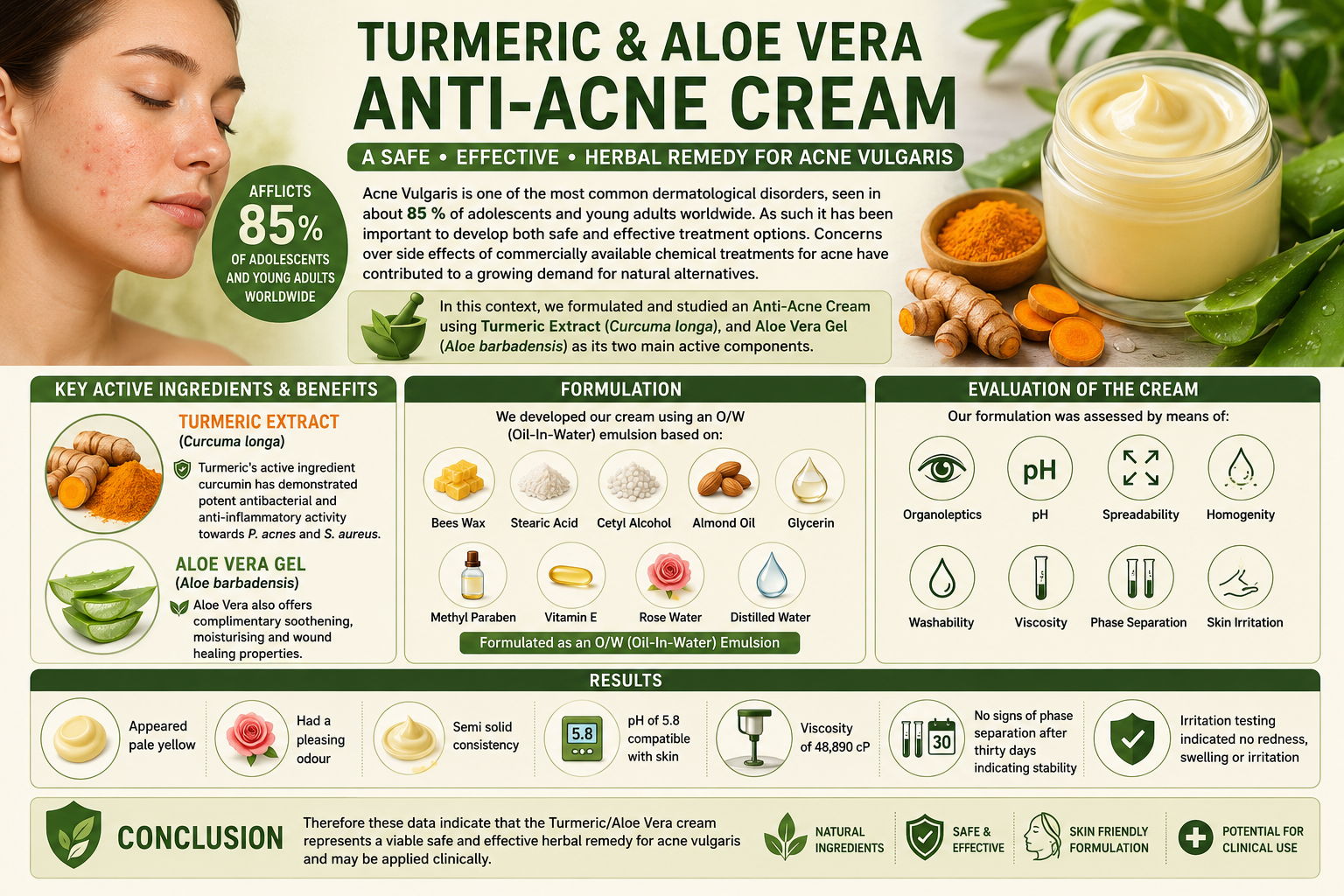
Acne Vulgaris is one of the most common dermatological disorders, seen in about 85 % of adolescents and young adults worldwide. As such it has been important to develop both safe and effective treatment options. Concerns over side effects of commercially available chemical treatments for acne have contributed to a growing demand for natural alternatives. In this context, we formulated and studied an Anti-Acne Cream using Turmeric Extract (Curcuma longa), and Aloe Vera Gel (Aloe barbadensis) as its two main active components. We developed our cream using an O/W (Oil-In-Water) emulsion based on Bees Wax, Stearic Acid, Cetyl Alcohol, Almond Oil, Glycerin, Methyl Paraben, Vitamin E, Rose Water, Distilled Water. Turmeric’s active ingredient curcumin has demonstrated potent antibacterial and anti-inflammatory activity towards P. acnes and S. aureus. Aloe Vera also offers complimentary soothening, moisturising and wound healing properties. Our formulation was assessed by means of Organoleptics; pH; Spreadability; Homogenity; Washability; Viscosity; Phase Separation; Skin Irritation. The Cream appeared pale yellow; had a pleasing odour; a semi solid consistency; had a pH of 5.8 which is compatible with skin; had a viscosity of 48,890 cP; showed no signs of phase separation after thirty days indicating stability. Also, the results of irritation testing indicated no redness, swelling or irritation. Therefore these data indicate that the Turmeric/Aloe Vera cream represents a viable safe and effective herbal remedy for acne vulgaris and may be applied clinically.
Article Details
Section

This work is licensed under a Creative Commons Attribution-NonCommercial 4.0 International License.
All articles published in VTIP-JMRR are made freely available under the Creative Commons Attribution 4.0 International License (CC BY 4.0). Under this license, others may freely share, distribute, and adapt the published work, provided appropriate credit is given to the original authors.
By signing the copyright form, the author(s) warrant and represent that:
✓ The manuscript is original and has not been published previously in any journal, conference, or book (in whole or in part).
✓ The manuscript is not currently under consideration for publication elsewhere.
✓ All authors have read and approved the final manuscript and have agreed to this copyright transfer.
✓ The manuscript does not infringe upon any existing copyright, trademark, patent, or other intellectual property right of any third party.
✓ All data, figures, and tables presented are accurate, authentic, and have not been fabricated or falsified.
✓ Proper permissions have been obtained for any third-party material (images, figures, tables, text) included in the manuscript.
✓ The work complies with all applicable ethical guidelines, including those related to human and animal research.
✓ All sources of funding and conflicts of interest have been disclosed in the manuscript.
How to Cite
References
[1] Dureja, H., Kaushik, D., Gupta, M., Kumar, V., & Lather, V. (2005). Cosmeceuticals: An emerging concept. Indian Journal of Pharmacology, 37(3), 155–159.
[2] Williams, H. C., Dellavalle, R. P., & Garner, S. (2012). Acne vulgaris. The Lancet, 379(9813), 361–372. https://doi.org/10.1016/S0140-6736(11)60321-8
[3] Vaughn, A. R., Branum, A., & Sivamani, R. K. (2016). Effects of turmeric (Curcuma longa) on skin health: A systematic review of the clinical evidence. Phytotherapy Research, 30(8), 1243–1264. https://doi.org/10.1002/ptr.5640
[4] Surjushe, A., Vasani, R., & Saple, D. G. (2008). Aloe vera: A short review. Indian Journal of Dermatology, 53(4), 163–166. https://doi.org/10.4103/0019-5154.44786
[5] Fox, L., Csongradi, C., Aucamp, M., du Plessis, J., & Gerber, M. (2016). Treatment modalities for acne. Molecules, 21(8), 1063. https://doi.org/10.3390/molecules21081063
[6] Pandey, S., Meshya, N., & Viral, D. (2010). Herbs play an important role in the field of cosmetics. International Journal of PharmTech Research, 2(1), 632–639.
[7] Thring, T. S. A., Hili, P., & Naughton, D. P. (2009). Anti-collagenase, anti-elastase and anti-oxidant activities of extracts from 21 plants. BMC Complementary and Alternative Medicine, 9, 27. https://doi.org/10.1186/1472-6882-9-27
[8] Ali, A., Akhtar, N., Khan, B. A., Khan, H. M. S., Rasul, A., & Zaman, S. U. (2012). Evaluation of various functional skin parameters using a topical cream of Aloe vera extract. International Journal of Biology and Biotechnology, 9(3), 267–271.
[9] Ansel, H. C., Popovich, N. G., & Allen, L. V. (2011). Ansel's pharmaceutical dosage forms and drug delivery systems (9th ed.). Lippincott Williams & Wilkins.
[10] Kaur, C., & Saraf, S. (2010). In vitro sun protection factor determination of herbal oils used in cosmetics. Journal of Cosmetic Science, 61(6), 449–452.
[11] Sharma, P. P. (2008). Cosmetics: Formulation, manufacturing and quality control (4th ed.). Vandana Publications.
[12] Jain, N. K. (2009). A textbook of pharmaceutics. Vallabh Prakashan.
[13] Bhatia, A., Maisonneuve, J. F., & Persing, D. H. (2004). Propionibacterium acnes and chronic diseases. Clinical Microbiology Reviews, 17(4), 987–1004. https://doi.org/10.1128/CMR.17.4.987-1004.2004
[14] Khandelwal, K. R. (2013). Practical pharmacognosy: Techniques and experiments (23rd ed.). Nirali Prakashan.
[15] Kokate, C. K., Purohit, A. P., & Gokhale, S. B. (2014). Pharmacognosy (49th ed.). Nirali Prakashan.