Formulation and Evaluation of Polyherbal Ayurvedic Anti-Inflammatory Lepa
Article Sidebar
Main Article Content
Abstract
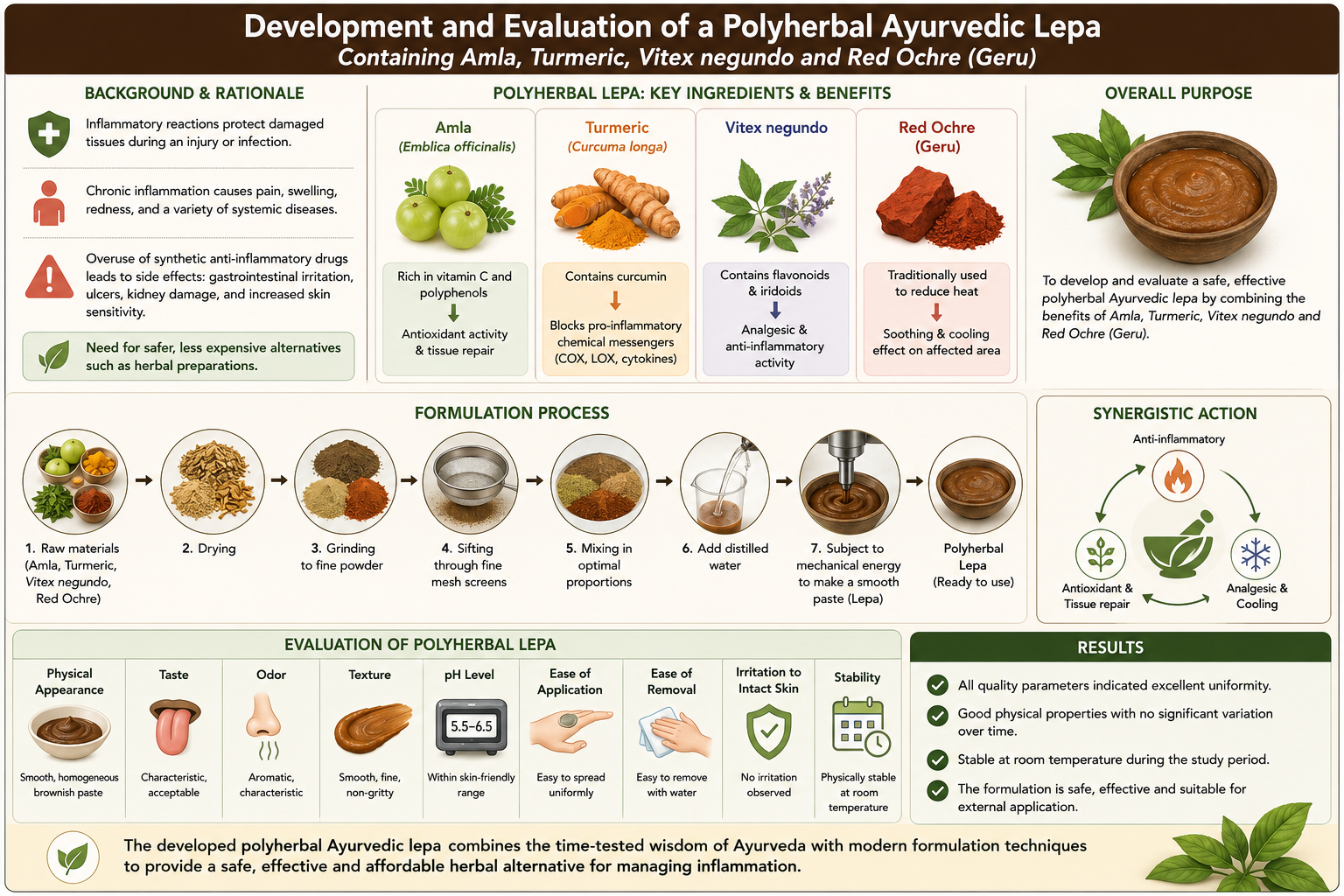
Inflammatory reactions protect damaged tissues during an injury or infection; chronic inflammatory responses produce signs such as pain, swelling, redness, and a variety of systemic diseases. Overuse of synthetic anti-inflammatory drugs has led to side effects that include gastrointestinal irritation, ulcers, kidney damage, and increased skin sensitivity. Therefore, the need for safer and less expensive alternatives such as herbal preparations has developed. This research study aimed at developing and evaluating a polyherbal Ayurvedic lepa containing Amla (Emblica officinalis), Turmeric (Curcuma longa), Vitex negundo, and Red Ochre (Geru) that would be both safe and effective. Each ingredient was chosen because it is important in traditional medicine and each component has well documented bioactive compounds. Specifically, curcumin in turmeric blocks the production of pro-inflammatory chemical messengers while Amla provides antioxidant activity and tissue repair; Vitex negundo produces analgesia and anti-inflammatory activity; and geru reduces heat in the affected area. After drying, grinding into powder form, sifting through fine mesh screens and mixing together in optimal proportions, the four ground powders were mixed with distilled water and then subjected to mechanical energy to create a smooth paste. The new product was tested for its quality characteristics including physical appearance, taste, odor, texture, pH level, ease of application, ability to remove after application, irritation to intact skin and stability. All results indicated excellent uniformity and mixtures had good physical properties that did not vary significantly over time when stored at room temperature.
Article Details
Section

This work is licensed under a Creative Commons Attribution-NonCommercial 4.0 International License.
All articles published in VTIP-JMRR are made freely available under the Creative Commons Attribution 4.0 International License (CC BY 4.0). Under this license, others may freely share, distribute, and adapt the published work, provided appropriate credit is given to the original authors.
By signing the copyright form, the author(s) warrant and represent that:
✓ The manuscript is original and has not been published previously in any journal, conference, or book (in whole or in part).
✓ The manuscript is not currently under consideration for publication elsewhere.
✓ All authors have read and approved the final manuscript and have agreed to this copyright transfer.
✓ The manuscript does not infringe upon any existing copyright, trademark, patent, or other intellectual property right of any third party.
✓ All data, figures, and tables presented are accurate, authentic, and have not been fabricated or falsified.
✓ Proper permissions have been obtained for any third-party material (images, figures, tables, text) included in the manuscript.
✓ The work complies with all applicable ethical guidelines, including those related to human and animal research.
✓ All sources of funding and conflicts of interest have been disclosed in the manuscript.
How to Cite
References
[1] Chen, L., Deng, H., Cui, H., Fang, J., Zuo, Z., Deng, J., Li, Y., Wang, X., & Zhao, L. (2017). Inflammatory responses and inflammation-associated diseases in organs. Oncotarget, 9(6), 7204–7218. https://doi.org/10.18632/oncotarget.23208
[2] Bennett, J. M., Reeves, G., Billman, G. E., & Sturmberg, J. P. (2018). Inflammation—Nature's way to efficiently respond to all types of challenges: Implications for understanding and managing chronic diseases. Frontiers in Medicine, 5, 316. https://doi.org/10.3389/fmed.2018.00316
[3] Mukherjee, P. K., Harwansh, R. K., Bahadur, S., Banerjee, S., Kar, A., Chanda, J., Biswas, S., Ahmmed, S. M., & Katiyar, C. K. (2017). Development of Ayurveda—Tradition to trend. Journal of Ethnopharmacology, 197, 10–24. https://doi.org/10.1016/j.jep.2016.07.030
[4] Sharma, D., Kumar, M., Andrade-Cetto, A., Puri, S., Kumar, A., Thakur, M., Chandran, D., Pundir, A., Prakash, S., & Pandiselvam, R. (2023). Chemical diversity and medicinal potential of Vitex negundo L.: From traditional knowledge to modern clinical trials. Chemistry & Biodiversity, 20(11), e202301086. https://doi.org/10.1002/cbdv.202301086
[5] Dasaroju, S., & Gottumukkala, K. M. (2014). Current trends in the research of Emblica officinalis: A pharmacological perspective. International Journal of Pharmaceutical Sciences Review and Research, 24(2), 150–159.
[6] Hart, F. D., & Huskisson, E. C. (1984). Non-steroidal anti-inflammatory drugs: Current status and rational therapeutic use. Drugs, 27(3), 232–255. https://doi.org/10.2165/00003495-198427030-00003
[7] Ansar, W., & Ghosh, S. (2016). Inflammation and inflammatory diseases, markers, and mediators: Role of CRP in inflammatory diseases. In Biology of C-reactive protein in health and disease (pp. 67–107). Springer.
[8] Sharma, C. S., & Pawar, R. (2026). Enhancing quality of life in Janusandhigata Vaat patients: A case study on topical ointment therapy. International Research Journal of Ayurveda & Yoga, 9(03), 22–25.
[9] Banik, B., Das, S., & Das, M. K. (2020). Medicinal plants with potent anti-inflammatory and anti-arthritic properties found in eastern Himalaya. Pharmacognosy Reviews, 14(28).
[10] Tributsch, H. (2016). Ochre bathing of the bearded vulture: A biomimetic model for early humans toward smell prevention and health. Animals, 6(1), 7. https://doi.org/10.3390/ani6010007
[11] Sen, S., & Chakraborty, R. (2015). Toward the integration and advancement of herbal medicine: A focus on traditional Indian medicine. Botanics: Targets and Therapy, 5, 33–44. https://doi.org/10.2147/BTAT.S66791
[12] Kumar, K. S., Bhowmik, D., Dutta, A., Yadav, A. P., Paswan, S., Srivastava, S., & Deb, L. (2012). Recent trends in traditional Indian herb Emblica officinalis and its medicinal importance. Journal of Pharmacognosy and Phytochemistry, 1(1), 18–28.
[13] Nguyen, T. T., & colleagues. (2022). Herbal anti-inflammatory agents: Safety profiles and cytokine inhibition. Journal of Ethnopharmacology, 285, 114–125.
[14] Verma, A. K. (2024). Polyherbal formulation of anti-arthritic activity. Biochemical & Cellular Archives.
[15] Wadnerwar, N. N., Prasad, K. S., Meena, D., & Kadu, A. (2020). Comparative study of efficacy of Gunja Beeja lepa and Shunthi Churna lepa in inflammatory conditions of arthritis. International Journal of Ayurvedic Medicine, 11, 200–204.
[16] Tchienou, G. E. D., Tsague, R. K. T., Mbam, T. F., Bama, V., Bamseck, A., Dongmo, S. S., & Ngassoum, M. B. (2018). Multi-response optimization in the formulation of a topical cream from natural ingredients. Cosmetics, 5(1), 7. https://doi.org/10.3390/cosmetics5010007
[17] Gupta, R. K., & colleagues. (2023). Synergistic anti-inflammatory activity of polyherbal paste formulation. Journal of Herbal Medicine, 40, 100668.
[18] Das, N., & colleagues. (2022). Traditional herbal medicines and Ayurvedic topical preparations for inflammation. Asian Pacific Journal of Tropical Biomedicine, 12(5), 189–198.
[19] Kulkarni, V., & colleagues. (2021). Patient acceptance and safety of herbal topical formulations. Journal of Drug Delivery & Therapeutics, 11(4), 45–52.
[20] Razavi, B. M., Ghasemzadeh Rahbardar, M., & Hosseinzadeh, H. (2021). A review of therapeutic potentials of turmeric (Curcuma longa) and its active constituent curcumin on inflammatory disorders and pain. Phytotherapy Research, 35(12), 6489–6513. https://doi.org/10.1002/ptr.7224
[21] Yadav, R., Choubey, A., & Mishra, M. A. (2022). Industrial pharmacognosy. Booksclinic Publishing.
[22] Feng, T., Paul, B., & Chen, W. (2025). Synergistic effects of co-delivery bioactive compounds using polymeric nanoparticles for biological activities: Recent trends. Food Quality and Safety, 9, fyaf061.
[23] Kharat, M., Du, Z., Zhang, G., & McClements, D. J. (2017). Physical and chemical stability of curcumin in aqueous solutions and emulsions. Journal of Agricultural and Food Chemistry, 65(8), 1525–1532. https://doi.org/10.1021/acs.jafc.6b04815
[24] Shimpi, A. A., & Pawara, A. S. (2022). A review on herbal face pack. Research Journal of Pharmacology and Pharmacodynamics, 14(3), 146–150.