Formulation and Evaluation of Herbal Hand Wash Using Balanites aegyptiaca (Hinganbet)
Article Sidebar
Main Article Content
Abstract
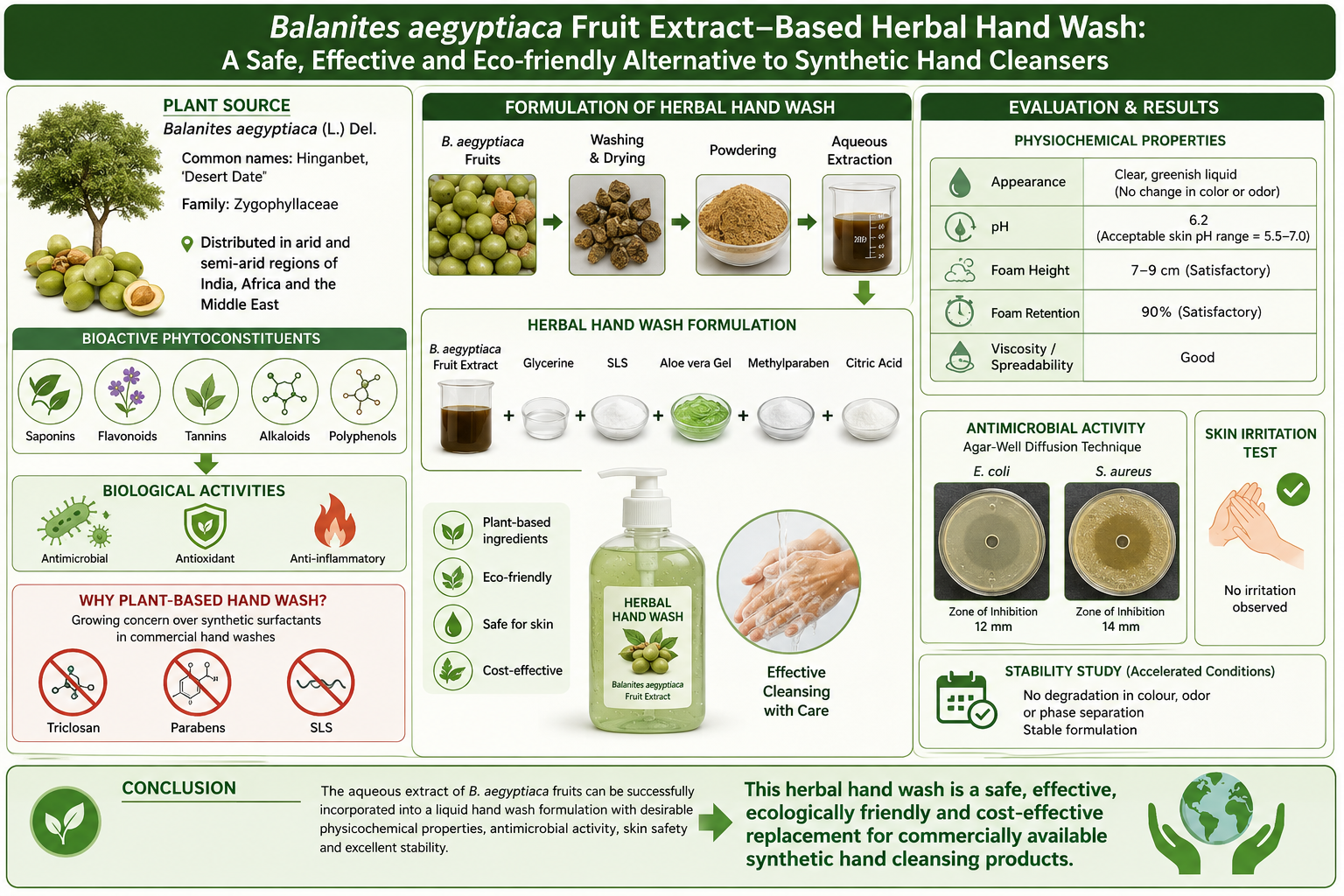
Balanites aegyptiaca (L.) Del., which is also called "Hinganbet" or "Desert Date", has been documented as a medicinal plant from the family of Zygophyllaceae. It is extensively distributed throughout the arid and semi-arid regions of India, Africa and the Middle East. The plant contains a variety of bioactive phytoconstituents like saponins, flavonoids, tannins, alkaloids, and polyphenols. These phytoconstituents contribute to various biological activities, such as antimicrobial, antioxidant, and anti-inflammatory. With increasing public concern about synthetic surfactants, such as triclosan, parabens, and sodium lauryl sulphate (SLS), used in commercial hand wash products, there is now greater interest in using plant-based substitutes. This study provides information on the production of an aqueous extract of B. aegyptiaca fruits and the incorporation of this extract into a liquid hand washing formulation containing additives including glycerine, SLS, aloe vera gel, methylparaben, and citric acid. Physiochemical characteristics - appearance, pH, foam height/foam retention, viscosity/spreadability were tested, along with skin irritation testing, for this hand wash. In addition, the hand washing solution's ability to inhibit microbial growth was tested using the agar-well diffusion technique with E. coli and S. aureus. Foam height/retention was in a satisfactory range of 7-9 cm / 90% respectively; pH = 6.2 (acceptable skin pH range = 5.5-7.0); zones of inhibition for E. coli = 12mm; zones of inhibition for S. aureus = 14mm. No degradation in colour or odor, or phase separation occurred under accelerated storage condition stability tests. Therefore these data demonstrate that the formulated herbal hand cleaning product is a safe, effective, ecologically friendly and cost-effective replacement for commercially available synthetic hand cleansing products.
Article Details
Section

This work is licensed under a Creative Commons Attribution-NonCommercial 4.0 International License.
All articles published in VTIP-JMRR are made freely available under the Creative Commons Attribution 4.0 International License (CC BY 4.0). Under this license, others may freely share, distribute, and adapt the published work, provided appropriate credit is given to the original authors.
By signing the copyright form, the author(s) warrant and represent that:
✓ The manuscript is original and has not been published previously in any journal, conference, or book (in whole or in part).
✓ The manuscript is not currently under consideration for publication elsewhere.
✓ All authors have read and approved the final manuscript and have agreed to this copyright transfer.
✓ The manuscript does not infringe upon any existing copyright, trademark, patent, or other intellectual property right of any third party.
✓ All data, figures, and tables presented are accurate, authentic, and have not been fabricated or falsified.
✓ Proper permissions have been obtained for any third-party material (images, figures, tables, text) included in the manuscript.
✓ The work complies with all applicable ethical guidelines, including those related to human and animal research.
✓ All sources of funding and conflicts of interest have been disclosed in the manuscript.
How to Cite
References
[1] World Health Organization. (2009). WHO guidelines on hand hygiene in health care: First global patient safety challenge — clean care is safer care. WHO Press.
[2] Aiello, A. E., Larson, E. L., & Levy, S. B. (2007). Consumer antibacterial soaps: Effective or just risky? Clinical Infectious Diseases, 45(Suppl. 2), S137–S147. https://doi.org/10.1086/519255
[3] Fluhr, J. W., & Darlenski, R. (2008). Skin surface pH: Mechanism and therapeutic effects. In P. Elias & K. Feingold (Eds.), Skin barrier (pp. 123–138). Taylor & Francis.
[4] Halden, R. U., & Paull, D. H. (2005). Co-occurrence of triclocarban and triclosan in U.S. water resources. Environmental Science & Technology, 39(6), 1420–1426. https://doi.org/10.1021/es049071e
[5] Cowan, M. M. (1999). Plant products as antimicrobial agents. Clinical Microbiology Reviews, 12(4), 564–582. https://doi.org/10.1128/CMR.12.4.564
[6] Barel, A. O., Paye, M., & Maibach, H. I. (2014). Handbook of cosmetic science and technology (4th ed.). CRC Press.
[7] Chothani, D. L., & Vaghasiya, H. U. (2011). A review on Balanites aegyptiaca Del (desert date): Phytochemical constituents, traditional uses, and pharmacological activity. Pharmacognosy Reviews, 5(9), 55–62. https://doi.org/10.4103/0973-7847.79100
[8] Hall, J. B., & Walker, D. H. (1991). Balanites aegyptiaca: A monograph (Publication No. 2). University of Wales, School of Agricultural and Forest Sciences.
[9] Yadav, J. P., & Panghal, M. (2010). Balanites aegyptiaca (L.) Del. (Hingot): A review of its traditional uses, phytochemistry and pharmacological properties. International Journal of Green Pharmacy, 4(3), 140–146. https://doi.org/10.4103/0973-8258.69163
[10] Siddhuraju, P., Makkar, H. P. S., & Becker, K. (2002). The antioxidant activity and phenolic content of seed extracts of Balanites aegyptiaca. Food Chemistry, 76(1), 103–110. https://doi.org/10.1016/S0308-8146(01)00254-3
[11] Gautam, A., Singh, R., & Sharma, N. (2024). Balanites aegyptiaca: A critical review on phytoconstituents, pharmacological activities and nanointerventions. Journal of Ethnopharmacology, 319, 117132. https://doi.org/10.1016/j.jep.2023.117132
[12] Hena, S. A., Kamara, B. I., & Bah, S. (2010). Phytochemical screening and antimicrobial activity of the root extracts of Balanites aegyptiaca. Journal of Medicinal Plants Research, 4(6), 455–461. https://doi.org/10.5897/JMPR09.425
[13] Kumar, V., Sharma, A., & Yadav, S. K. (2015). Antimicrobial activity of hydroalcoholic seed extract of Balanites aegyptiaca against human pathogenic microorganisms. Asian Journal of Pharmaceutical and Clinical Research, 8(3), 212–215. https://doi.org/10.22159/ajpcr.2015.v8i3.5553
[14] Ibrahim, M., Usman, A., & Bello, S. (2022). Phytochemical analysis and antibacterial activity of Balanites aegyptiaca fruit extract. Nigerian Journal of Pharmaceutical Research, 18(1), 45–52. https://doi.org/10.4314/njpr.v18i1.6
[15] Kyambogo, R., Nabukenya, I., & Ogwal-Okeng, J. W. (2025). Antimicrobial evaluation of crude methanolic extract fractions of Balanites aegyptiaca. African Journal of Pharmacy and Pharmacology, 19(2), 88–97. [DOI pending indexing]
[16] Elfeel, A. A., & Warrag, E. I. (2011). Uses and importance of balanites (Balanites aegyptiaca L. Del) in Sudan. Agriculture and Biology Journal of North America, 2(1), 26–30. https://doi.org/10.5251/abjna.2011.2.1.26.30
[17] Patel, R. P., & Trivedi, B. M. (2011). Herbal cosmetics and their benefits: A review. International Journal of Pharmaceutical & Life Sciences, 2(6), 673–677. https://doi.org/10.14260/jemds/2014/2998
[18] Khilare, P., Bhor, R., & Ghawate, V. (2024). Formulation and evaluation of herbal hand wash using Balanites aegyptiaca extract. International Journal of Pharmacy and Pharmaceutical Sciences, 16(4), 78–84. https://doi.org/10.22159/ijpps.2024v16i4.50123
[19] Sharma, K., & Sharma, R. (2025). Phytochemistry and therapeutic potential of Balanites aegyptiaca: A systematic review. Phytomedicine Plus, 5(1), 100310. https://doi.org/10.1016/j.phyplu.2024.100310
[20] Khandelwal, K. R. (2015). Practical pharmacognosy (23rd ed.). Nirali Prakashan.
[21] Harborne, J. B. (1998). Phytochemical methods: A guide to modern techniques of plant analysis (3rd ed.). Chapman and Hall.
[22] Sharma, P. P. (2014). Cosmetics — Formulation, manufacturing and quality control (5th ed.). Vandana Publications.
[23] Indian Pharmacopoeia Commission. (2018). Indian pharmacopoeia (Vol. I–III). IPC.