
Comprehensive Framework for Data Science-Driven Decision-Making Across Healthcare, Finance, Marketing, and Supply Chain Domains
Article Sidebar
Main Article Content
Abstract
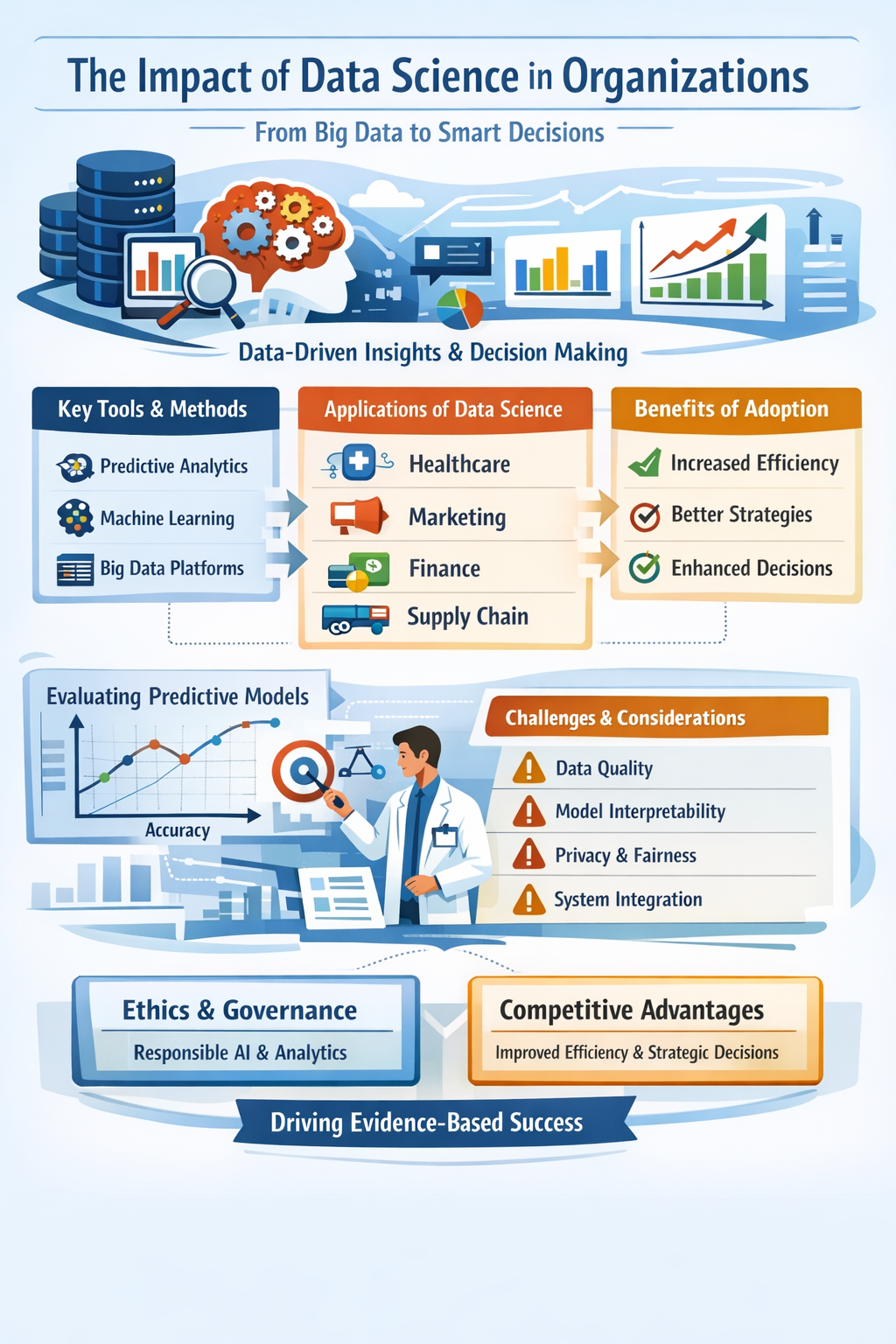
Data Science is transforming many industries by allowing organizations to use complex and large amounts of data to inform data-driven decision making. In this research paper we explore the methods and tools of Data Science in today's organizational environment, as well as its practical applications. Organizations that implement Data Science through predictive analytics, machine learning algorithms, and large-scale data platforms are able to increase their operational efficiency, make better strategic plans, and improve decision quality. In addition to examining how Data Science is applied in healthcare, marketing, finance, and supply chains, we evaluated the performance of predictive models. Several challenges were identified, including data quality, model interpretability, privacy, algorithmic fairness, and systems integration. Ethical issues and governance frameworks promoting responsible development of AI and analytics are also discussed. Findings confirmed that organizations adopting data-driven approaches achieve significant competitive advantages, improved resource allocation, and support long-term evidence-based decision-making.
Article Details
Section

This work is licensed under a Creative Commons Attribution-NonCommercial 4.0 International License.
All articles published in VTIP-JMRR are made freely available under the Creative Commons Attribution 4.0 International License (CC BY 4.0). Under this license, others may freely share, distribute, and adapt the published work, provided appropriate credit is given to the original authors.
By signing the copyright form, the author(s) warrant and represent that:
✓ The manuscript is original and has not been published previously in any journal, conference, or book (in whole or in part).
✓ The manuscript is not currently under consideration for publication elsewhere.
✓ All authors have read and approved the final manuscript and have agreed to this copyright transfer.
✓ The manuscript does not infringe upon any existing copyright, trademark, patent, or other intellectual property right of any third party.
✓ All data, figures, and tables presented are accurate, authentic, and have not been fabricated or falsified.
✓ Proper permissions have been obtained for any third-party material (images, figures, tables, text) included in the manuscript.
✓ The work complies with all applicable ethical guidelines, including those related to human and animal research.
✓ All sources of funding and conflicts of interest have been disclosed in the manuscript.
How to Cite
References
[1] Reinsel, D., Gantz, J., & Rydning, J. (2018). The digitization of the world: From edge to core (IDC White Paper No. US44413318). International Data Corporation.
[2] Dhar, V. (2013). Data science and prediction. Communications of the ACM, 56(12), 64–73. https://doi.org/10.1145/2500499
[3] Provost, F., & Fawcett, T. (2013). Data science for business: What you need to know about data mining and data-analytic thinking. O'Reilly Media.
[4] Rajkomar, A., Dean, J., & Kohane, I. (2019). Machine learning in medicine. New England Journal of Medicine, 380(14), 1347–1358. https://doi.org/10.1056/NEJMra1814259
[5] Cao, L. (2022). Artificial intelligence in finance: Challenges, techniques, and opportunities. ACM Computing Surveys, 55(3), Article 64. https://doi.org/10.1145/3502289
[6] Wang, Y., Tang, S., Aglin, A., & Chen, J. (2019). Customer segmentation using machine learning techniques for targeted marketing campaigns. Journal of Marketing Analytics, 7(2), 88–102.
[7] Carbonneau, R., Laframboise, K., & Vahidov, R. (2008). Application of machine learning techniques for supply chain demand European Journal
of Operational Research, 184(3), 1140–1154. https://doi.org/10.1016/j.ejor.2006.12.004
[8] Dean, J., & Ghemawat, S. (2008). MapReduce: Simplified data processing on large clusters. Communications of the ACM, 51(1), 107–113. https://doi.org/10.1145/1327452.1327492
[9] Zaharia, M., Chowdhury, M., Das, T., Dave, A., Ma, J., McCauley, M., Franklin, M. J., Shenker, S., & Stoica, I. (2016). Apache Spark: A unified engine for big data processing. Communications of the ACM, 59(11), 56–65. https://doi.org/10.1145/2934664
[10] Hastie, T., Tibshirani, R., & Friedman, J. (2009). The elements of statistical learning: Data mining, inference, and prediction (2nd ed.). Springer.
[11] LeCun, Y., Bengio, Y., & Hinton, G. (2015). Deep learning. Nature, 521(7553), 436–444. https://doi.org/10.1038/nature14539
[12] Goodfellow, I., Bengio, Y., & Courville, A. (2016). Deep learning. MIT Press.
[13] Redman, T. C. (2016). Getting in front on data: Who does what. Technics Publications.
[14] Arrieta, A. B., Díaz-Rodríguez, N., Del Ser, J., Bennetot, A., Tabik, S., Barbado, A., & Herrera, F. (2020). Explainable artificial intelligence (XAI): Concepts, taxonomies, opportunities and challenges toward responsible AI. Information Fusion, 58, 82–115. https://doi.org/10.1016/j.inffus.2019.12.012
[15] Mehrabi, N., Morstatter, F., Saxena, N., Lerman, K., & Galstyan, A. (2021). A survey on bias and fairness in machine learning. ACM Computing Surveys, 54(6), Article 115.https://doi.org/10.1145/3457607
[16] Barocas, S., Hardt, M., & Narayanan, A. (2019). Fairness and machine learning: Limitations and opportunities. fairmlbook.org. http://www.fairmlbook.org
[17] Artetxe, A., Beristain, A., & Graña, M. (2018). Predictive models for hospital readmission risk: A systematic review. Computer Methods and Programs in Biomedicine, 164, 49–64. https://doi.org/10.1016/j.cmpb.2018.06.006
[18] Topol, E. J. (2019). High-performance medicine: The convergence of human and artificial intelligence. Nature Medicine, 25(1), 44–56. https://doi.org/10.1038/s41591-018-0300-7
[19] Johnson, K. W., Torres Soto, J., Glicksberg, B. S., Shameer, K., Miotto, R., Ali, M., & Dudley, J. T. (2018). Artificial intelligence in cardiology. Journal of the American College of Cardiology, 71(23), 2668–2679. https://doi.org/10.1016/j.jacc.2018.03.521
[20] Zhang, W., & Chen, J. (2020). Domain-aware statistical learning for financial risk modeling. Journal of Financial Data Science, 2(3), 45–60.
[21] Verbeke, W., Martens, D., & Baesens, B. (2014). Social network analysis for customer churn prediction. Applied Soft Computing, 14, 431–446. https://doi.org/10.1016/j.asoc.2013.09.017
[22] Zhang, S., Yao, L., Sun, A., & Tay, Y. (2019). Deep learning based recommender system: A survey and new perspectives. ACM Computing Surveys, 52(1), Article 5. https://doi.org/10.1145/3285029
[23] Floridi, L., Cowls, J., Beltrametti, M., & Vayena, E. (2018). AI4People — An ethical framework for a good AI society. Minds and Machines, 28(4), 689–707. https://doi.org/10.1007/s11023-018-9482-5
[24] Ivanov, D., Dolgui, A., & Sokolov, B. (2019). Digital supply chain management and Industry 4.0. International Journal of Production Research, 57(3), 829–846. https://doi.org/10.1080/00207543.2018.1442945
[25] Min, H. (2010). Artificial intelligence in supply chain management. International Journal of Logistics Research and Applications, 13(1), 13–39. https://doi.org/10.1080/13675560902736537
[26] Johnson, A. E. W., Pollard, T. J., Shen, L., & Mark, R. G. (2016). MIMIC-III, a freely accessible critical care database. Scientific Data, 3, Article 160035. https://doi.org/10.1038/sdata.2016.35
[27] Lundberg, S. M., & Lee, S.-I. (2017). A unified approach to interpreting model predictions. Advances in Neural Information Processing Systems 30 (pp. 4765–4774). Curran Associates.
[28] Waller, M. A., & Fawcett, S. E. (2013). Data science, predictive analytics, and big data: A revolution that will transform supply chain design and management. Journal of Business Logistics, 34(2), 77–84. https://doi.org/10.1111/jbl.12010