
Optimization of the Hard Turning Process by Artificial Neural Networks: A Review
Article Sidebar
Main Article Content
Abstract
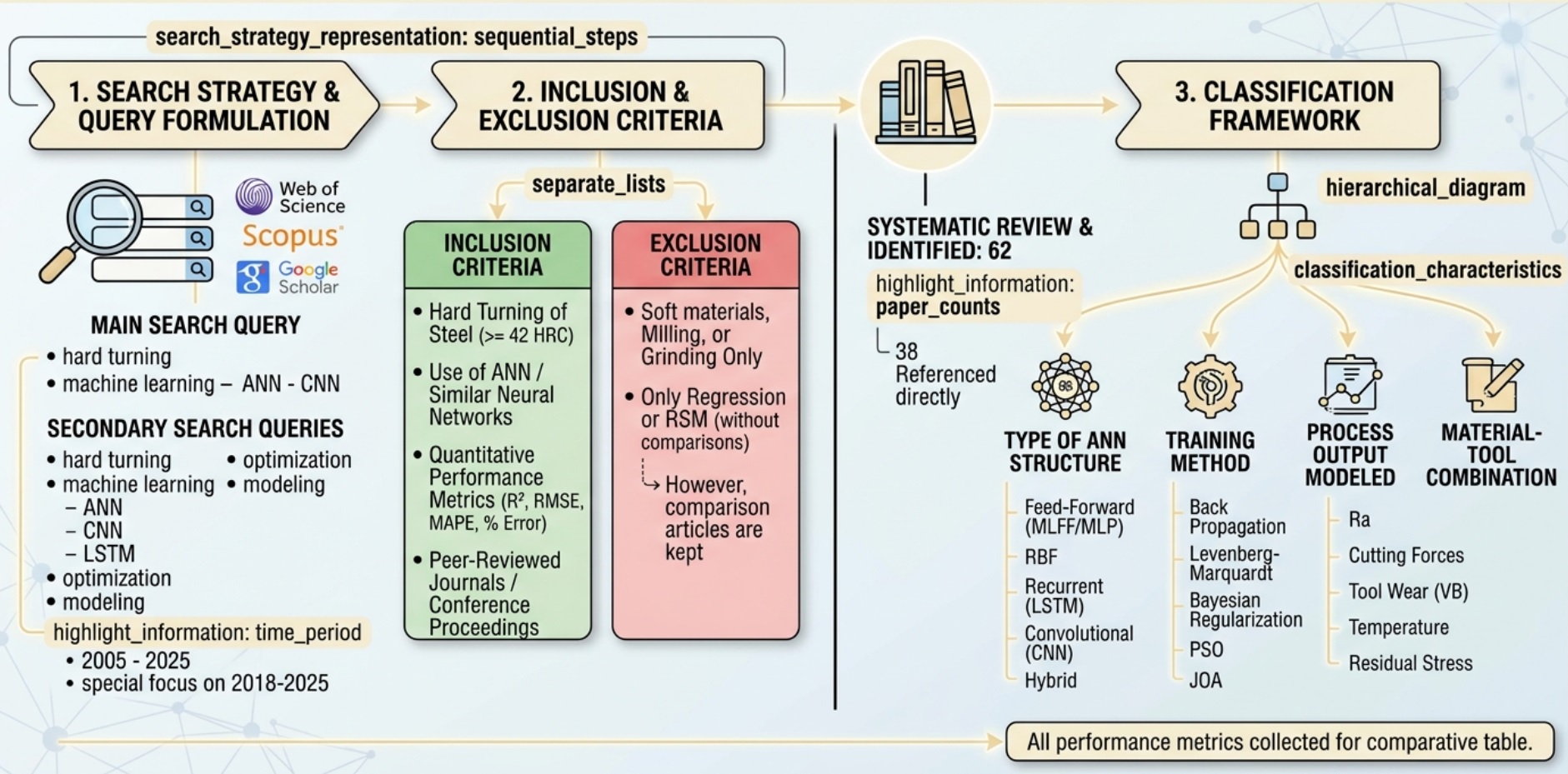
Hard turning is a precision machining process employed as a finish operation on hardened alloy steels (42–68 HRC), widely used as an alternative to cylindrical grinding. The complexity and non-linearity of the hard turning process—governing surface roughness, cutting forces, tool wear, and cutting temperature—make traditional analytical modeling inadequate. Artificial neural networks (ANNs) have emerged as powerful data-driven tools capable of modeling and optimizing these intricate relationships with high predictive accuracy. This review systematically surveys peer-reviewed research published between 2005 and 2025, with emphasis on studies from 2018–2025, examining the application of ANN-based models to optimize hard turning parameters. The review covers ANN architectures employed (feedforward, radial basis function, deep neural networks, and hybrid approaches such as ANN–GA, ANN–PSO, and CNN-LSTM), training algorithms (back-propagation, Levenberg–Marquardt, Bayesian regularization), workpiece materials (AISI 52100, AISI H13, AISI D2, AISI 4340), cutting tool types (CBN, PCBN, coated carbides), and performance indicators (surface roughness Ra, cutting forces Fx/Fy/Fz, tool flank wear VB, cutting temperature). Key findings confirm that ANN models consistently outperform regression-based models in capturing non-linear input–output relationships, with prediction errors frequently below 5%. Recent trends toward hybrid ANN–genetic algorithm models, explainable machine learning (XAI), and real-time CNN-LSTM architectures signal a move toward intelligent and autonomous hard turning optimization systems.
Article Details
Section

This work is licensed under a Creative Commons Attribution-NonCommercial 4.0 International License.
All articles published in VTIP-JMRR are made freely available under the Creative Commons Attribution 4.0 International License (CC BY 4.0). Under this license, others may freely share, distribute, and adapt the published work, provided appropriate credit is given to the original authors.
By signing the copyright form, the author(s) warrant and represent that:
✓ The manuscript is original and has not been published previously in any journal, conference, or book (in whole or in part).
✓ The manuscript is not currently under consideration for publication elsewhere.
✓ All authors have read and approved the final manuscript and have agreed to this copyright transfer.
✓ The manuscript does not infringe upon any existing copyright, trademark, patent, or other intellectual property right of any third party.
✓ All data, figures, and tables presented are accurate, authentic, and have not been fabricated or falsified.
✓ Proper permissions have been obtained for any third-party material (images, figures, tables, text) included in the manuscript.
✓ The work complies with all applicable ethical guidelines, including those related to human and animal research.
✓ All sources of funding and conflicts of interest have been disclosed in the manuscript.
How to Cite
References
[1] Ozel, T., & Karpat, Y. (2005). Predictive modeling of surface roughness and tool wear in hard turning using regression and neural networks. International Journal of Machine Tools and Manufacture, 45(4–5), 467–479. https://doi.org/10.1016/j.ijmachtools.2004.09.007
[2] Nakayama, K., Arai, M., & Kanda, T. (1988). Machining characteristics of hard materials. CIRP Annals – Manufacturing Technology, 37(1), 89–92. https://doi.org/10.1016/S0007-8506(07)61592-3
[3] Chinchanikar, S., & Choudhury, S. K. (2015). Hardened steel turning at different levels of hardness with coated carbide inserts: Surface roughness and tool wear prediction using response surface methodology and artificial neural networks. Journal of Mechanical Science and Technology, 29(5), 2065–2071.
[4] Aouici, H., Yallese, M. A., Chaoui, K., Mabrouki, T., & Rigal, J. F. (2012). Analysis of surface roughness and cutting force components in hard turning with CBN tool: Prediction model and cutting conditions optimization. Measurement, 45(3), 344–353. https://doi.org/10.1016/j.measurement.2011.11.011
[5] Davim, J. P., & Figueira, L. (2007). Machinability evaluation in hard turning of cold work tool steel (D2) with ceramic tools using statistical techniques. Materials and Design, 28(4), 1186–1191. https://doi.org/10.1016/j.matdes.2005.12.013
[6] Mia, M., & Dhar, N. R. (2017). Prediction and optimization by using SVR, RSM and GA in hard turning of tempered AISI 1060 steel under effective cooling condition. Neural Computing and Applications, 30(8), 2471–2487. https://doi.org/10.1007/s00521-017-3192-4
[7] Ozel, T., Hsu, T. K., & Zeren, E. (2005). Effects of cutting edge geometry, workpiece hardness, feed rate and cutting speed on surface roughness and forces in finish turning of hardened AISI H13 steel. International Journal of Advanced Manufacturing Technology, 25(3–4), 262–269. https://doi.org/10.1007/s00170-003-1878-5
[8] Benga, G. C., & Abrao, A. M. (2003). Turning of hardened 100Cr6 bearing steel with ceramic and PCBN cutting tools. Journal of Materials Processing Technology, 143–144, 237–241. https://doi.org/10.1016/S0924-0136(03)00346-7
[9] Lalwani, D. I., Mehta, N. K., & Jain, P. K. (2008). Experimental investigations of cutting parameters influence on cutting forces and surface roughness in finish hard turning of MDN250 steel. Journal of Materials Processing Technology, 206(1–3), 167–179. https://doi.org/10.1016/j.jmatprotec.2007.12.018
[10] Liu, M., Xie, H., Pan, W., et al. (2025). Prediction of cutting force via machine learning: state of the art, challenges and potentials. Journal of Intelligent Manufacturing, 36, 703–764. https://doi.org/10.1007/s10845-023-02260-8
[11] Sharma, V. S., Dhiman, S., Sehgal, R., & Sharma, S. K. (2008). Estimation of cutting forces and surface roughness for hard turning using neural networks. Journal of Intelligent Manufacturing, 19(4), 473–483. https://doi.org/10.1007/s10845-008-0097-1
[12] Makhfi, S., Velasco, R., Habak, M., Haddouche, K., & Vantomme, P. (2013). An optimized ANN approach for cutting forces prediction in AISI 52100 bearing steel hard turning. Science and Technology, 3(1), 24–32. https://doi.org/10.5923/j.scit.20130301.03
[13] Adizue, U. L., Tura, A. D., Isaya, E. O., Farkas, B. Z., & Takacs, M. (2023). Surface quality prediction by machine learning methods and process parameter optimization in ultra-precision machining of AISI D2 using CBN tool. International Journal of Advanced Manufacturing Technology, 129(3–4), 1375–1394. https://doi.org/10.1007/s00170-023-12366-1
[14] Kumar, R., Rafighi, M., Ozdemir, M., et al. (2025). Modeling and optimization of hard turning: predictive analysis of surface roughness and cutting forces in AISI 52100 steel using machine learning. International Journal on Interactive Design and Manufacturing, 19, 5749–5778. https://doi.org/10.1007/s12008-024-02166-6
[15] Rao, G. S., Mukkamala, U., Hanumanthappa, H., Prasad, C. D., Vasudev, H., Shanmugam, B., & KishoreKumar, K. C. (2024). Evaluating and optimizing surface roughness using genetic algorithm and artificial neural networks during turning of AISI 52100 steel. International Journal on Interactive Design and Manufacturing, 18, 6151–6160. https://doi.org/10.1007/s12008-023-01549-5
[16] Abdelhakim, D., Harrou, F., Sun, Y., et al. (2024). Explainable machine learning for enhancing predictive accuracy of cutting forces in hard turning processes. International Journal of Advanced Manufacturing Technology, 135, 939–961. https://doi.org/10.1007/s00170-024-14470-2
[17] Khetre, S., Bongale, A. & Kumar, S.. (2025). CBN cutting tool surface roughness and tool wear prediction using JOA-optimized CNN-LSTM. Scientific Reports. https://doi.org/10.1038/s41598-025-29658-z
[18] Mohamad, A. B., et al. (2025). Predictive modeling of surface roughness and cutting temperature using response surface methodology and artificial neural network in hard turning of AISI 52100 steel with minimal cutting fluid application. Machines, 13(4), 266. https://doi.org/10.3390/machines13040266
[19] Haas, T., et. all. (2024). Data-driven prediction of the surface layer state in hard-turning for optimization of component quality. Production Engineering, 18, 213–226. https://doi.org/10.1007/s11740-023-01256-w
[20] Mimoun, C. H., Haddouche, K., & Makhfi, S. (2025). Predicting the resultant cutting force in hard turning using machine learning techniques. Engineering, Technology & Applied Science Research, 15(5), 26505–26510. https://doi.org/10.48084/etasr.11759
[21] Tariq, M., Kovac, P., Nedic, B., Rodic, D., & Jesic, D. (2024). Prediction and optimization of surface roughness and cutting forces in turning process using ANN, SHAP analysis, and hybrid MCDM method. Applied Sciences, 14(23), 11386. https://doi.org/10.3390/app142311386
[22] Saeed Zare Chavoshi & Mehdi Tajdari (2010). Surface roughness modelling in hard turning operation of AISI 4140 using CBN cutting tool. International Journal of Material Forming, 3(1), 233–239. https://doi.org/10.1007/s12289-009-0679-2
[23] Soori, M., Arezoo, B., & Dastres, R. (2023). Machine learning and artificial intelligence in CNC machine tools: A review. Sustainable Manufacturing and Service Economics, 2, 100009. https://doi.org/10.1016/j.smse.2023.100009
[24] Mia, M., & Dhar, N. R. (2016). Response surface and neural network based predictive models of cutting temperature in hard turning. Journal of Advanced Research, 7(6), 1035–1044. https://doi.org/10.1016/j.jare.2016.05.004
[25] Panda, A., Sahoo, A. K., Panigrahi, I., & Rout, A. K. (2018). Investigating machinability in hard turning of AISI 52100 bearing steel through performance measurement: QR, ANN and GRA study. International Journal of Automotive and Mechanical Engineering, 15(3), 4935–4961. https://doi.org/10.15282/ijame.15.1.2018.5.0384
[26] Makhfi, S., Dorbane, A., Harrou, F., & Sun, Y. (2024). Prediction of cutting forces in hard turning process using machine learning methods: A case study. Journal of Materials Engineering and Performance, 33(17), 9095–9111. https://doi.org/10.1007/s11665-023-08555-4