
Banking Security System Using Face and Liveness Detection Using Machine Learning and Image Processing
Article Sidebar
Main Article Content
Abstract
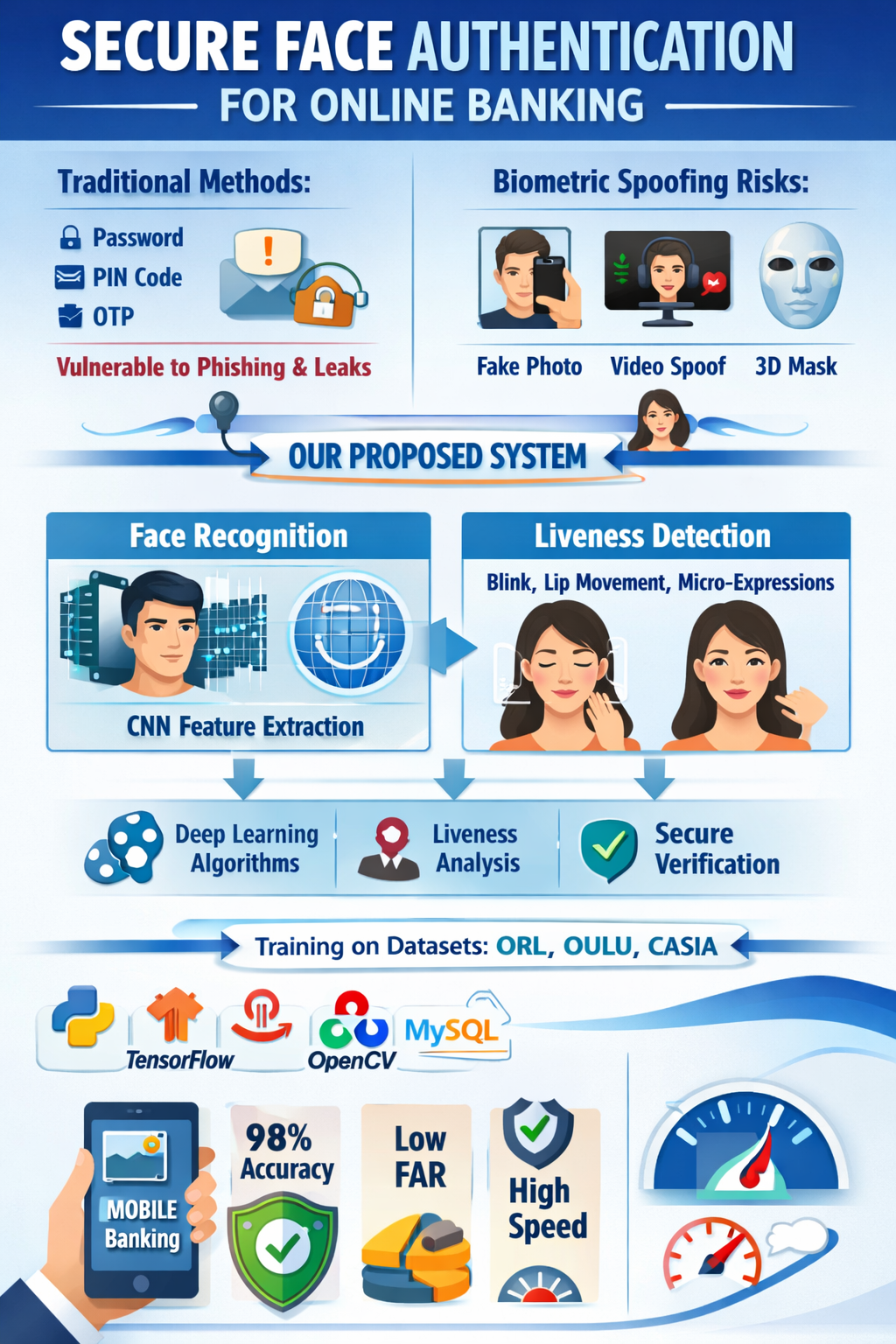
To provide safer user login experiences on ever-growing online banking services, it will be important to develop new, better forms of secure authentication. Traditional convolutional methods such as password, pin or one-time passwords are vulnerable to common attacks such as phishing and have been known to lose their validity when credentials are leaked. Biometric authentication based on face recognition offers both convenience and non-contact verification; however, traditional systems can be easily spoofed by fake photos, videos, or even 3-D masks. This paper presents an ML-based method to develop a more robust ID verification system via the use of image processing techniques along with deep learning techniques. An initial CNN will be used to extract facial features and recognize faces. In addition to the CNN, we also propose a liveness detection module that would detect the presence of natural behaviors associated with humans i.e., eye blinks, lip movements and small micro-expression changes in facial expressions to determine if the user is a living being or attempting to spoof the system. We plan to train and validate our model on publically available datasets like ORL, OULU, and CASIA to ensure that it will work under different lighting conditions, pose variations and textures. The system will utilize Python/TensorFlow/OpenCV/Keras and a MySQL DB. We will test this system’s accuracy/latency/resistance to spoofing attacks. Our experimental results show that the proposed system performs much better than other reported systems (over 98% recognition accuracy, very low FAR & very fast) for online/mobile banking applications. Therefore, this study demonstrates that the proposed system is an inexpensive way to improve security in banking infrastructures. Furthermore, due to the modularity of the proposed system, it can be easily integrated into all current banking platforms while complying with regulations related to data protection.
Article Details
Section

This work is licensed under a Creative Commons Attribution-NonCommercial 4.0 International License.
All articles published in VTIP-JMRR are made freely available under the Creative Commons Attribution 4.0 International License (CC BY 4.0). Under this license, others may freely share, distribute, and adapt the published work, provided appropriate credit is given to the original authors.
By signing the copyright form, the author(s) warrant and represent that:
✓ The manuscript is original and has not been published previously in any journal, conference, or book (in whole or in part).
✓ The manuscript is not currently under consideration for publication elsewhere.
✓ All authors have read and approved the final manuscript and have agreed to this copyright transfer.
✓ The manuscript does not infringe upon any existing copyright, trademark, patent, or other intellectual property right of any third party.
✓ All data, figures, and tables presented are accurate, authentic, and have not been fabricated or falsified.
✓ Proper permissions have been obtained for any third-party material (images, figures, tables, text) included in the manuscript.
✓ The work complies with all applicable ethical guidelines, including those related to human and animal research.
✓ All sources of funding and conflicts of interest have been disclosed in the manuscript.
How to Cite
References
1. Khairnar, S., Gite, S., Kotecha, K., & Thepade, S. D. (2023). Face liveness detection using artificial intelligence techniques: A systematic literature review and future directions. Big Data and Cognitive Computing, 7(1), 37. https://doi.org/10.3390/bdcc7010037
2. Xing, H., Tan, S. Y., Qamar, F., & Jiao, Y. (2025). Face anti-spoofing based on deep learning: A comprehensive survey. Applied Sciences, 15(12), 6891. https://doi.org/10.3390/app15126891
3. Huang, P.-K., Chong, J.-X., Hsu, M.-T., Hsu, F.-Y., Chiang, C.-H., Chen, T.-H., & Hsu, C.-T. (2024). A survey on deep learning-based face anti-spoofing. APSIPA Transactions on Signal and Information Processing, 13, e34. https://doi.org/10.1561/116.20240053
3. Keresh, A., & Shamoi, P. (2024). Liveness detection in computer vision: Transformer-based self-supervised learning for face anti-spoofing. IEEE Access, 12. https://doi.org/10.1109/ACCESS.2024.3513795
4. Padmashree, G., & Karunakar, A. K. (2024). Disguised face liveness detection: An ensemble approach using deep features. Cogent Engineering, 11(1), 2423025. https://doi.org/10.1080/23311916.2024.2423025
5. Mahmood, H. S., & Al-Darraji, S. (2024). Face anti-spoofing detection with multi-modal CNN enhanced by ResNet. Journal of Basrah Researches (Sciences), 50(1), 12. https://doi.org/10.56714/bjrs.50.1.7
6. Shinde, S. R., Bongale, A. M., Dharrao, D., Jadhav, D., & Yadav, N. (2025). Enhancing face liveness detection: Novel deep CNN architectures for anti-spoofing. Engineering, Technology & Applied Science Research, 15(5), 27206–27212. https://doi.org/10.48084/etasr.12431
7. Ibrahim, M. S., Ibrahim, M. S., Khan, S., Ko, Y.-W., & Lee, J.-G. (2025). Improving face presentation attack detection through deformable convolution and transfer learning. IEEE Access, 13, 31228–31238.
https://doi.org/10.1109/ACCESS.2025.3541546
8. Pei, M., Yan, B., Hao, H., & Zhao, M. (2023). Person-specific face spoofing detection based on a Siamese network. Pattern Recognition, 135, 109148. https://doi.org/10.1016/j.patcog.2022.109148
9. Rehman, Y. A. U., Po, L. M., Liu, M., Zou, Z., Ou, W., & Zhao, Y. (2019). Face liveness detection using convolutional-features fusion of real and deep network generated face images. Journal of Visual Communication and Image Representation, 59, 574–582. https://doi.org/10.1016/j.jvcir.2018.12.009
10. Singh, A. K., Joshi, P., & Nandi, G. C. (2014). Face recognition with liveness detection using eye and mouth movement. In Proceedings of the International Conference on Signal Propagation and Computer Technology (ICSPCT) (pp. 592–597). IEEE. https://doi.org/10.1109/ICSPCT.2014.6884919
11. George, A., Mostaani, Z., & Marcel, S. (2020). Biometric face presentation attack detection with multi-channel convolutional neural network. IEEE Transactions on Information Forensics and Security, 15, 42–55.
https://doi.org/10.1109/TIFS.2019.2916652
12. Zhang, K. Y., Yao, T., Zhang, J., Tai, Y., Ding, S., Li, J., & Ma, J. (2020). Face anti-spoofing via disentangled representation learning. IEEE Transactions on Information Forensics and Security, 15, 2915–2929.
https://doi.org/10.1109/TIFS.2020.2980grievances
13. Tian, Y., Sun, X., Li, Y., & He, R. (2020). Face anti-spoofing by learning polarization cues in a real-world scenario. IEEE Transactions on Information Forensics and Security, 15, 2948–2960.
https://doi.org/10.1109/TIFS.2020.2988771
14. Long, X., Zhang, J., & Shan, S. (2024). Confidence-aware learning for reliable face anti-spoofing. arXiv preprint arXiv:2411.01263. https://arxiv.org/abs/2411.01263
15. Ramachandra, R., & Busch, C. (2017). Presentation attack detection methods for face recognition systems: A comprehensive survey. ACM Computing Surveys, 50(1), 1–37. https://doi.org/10.1145/3038924
16. Erdogmus, N., & Marcel, S. (2014). Spoofing face recognition with 3D masks. IEEE Transactions on Information Forensics and Security, 9(7), 1084–1097. https://doi.org/10.1109/TIFS.2014.2322255
17. Boulkenafet, Z., Komulainen, J., & Hadid, A. (2015). Face anti-spoofing using speeded-up robust features. In Proceedings of the IEEE International Conference on Biometrics (ICB) (pp. 1–6). IEEE.
https://doi.org/10.1109/ICB.2015.7139085
18. Marcel, S., Nixon, M. S., & Li, S. Z. (Eds.). (2019). Handbook of biometric anti-spoofing: Presentation attack detection (2nd ed.). Springer. https://doi.org/10.1007/978-3-319-92627-8
19. Jain, A. K., Ross, A. A., & Nandakumar, K. (2011). Introduction to biometrics. Springer. https://doi.org/10.1007/978-0-387-77326-1
20. Hadid, A., Evans, N., Marcel, S., & Fierrez, J. (2015). Biometrics systems under spoofing attack: An evaluation methodology and lessons learned. IEEE Signal Processing Magazine, 32(5), 20–30. https://doi.org/10.1109/MSP.2015.2434134