
Study on Intelligent Predictive Maintenance for Industrial Machinery: A Review
Article Sidebar
Main Article Content
Abstract
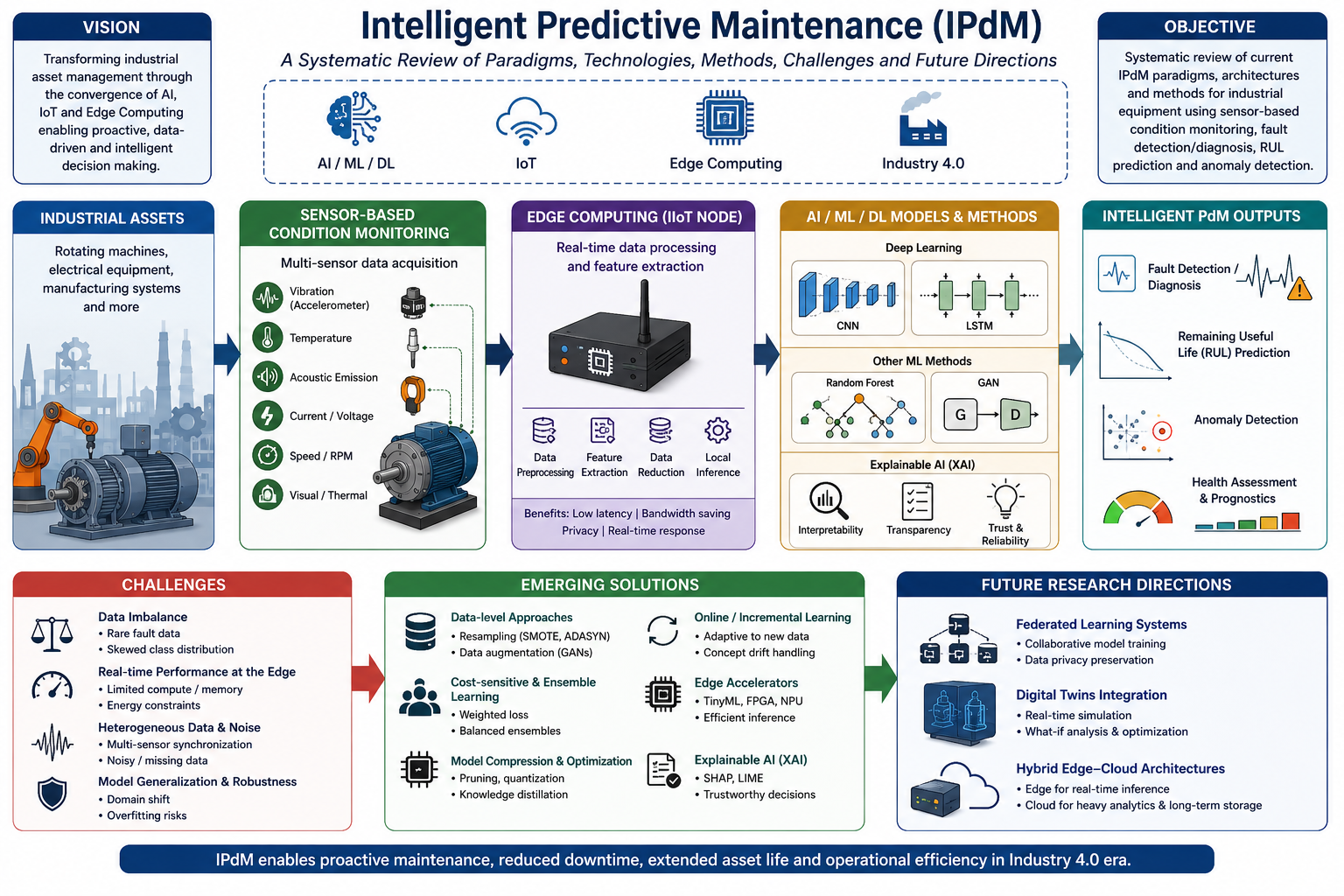
The application of Intelligent Predictive Maintenance (IPdM) is transforming industrial asset management through the intersection of Industry 4.0 technologies such as; Artificial Intelligence (AI), Machine Learning (ML), Deep Learning (DL), the Internet of Things (IoT) and Edge Computing. A systematic review of existing literature on current intelligent predictive maintenance paradigms, architectures and methods for use with industrial equipment is examined within this study. Additionally, the major technologies to be used for sensor based condition monitoring, fault detection/diagnosis, remaining useful life prediction and anomaly detection will be reviewed. This includes analysis of CNN's, LSTM's, random forests, GAN's, and explainable AI (xai). Data imbalance challenges in deploying models at the edge of an IoT network and how to achieve real time performance are presented. Emerging solutions to these issues are also addressed. Finally, this review presents several areas for potential research, which may include the development of federated learning systems, incorporation of digital twins into IPdM systems, and the design of hybrid edge cloud architectures.
Article Details
Section

This work is licensed under a Creative Commons Attribution-NonCommercial 4.0 International License.
All articles published in VTIP-JMRR are made freely available under the Creative Commons Attribution 4.0 International License (CC BY 4.0). Under this license, others may freely share, distribute, and adapt the published work, provided appropriate credit is given to the original authors.
By signing the copyright form, the author(s) warrant and represent that:
✓ The manuscript is original and has not been published previously in any journal, conference, or book (in whole or in part).
✓ The manuscript is not currently under consideration for publication elsewhere.
✓ All authors have read and approved the final manuscript and have agreed to this copyright transfer.
✓ The manuscript does not infringe upon any existing copyright, trademark, patent, or other intellectual property right of any third party.
✓ All data, figures, and tables presented are accurate, authentic, and have not been fabricated or falsified.
✓ Proper permissions have been obtained for any third-party material (images, figures, tables, text) included in the manuscript.
✓ The work complies with all applicable ethical guidelines, including those related to human and animal research.
✓ All sources of funding and conflicts of interest have been disclosed in the manuscript.
How to Cite
References
[1] Pinciroli, L., Baraldi, P., & Zio, E. (2023). Maintenance optimization in industry 4.0. Reliability Engineering & System Safety, 234, 109204. https://doi.org/10.1016/j.ress.2023.109204
[2] Meriem, H., Balouk, A., & Sahraoui, S. (2023). Predictive maintenance for smart industrial systems: A roadmap. Procedia Computer Science, 220, 645-650. https://doi.org/10.1016/j.procs.2023.03.082
[3] Shaheen, B., Khodaei, M., & Sadeghi-Tehran, P. (2023). Data-driven failure prediction and RUL estimation of mechanical components using accumulative artificial neural networks. Engineering Applications of Artificial Intelligence, 119, 105749. https://doi.org/10.1016/j.engappai.2022.105749
[4] Lee, W. J., Wu, H., Yun, H., Kim, H., Jun, M. B. G., & Sutherland, J. W. (2019). Predictive maintenance of machine tool systems using artificial intelligence techniques applied to machine condition data. Procedia CIRP, 80, 506-511. https://doi.org/10.1016/j.procir.2018.12.019
[5] Alombah, N. H., Nzeukou, A., & Tchappi, I. H. (2025). Advanced IoT-based monitoring system for real-time photovoltaic performance evaluation: Conception, development and experimental validation. Scientific African, 28, e02763. https://doi.org/10.1016/j.sciaf.2025.e02763
[6] Akyaz, T., & Demir, K. A. (2024). Machine learning-based predictive maintenance system for artificial yarn machines. IEEE Access, 12, 1-15. https://doi.org/10.1109/ACCESS.2024.3387092
[7] Wu, K., Zhang, Y., Li, Q., Wang, Z., & Liu, H. (2025). The design and implementation of automated maintenance system for the first-wall based on dual-arm manipulator. Nuclear Engineering and Technology, 57(2), 103170. https://doi.org/10.1016/j.net.2024.08.039
[8] de Villiers, P.-R. H., Kruger, K., & Basson, A. H. (2023). Smart maintenance system for inner city public bus services. Procedia CIRP, 120, 285-290. https://doi.org/10.1016/j.procir.2023.08.040
[9] Arno, H., Tobback, E., & Martens, D. (2025). Business failure prediction from textual and tabular data with sentence-level interpretations. Annals of Operations Research. https://doi.org/10.1007/s10479-025-06574-z
[10] Ferrara, E. (2024). The butterfly effect in artificial intelligence systems: Implications for AI bias and fairness. Machine Learning with Applications, 15, 100525. https://doi.org/10.1016/j.mlwa.2024.100525
[11] Tortora, A. M. R., Tsohou, A., & Chatzoglou, P. (2024). Machine learning for failure prediction: A cost-oriented model selection. Procedia Computer Science, 232, 3195-3205. https://doi.org/10.1016/j.procs.2024.01.317
[12] Agyemang, E. F., Osei, K., & Osei-Frimpong, K. (2024). Anomaly detection using unsupervised machine learning algorithms: A simulation study. Scientific African, 26, e02386. https://doi.org/10.1016/j.sciaf.2024.e02386
[13] Jamarani, A., Mehrabi, M., & Haghighi, M. S. (2024). Big data and predictive analytics: A systematic review of applications. Artificial Intelligence Review, 57, 226. https://doi.org/10.1007/s10462-024-10811-5
[14] Xu, X., Lu, Y., Vogel-Heuser, B., & Wang, L. (2021). Industry 4.0 and industry 5.0-inception, conception and perception. Journal of Manufacturing Systems, 61, 530-535. https://doi.org/10.1016/j.jmsy.2021.10.006
[15] Kumar, S., Tiwari, P., & Zymbler, M. (2019). Internet of things is a revolutionary approach for future technology enhancement: A review. Journal of Big Data, 6, 111. https://doi.org/10.1186/s40537-019-0268-2
[16] Pulikottil, T., Schloegl, W., & Ansari, F. (2023). Immune system inspired smart maintenance framework: Tool-wear monitoring use case. The International Journal of Advanced Manufacturing Technology, 131, 5547-5562. https://doi.org/10.1007/s00170-024-13472-4
[17] Qi, K., Chen, Y., Li, Z., & Zhang, H. (2025). Advancing hospital healthcare: Achieving IoT-based secure health monitoring through multilayer machine learning. Journal of Big Data, 12, 14. https://doi.org/10.1186/s40537-024-01038-w
[18] Alzubaidi, L., Zhang, J., Humaidi, A. J., Al-Dujaili, A., Duan, Y., Al-Shamma, O., Santamaria, J., Fadhel, M. A., Al-Amidie, M., & Farhan, L. (2021). Review of deep learning: Concepts, CNN architectures, challenges, applications, future directions. Journal of Big Data, 8, 53. https://doi.org/10.1186/s40537-021-00444-8
[19] Lara de Leon, M. A., Osornio-Rios, R. A., & Romero-Troncoso, R. J. (2024). Tool condition monitoring methods applicable in the metalworking process. Archives of Computational Methods in Engineering, 31, 1445-1466. https://doi.org/10.1007/s11831-023-09979-w
[20] Wang, S., Balarezo, J. F., & Kandeepan, S. (2021). Machine learning in network anomaly detection: A survey. IEEE Access, 9, 152379-152396. https://doi.org/10.1109/ACCESS.2021.3126834
[21] Lundberg, S. M., & Lee, S. I. (2017). A unified approach to interpreting model predictions. Advances in Neural Information Processing Systems, 30, 4765-4774.
[22] Ompusunggu, A. P., Vandenplas, S., & Smet, P. D. (2021). Condition monitoring of critical industrial assets using high performing low-cost MEMS accelerometers. Procedia CIRP, 104, 1389-1394. https://doi.org/10.1016/j.procir.2021.11.234
[23] Kunicki, M., Wotzka, D., & Daminabo, F. (2020). Data acquisition system for on-line temperature monitoring in power transformers. Measurement, 161, 107909. https://doi.org/10.1016/j.measurement.2020.107909
[24] Attaran, M., & Attaran, S. (2023). Digital twin: Benefits, use cases, challenges, and opportunities. Decision Analytics Journal, 6, 100165. https://doi.org/10.1016/j.dajour.2023.100165
[25] Giliyana, S., Johansen, K., & Sobaszek, L. (2025). Implementing and using smart maintenance technologies: Introducing challenges and enablers related to human, organizational and technological perspectives. Procedia Computer Science, 253, 932-941. https://doi.org/10.1016/j.procs.2025.01.117