
Comparative Study of AI-Based Optimization Techniques in VLSI Circuit Design Using Python
Article Sidebar
Main Article Content
Abstract
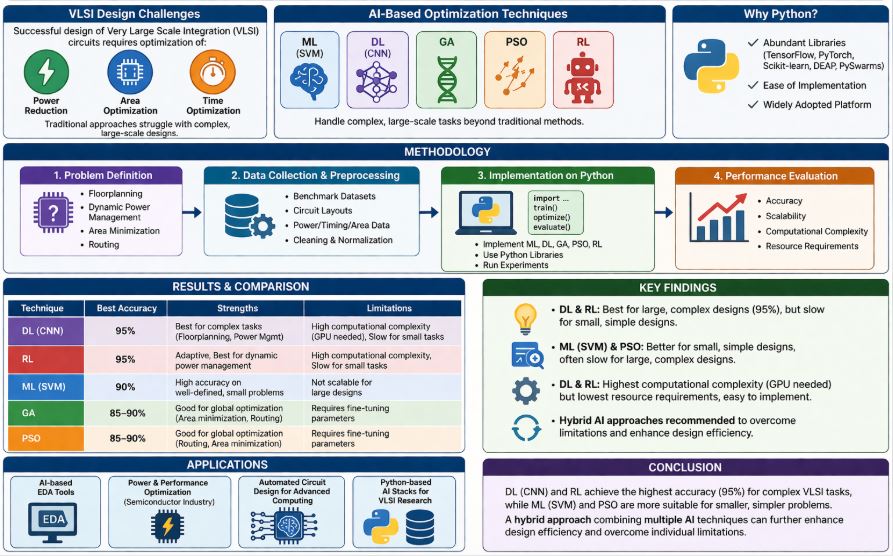
Successful design of very large scale integration (VLSI) circuits requires the use of various optimizations—power reduction, area, and time optimization. This requires the involvement of AI-based optimization techniques, such as machine learning (ML), deep learning (DL), genetic algorithms (GA), particle swarm optimization (PSO), and reinforcement learning (RL), to fulfill such tasks where traditional approaches fail to do so. The abundant libraries and ease of implementation have made Python a widely used platform in AI-based VLSI optimization. The methodology used in this study is a comparative study of different AI-based optimization algorithms used in the VLSI circuits. This research is structured in the following way: problem definition, data collection & preprocessing, implementation on Python, and performance evaluation. The best number was obtained using DL (CNN) and RL (95%) for the complex tasks (floorplanning and dynamic power management). ML (SVM) achieved high accuracy (90%) on well-defined problems but was not scalable for large designs. GA and PSO were good in performing global optimizations for problems like area minimization and routing but required fine-tuning of parameters. DL and RL had the highest computational complexity (GPU acceleration) and the lowest resource requirements, with easier implementation, with ML techniques. We found that DL and RL are better suited to large and complex designs and are slow for small and simple designs, whereas ML (SVM) and PSO are better suited to small and simple designs and are often slow given large and complex designs. Therefore, additional research is needed on the use of multiple AI techniques in a hybrid way to overcome limitations of the different techniques and enhance design efficiency. The results of this study can be applied in the following areas: AI-based Electronic Design Automation (EDA) tools, Power and performance optimization in semiconductor industries, Automated circuit design for advanced computing and development of Python-based AI stacks for VLSI research.
Article Details
Section

This work is licensed under a Creative Commons Attribution-NonCommercial 4.0 International License.
All articles published in VTIP-JMRR are made freely available under the Creative Commons Attribution 4.0 International License (CC BY 4.0). Under this license, others may freely share, distribute, and adapt the published work, provided appropriate credit is given to the original authors.
By signing the copyright form, the author(s) warrant and represent that:
✓ The manuscript is original and has not been published previously in any journal, conference, or book (in whole or in part).
✓ The manuscript is not currently under consideration for publication elsewhere.
✓ All authors have read and approved the final manuscript and have agreed to this copyright transfer.
✓ The manuscript does not infringe upon any existing copyright, trademark, patent, or other intellectual property right of any third party.
✓ All data, figures, and tables presented are accurate, authentic, and have not been fabricated or falsified.
✓ Proper permissions have been obtained for any third-party material (images, figures, tables, text) included in the manuscript.
✓ The work complies with all applicable ethical guidelines, including those related to human and animal research.
✓ All sources of funding and conflicts of interest have been disclosed in the manuscript.
How to Cite
References
1. Huang, G., Hu, J., He, Y., et al. (2021). Machine learning for electronic design automation: A survey. ACM Transactions on Design Automation of Electronic Systems, 26(5), Article 40.
2. Rapp, M., Amrouch, H., Lin, Y., et al. (2021). MLCAD: A survey of research in machine learning for CAD. IEEE Transactions on Computer-Aided Design of Integrated Circuits and Systems, 41(10), 3449–3466.
3. Khailany, B., Ren, H., Dai, S., et al. (2020). Accelerating chip design with machine learning. IEEE Micro, 40(6), 23–32.
4. Mirhoseini, A., Goldie, A., Yazgan, M., et al. (2021). A graph placement methodology for fast chip design. Nature, 594(7862), 207–212.
5. Lin, Y., Jiang, Z., Gu, J., et al. (2021). DREAMPlace: Deep learning toolkit-enabled GPU acceleration for modern VLSI placement. IEEE Transactions on Computer-Aided Design of Integrated Circuits and Systems, 40(4), 748–761.
6. Liao, P., Guo, D., Guo, Z., et al. (2023). DREAMPlace 4.0: Timing-driven global placement with momentum-based net weighting. IEEE Transactions on Computer-Aided Design of Integrated Circuits and Systems, 42(10), 3374–3387.
7. Wang, Z., Zhou, Q., Cong, J., & Hu, J. (2021). Reinforcement learning-based dynamic power management for VLSI circuits. In Proceedings of the Design Automation Conference (DAC).
8. Kim, S., & Kang, S. (2022). Reinforcement learning-based macro placement for VLSI design. Information Sciences, 602, 15–29.
9. Yin, J., & Cheng, C. (2023). Hybrid reinforcement learning for chip layout optimization. Information Sciences, 660, 119–138.
10. Xu, H., Zhang, Y., & Li, W. (2023). Graph convolutional reinforcement learning for VLSI floorplanning. Applied Sciences, 13(22), Article 12104.
11. Shanavas, I. H., & Gnanamurthy, R. K. (2014). Hybrid genetic algorithm approach for VLSI design automation. Mathematical Problems in Engineering.
12. Liu, G., Chen, G., Guo, W., & Chen, Z. (2022). PSO-based timing-driven routing for VLSI circuits. ACM Transactions on Management Information Systems, 13(4), Article 41.
13. Devarasetty, P., Bhatta, R., Vudumula, H. V., et al. (2023). Artificial intelligence and machine learning in VLSI design: A comprehensive study. Integration, 90, 10–26.
14. Lopera, D. S., Servadei, L., Kiprit, G. N., et al. (2021). Graph neural networks for electronic design automation. In Proceedings of the ACM/IEEE Workshop on Machine Learning for CAD (MLCAD).
15. Khetarpal, V., Gupta, L., Dhand, R., & Sharma, P. (2024). Machine learning techniques for VLSI circuit design optimization. In Lecture Notes in Networks and Systems. Springer.
16. Govindaraj, V., & Arunadevi, B. (2021). Machine learning-based power estimation and signal integrity optimization in VLSI design. Applied Artificial Intelligence.
17. Ajayi, T., & Blaauw, D. (2019). OpenROAD: Toward a self-driving, open-source digital layout implementation tool chain. In Proceedings of the GOMACTech Conference.
18. Kahng, A. B. (2018). Learning-based methods for IC design and implementation tools. In Proceedings of the Asia and South Pacific Design Automation Conference (ASP-DAC).
19. Beerel, P. A., & Pedram, M. (2018). Machine learning opportunities in electronic design automation. In Proceedings of the IEEE International Symposium on Circuits and Systems (ISCAS).
20. Agnesina, A., Chang, K., & Lim, S. K. (2020). VLSI placement parameter optimization using deep reinforcement learning. In Proceedings of the IEEE/ACM International Conference on Computer-Aided Design (ICCAD).
21. Fang, J., Yang, Y., & He, X. (2023). Thermal-aware VLSI floorplanning using machine learning. Integration, 88, 131–140.