
From Intuition to Intelligence: A Data Science Framework for Modern Sports Analytics
Article Sidebar
Main Article Content
Abstract
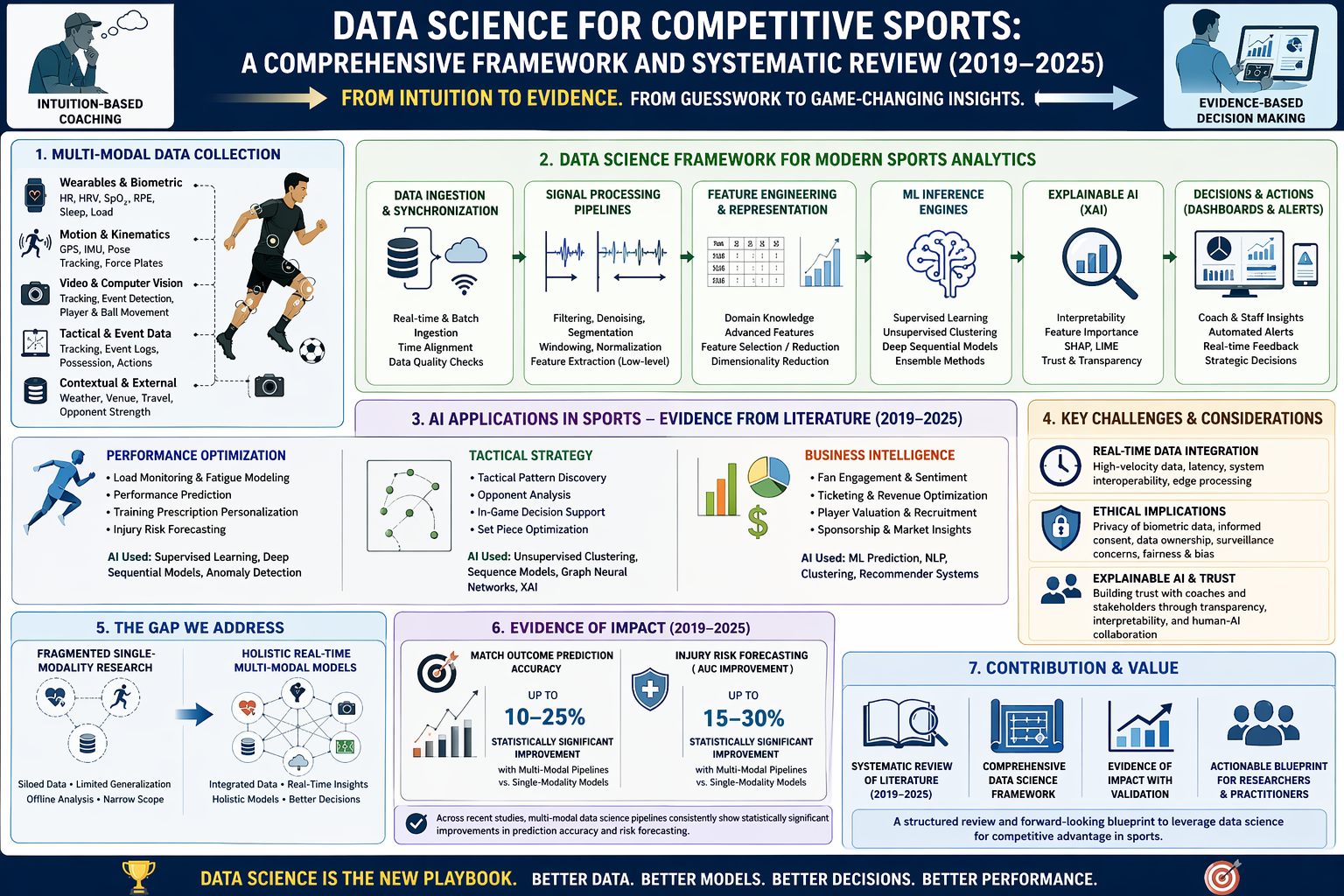
The use of Data Science and Competitive Sports represents a major paradigm shift from using intuition to coach to making decisions based on evidence. In this study, a comprehensive Data Science Framework for Modern Sports Analytics is developed. It combines the collection of multi-modal data, the construction of signal-processing pipelines, the generation of advanced features through feature engineering, and the application of Machine Learning (ML) inference engines. A systematic review of the Literature from 2019 to 2025 was conducted to examine how Artificial Intelligence (AI) sub-disciplines such as supervised learning, unsupervised clustering, deep sequential models, and Explainable AI (XAI) were used in the three primary areas of Performance Optimization, Tactical Strategy, and Business Intelligence. Additionally, the challenges of integrating real-time data into the Data Science pipeline, the Ethical Implications of Collecting Biometric Data of Athletes, and the Increasing Use of Explainable AI to Build Trust with Coaches and Stakeholders are discussed. The proposed Data Science Framework addresses the gap that exists between Fragmented Single-Modality Research and Holistic Real-Time Models of Performance. Indicators of experimental validation across recent studies have shown Statistically Significant Improvements in Match Outcome Prediction Accuracy and Injury Risk Forecasting when Multi-Modal Pipelines were employed. As both a Structured Review and a Forward-Looking Blueprint for Researchers and Practitioners looking to Leverage Data Science for Competitive Advantage in Sports, this Study will be a valuable resource.
Article Details
Section

This work is licensed under a Creative Commons Attribution-NonCommercial 4.0 International License.
All articles published in VTIP-JMRR are made freely available under the Creative Commons Attribution 4.0 International License (CC BY 4.0). Under this license, others may freely share, distribute, and adapt the published work, provided appropriate credit is given to the original authors.
By signing the copyright form, the author(s) warrant and represent that:
✓ The manuscript is original and has not been published previously in any journal, conference, or book (in whole or in part).
✓ The manuscript is not currently under consideration for publication elsewhere.
✓ All authors have read and approved the final manuscript and have agreed to this copyright transfer.
✓ The manuscript does not infringe upon any existing copyright, trademark, patent, or other intellectual property right of any third party.
✓ All data, figures, and tables presented are accurate, authentic, and have not been fabricated or falsified.
✓ Proper permissions have been obtained for any third-party material (images, figures, tables, text) included in the manuscript.
✓ The work complies with all applicable ethical guidelines, including those related to human and animal research.
✓ All sources of funding and conflicts of interest have been disclosed in the manuscript.
How to Cite
References
1. Chmait, N., & Westerbeek, H. (2021). Artificial intelligence and machine learning in sport research: An introduction for non-data scientists. Frontiers in Sports and Active Living, 3, 682287. https://doi.org/10.3389/fspor.2021.682287
2. Tribe AI. (2024). AI-driven sports analytics. Tribe AI Applied AI. https://www.tribe.ai/applied-ai/ai-driven sports-analytics.
3. Nakahara, H., Tsutsui, K., Takeda, K., & Fujii, K. (2023). Action valuation of on- and off-ball soccer players based on multi-agent deep reinforcement learning. IEEE Access, 11, 131237–131244.
4. Dindorf, C., Bartaguiz, E., Gassmann, F., & Fröhlich, M. (2023). Conceptual structure and current trends in artificial intelligence, machine learning, and deep learning research in sports: A bibliometric review.
International Journal of Environmental Research and Public Health, 20(1), 173.
5. Vec, V., Tomažič, S., Kos, A., et al. (2024). Trends in real-time artificial intelligence methods in sports: A systematic review. Journal of Big Data, 11, 148.
6. Fujii, K. (2024). Machine learning in sports. SpringerBriefs in Computer Science. Springer Nature.
7. Chmait, N., & Westerbeek, H. (2021). Artificial intelligence and machine learning in sport research
8. Çavuş, Ö., & Biecek, P. (2022). Explainable expected goal models in football: Enhancing transparency in AI based performance analysis. arXiv preprint arXiv:2206.07212.
9. Ferraz, A., Duarte-Mendes, P., Sarmento, H., Valente-Dos-Santos, J., & Travassos, B. (2023). Tracking devices and physical performance analysis in team sports. Frontiers in Sports and Active Living, 5, 1284086.
10. Jia, X., Chen, Z., Zhang, Y., & Liu, H. (2025). A narrative review of deep learning applications in sports performance analysis. BMC Sports Science, Medicine and Rehabilitation, 17, 249.
11. Gao, J., Cheng, Y., & Gao, J. (2025). Predicting sport event outcomes using deep learning. PeerJ Computer Science, 11, e3011.
12. Ghosh, I., Ramamurthy, S. R., Chakma, A., & Roy, N. (2023). Sports analytics review: AI applications, emerging technologies, and algorithmic perspective. WIREs Data Mining and Knowledge Discovery, 13(5), e1496.
13. Kranzinger, S., Halmich, C., Hofer, D., & Kranzinger, C. (2025). A scoping review of explainable artificial intelligence in sports science. Discover Artificial Intelligence, 6, 5.
14. Kim, J.-H., Kim, J., Kang, H., & Youn, B.-Y. (2025). Ethical implications of artificial intelligence in sport: A systematic scoping review. Journal of Sport and Health Science, 14, 101047.
15. Gerrish Legal. (2024, October 2). AI in sport: The effect on athlete privacy. https://www.gerrishlegal.com/blog/ai in-sport-the-effect-on-athlete-privacy
16. Wang, T. Y., Cui, J., & Fan, Y. (2023). A wearable-based sports health monitoring system using CNN and LSTM with self-attentions. PLOS ONE, 18(10), e0292012.
17. Liu, A., Mahapatra, R. P., & Mayuri, A. V. R. (2023). Hybrid design for sports data visualisation using AI and big data analytics. Complex & Intelligent Systems, 9, 2969–2980.
18. Hochreiter, S., & Schmidhuber, J. (1997). Long short-term memory. Neural Computation, 9(8), 1735–1780.
19. Musat, C. L., Mereuta, C., Nechita, A., et al. (2024). Diagnostic applications of AI in sports: A comprehensive review of injury risk prediction methods. Diagnostics, 14(22), 2516.
20. Hohl, B., Satizábal, H. F., & Perez-Uribe, A. (2024). Unveiling the potential of synthetic data in sports science.
21. In Artificial Neural Networks and Machine Learning – ICANN 2024, Lecture Notes in Computer Science, 15023, 183–195.
22. Zhao, L. (2023). A hybrid deep learning-based intelligent system for sports action recognition via visual knowledge discovery. IEEE Access, 11, 46541–46549.