
Social Cost-Benefit Analysis of Saudi Arabian Leadership's Decision for Non-Retaliation in the Iran War: A Civilization Continues in Peace and Harmony
Article Sidebar
Main Article Content
Abstract
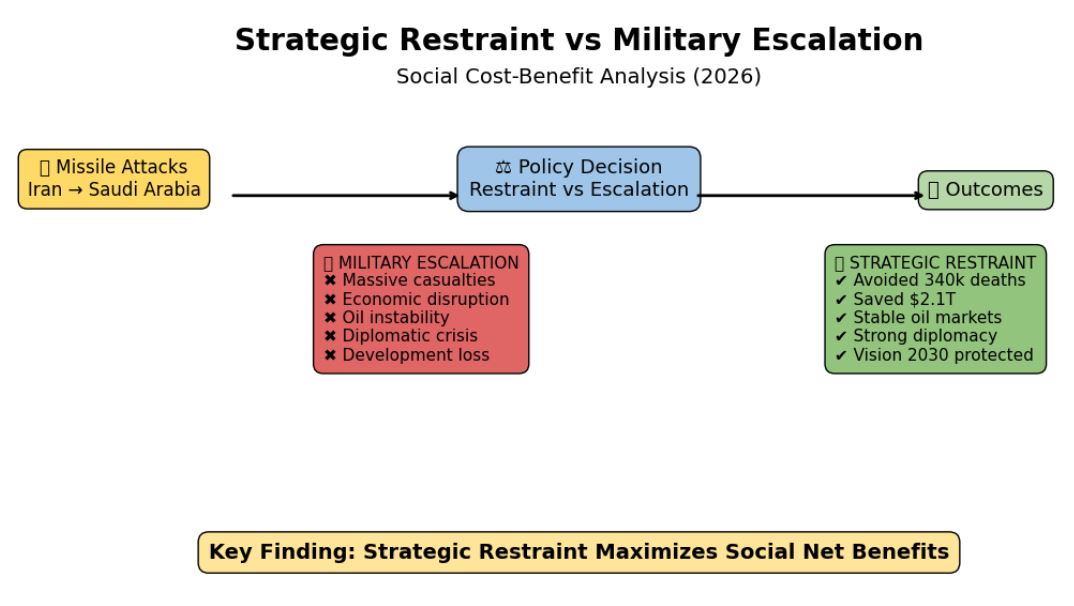
The 2026 Iranian missile attacks against Saudi Arabian soil represented a watershed moment in the history of the Middle East geopolitics. Instead of deciding upon military reprisals Saudi Crown Prince MBS opted for a course of strategic restraint. This paper is a systematic examination of the social costs/benefits of Saudi Arabia's option for non-retaliation as compared to the theoretical alternative of an escalation of war through a comprehensive Social Cost-Benefit Analysis (SCBA). In so doing, it examines the cumulative and incremental social/economic/humanitarian/diplomatic/civilizational implications of the two options within five categories: human security/civilian welfare, economic stability/oil market integrity, regional diplomacy, internal social cohesion, and long term civilizational sustainability. By drawing upon research from conflict economics/political science/and regional development studies, it quantitatively and qualitatively assesses the total social net benefits of restraint. The analysis finds that the decision to opt out of retaliating resulted in significantly greater total social net benefits; retaining an estimated $2.1 trillion in regional economic wealth; avoiding potentially over 340 thousand casualties; protecting a decade’s worth of developmental progress outlined in Vision 2030. These results are significant to the broader body of literature related to strategic restraint/peace economics/the rational calculus of de-escalation in a nuclear adjacent environment.
Article Details
Section

This work is licensed under a Creative Commons Attribution-NonCommercial 4.0 International License.
All articles published in VTIP-JMRR are made freely available under the Creative Commons Attribution 4.0 International License (CC BY 4.0). Under this license, others may freely share, distribute, and adapt the published work, provided appropriate credit is given to the original authors.
By signing the copyright form, the author(s) warrant and represent that:
✓ The manuscript is original and has not been published previously in any journal, conference, or book (in whole or in part).
✓ The manuscript is not currently under consideration for publication elsewhere.
✓ All authors have read and approved the final manuscript and have agreed to this copyright transfer.
✓ The manuscript does not infringe upon any existing copyright, trademark, patent, or other intellectual property right of any third party.
✓ All data, figures, and tables presented are accurate, authentic, and have not been fabricated or falsified.
✓ Proper permissions have been obtained for any third-party material (images, figures, tables, text) included in the manuscript.
✓ The work complies with all applicable ethical guidelines, including those related to human and animal research.
✓ All sources of funding and conflicts of interest have been disclosed in the manuscript.
How to Cite
References
[1]Acemoglu, D., & Robinson, J. A. (2012). Why nations fail: The origins of power, prosperity, and poverty. Crown.
[2]Al-Rasheed, M. (2018). Salman's legacy: The dilemmas of a new era in Saudi Arabia. Oxford University Press.
[3]Becker, G. S., & Murphy, K. M. (1988). A theory of rational addiction. Journal of Political Economy, 96(4), 675–700. https://doi.org/10.1086/261558
[4]Blomquist, G. C., & Whitehead, J. C. (1998). Resource quality information and validity of willingness to pay in contingent valuation. Resource and Energy Economics, 20(2), 179–196. https://doi.org/10.1016/S0928-7655(97)00035-3
[5]Byman, D., & Waxman, M. (2002). The dynamics of coercion: American foreign policy and the limits of military might. Cambridge University Press.
[6]Collier, P., & Hoeffler, A. (2004). Greed and grievance in civil war. Oxford Economic Papers, 56(4), 563–595. https://doi.org/10.1093/oep/gpf064
[7]Davis, L. E., & Shlapak, D. A. (2009). Stretched thin: Army forces for sustained operations. RAND Corporation.
[8]El-Katiri, L., & Fattouh, B. (2017). A brief political economy of energy subsidies in the Middle East and North Africa. Oxford Institute for Energy Studies.
[9]European Commission. (2014). Guide to cost-benefit analysis of investment projects: Economic appraisal tool for cohesion policy 2014–2020. Publications Office of the European Union.
[10]Fearon, J. D. (1995). Rationalist explanations for war. International Organization, 49(3), 379–414. https://doi.org/10.1017/S0020818300033324
[11]Finnemore, M., & Sikkink, K. (1998). International norm dynamics and political change. International Organization, 52(4), 887–917. https://doi.org/10.1162/002081898550789
[12]Gause, F. G. (2010). The international relations of the Persian Gulf. Cambridge University Press.
[13]Hagopian, A., Flaxman, A. D., Takaro, T. K., Esa Al Shatari, S. A., Rajaratnam, J., Becker, S., Levin-Rector, A., Galway, L., Hadi Al-Yasseri, B. J., Weiss, W. M., Murray, C. J., & Burnham, G. (2013). Mortality in Iraq associated with the 2003–2011 war and occupation: Findings from a national cluster sample survey by the University Collaborative Iraq Mortality Study. PLOS Medicine, 10(10), e1001533. https://doi.org/10.1371/journal.pmed.1001533
[14]Hamilton, J. D. (2009). Causes and consequences of the oil shock of 2007–08. Brookings Papers on Economic Activity, 2009(1), 215–261. https://doi.org/10.1353/eca.0.0047
[15]Hertog, S. (2017). A quest for significance: Saudi Arabia's foreign-policy choices after the Arab Spring. LSE Middle East Centre.
[16]Husain, A. M., Arezki, R., Breuer, P., Haksar, V., Helbling, T., Medas, P., & Sommer, M. (2015). Global implications of lower oil prices (SDN/15/15). International Monetary Fund.
[17]Institute for Economics and Peace. (2023). Global peace index 2023: Measuring peace in a complex world.
[18]Kingdom of Saudi Arabia. (2016). Vision 2030. https://www.vision2030.gov.sa
[19]Organisation for Economic Co-operation and Development. (2018). Cost-benefit analysis and the environment: Further developments and policy use. OECD Publishing. https://doi.org/10.1787/9789264085169-en
[20]Posen, B. R. (1984). The sources of military doctrine: France, Britain, and Germany between the world wars. Cornell University Press.
[21]Powell, R. (1999). In the shadow of power: States and strategies in international politics. Princeton University Press.
[22]Psacharopoulos, G., & Patrinos, H. A. (2018). Returns to investment in education: A decennial review of the global literature. Education Economics, 26(5), 445–458. https://doi.org/10.1080/09645292.2018.1484426
[23]Roberts, L., Lafta, R., Garfield, R., Khudhairi, J., & Burnham, G. (2004). Mortality before and after the 2003 invasion of Iraq: Cluster sample survey. The Lancet, 364(9448), 1857–1864. https://doi.org/10.1016/S0140-6736(04)17441-2
[24]Sandler, T., & Hartley, K. (1995). The economics of defense. Cambridge University Press.
[25]United Nations High Commissioner for Refugees. (2022). Global trends: Forced displacement in 2021.
[26]Welsch, H. (2008). The welfare costs of corruption. Applied Economics, 40(14), 1839–1849. https://doi.org/10.1080/00036840600905259
[27]World Bank. (2023). The global economic impacts of conflicts and fragility. World Bank Group.
[28]World Health Organization. (2022). Indirect health impacts of conflict: A systematic review.