
From Enquiry to Enrolment: A CRM-Based Funnel Analysis of Admission Conversion in a Private Engineering College in Pune, India
Article Sidebar
Main Article Content
Abstract
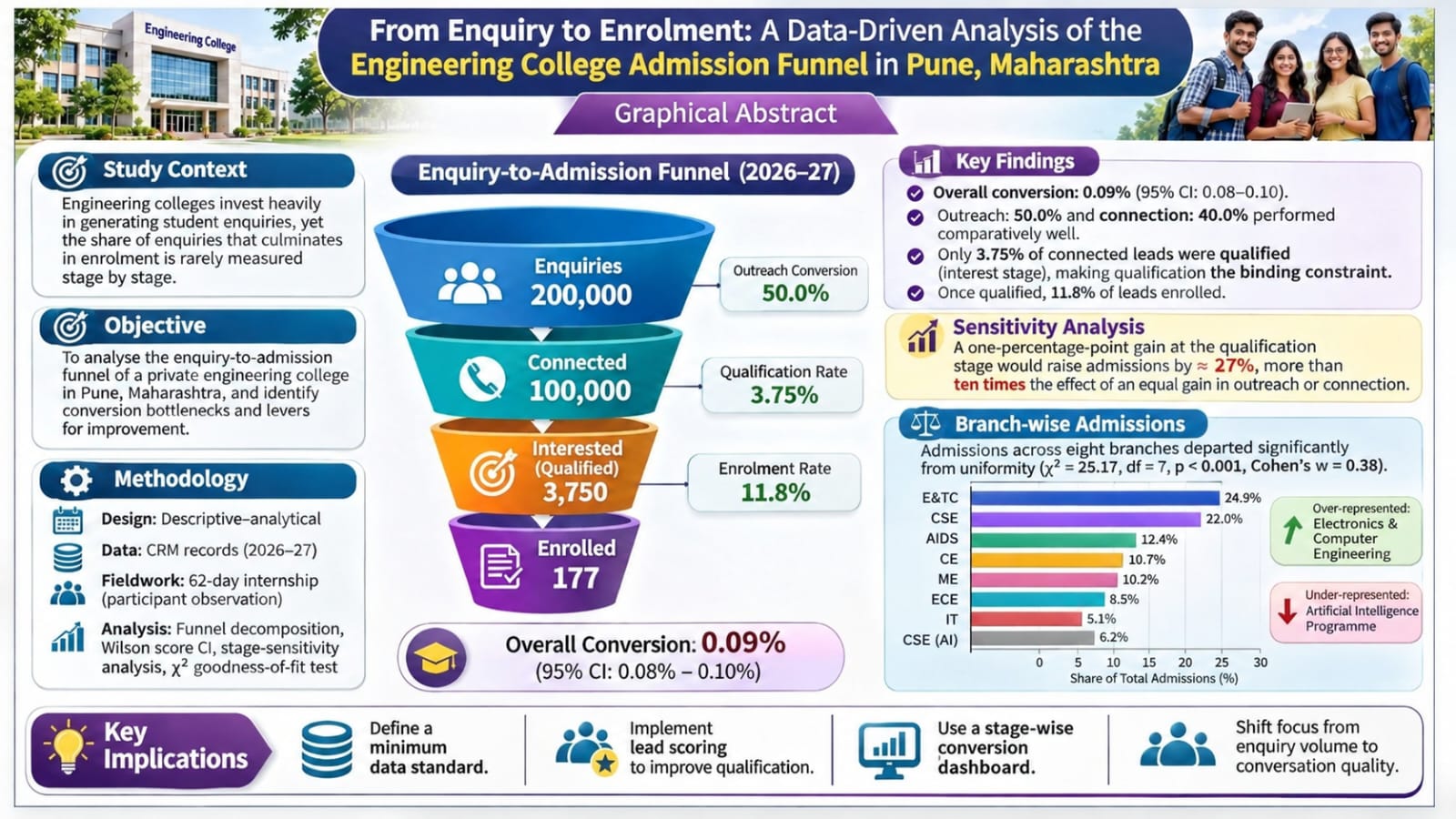
Engineering colleges invest heavily in generating student enquiries, yet the share of enquiries that culminates in enrolment is rarely measured stage by stage. This study examines the enquiry-to-admission funnel of a private engineering college in Pune, Maharashtra, using aggregate Customer Relationship Management records for the 2026–27 admission cycle, complemented by participant observation of lead-management operations during a 62-day internship. A descriptive–analytical design combines multiplicative funnel decomposition, Wilson score confidence intervals, a stage-sensitivity analysis and a chi-square goodness-of-fit test. Of 200,000 enquiries, 177 resulted in confirmed admissions, an overall conversion of 0.09 % (95 % confidence interval 0.08–0.10). Outreach (50.0 %) and tele-calling connection (40.0 %) performed comparatively well, whereas only 3.75 % of connected leads were qualified as interested, making qualification the binding constraint of the funnel. Once qualified, 11.8 % of leads enrolled. Sensitivity analysis shows that a one-percentage-point gain at the qualification stage would raise admissions by about 27 %, more than ten times the effect of an equal gain in outreach or connection. Admissions across eight branches departed significantly from uniformity (χ² = 25.17, df = 7, p < 0.001, Cohen’s w = 0.38), with electronics and computer science engineering over-represented and the specialised artificial-intelligence programme under-represented. The findings shift managerial attention from enquiry volume to conversation quality and support a minimum data standard, lead scoring and a stage-wise conversion dashboard for admissions teams.
Article Details
Section

This work is licensed under a Creative Commons Attribution-NonCommercial 4.0 International License.
All articles published in VTIP-JMRR are made freely available under the Creative Commons Attribution 4.0 International License (CC BY 4.0). Under this license, others may freely share, distribute, and adapt the published work, provided appropriate credit is given to the original authors.
By signing the copyright form, the author(s) warrant and represent that:
✓ The manuscript is original and has not been published previously in any journal, conference, or book (in whole or in part).
✓ The manuscript is not currently under consideration for publication elsewhere.
✓ All authors have read and approved the final manuscript and have agreed to this copyright transfer.
✓ The manuscript does not infringe upon any existing copyright, trademark, patent, or other intellectual property right of any third party.
✓ All data, figures, and tables presented are accurate, authentic, and have not been fabricated or falsified.
✓ Proper permissions have been obtained for any third-party material (images, figures, tables, text) included in the manuscript.
✓ The work complies with all applicable ethical guidelines, including those related to human and animal research.
✓ All sources of funding and conflicts of interest have been disclosed in the manuscript.
How to Cite
References
[1] Seeman, E. D., & O’Hara, M. (2006). Customer relationship management in higher education: Using information systems to improve the student–school relationship. Campus-Wide Information Systems, 23(1), 24–34. https://doi.org/10.1108/10650740610639714
[2] Payne, A., & Frow, P. (2005). A strategic framework for customer relationship management. Journal of Marketing, 69(4), 167–176. https://doi.org/10.1509/jmkg.2005.69.4.167
[3] Hossler, D., & Gallagher, K. S. (1987). Studying student college choice: A three-phase model and the implications for policymakers. College and University, 62(3), 207–221.
[4] Chapman, D. W. (1981). A model of student college choice. The Journal of Higher Education, 52(5), 490–505. https://doi.org/10.1080/00221546.1981.11778120
[5] Hemsley-Brown, J., & Oplatka, I. (2015). University choice: What do we know, what don’t we know and what do we still need to find out? International Journal of Educational Management, 29(3), 254–274. https://doi.org/10.1108/IJEM-10-2013-0150
[6] Amrutha, S., Arumugam, J., & Radha, L. (2026). The role of digital marketing in shaping student enrollment decision: Insights from engineering colleges in India. Shanlax International Journal of Arts, Science and Humanities, 13(4), 1–9. https://doi.org/10.34293/sijash.v13i4.10169
[7] Tran, H. A., Evanschitzky, H., Ludwig, S., Nguyen, B., Grewal, D., Farrell, A. M., & Ackfeldt, A. L. (2026). How universities can use social media for student acquisition. Journal of the Academy of Marketing Science, 54(2), 539–556. https://doi.org/10.1007/s11747-025-01131-3
[8] Cingillioglu, I., Gal, U., & Prokhorov, A. (2024). Social media marketing for student recruitment: An algorithmically sequenced literature review. Journal of Marketing for Higher Education, 34(2), 1101–1123. https://doi.org/10.1080/08841241.2023.2177789
[9] Ab Ghani, N. L., Che Cob, Z., Mohd Drus, S., & Sulaiman, H. (2019). Student enrolment prediction model in higher education institution: A data mining approach. In Proceedings of the 3rd International Symposium of Information and Internet Technology (SYMINTECH 2018) (pp. 43–52). Springer. https://doi.org/10.1007/978-3-030-20717-5_6
[10] Kotler, P., & Fox, K. F. A. (1995). Strategic marketing for educational institutions (2nd ed.). Prentice Hall.
[11] Cohen, J. (1988). Statistical power analysis for the behavioral sciences (2nd ed.). Lawrence Erlbaum Associates.
[12] Wilson, E. B. (1927). Probable inference, the law of succession, and statistical inference. Journal of the American Statistical Association, 22(158), 209–212. https://doi.org/10.1080/01621459.1927.10502953
[13] Nutan Maharashtra Institute of Engineering and Technology. (2026). Admission and CRM lead records for the 2026–27 admission cycle [Unpublished institutional data]. NMIET, Talegaon Dabhade, Pune.
[14] Rahane Sanchita Shekhar 1 , Dr. Meenakshi Shrivastava 2 1, 2 Department of Management, Mansarovar Global University, Sehore, M.P., India Digital Marketing Practices and Their Impact on E-Commerce Start-Up Performance DOI: https://doi.org/10.31426/ijamsr.2025.8.12.8965