
Hard Turning and CNC Parameter Optimization: A Review of Cutting Force, Surface Roughness, Tool Wear, and Taguchi/RSM Approaches
Article Sidebar
Main Article Content
Abstract
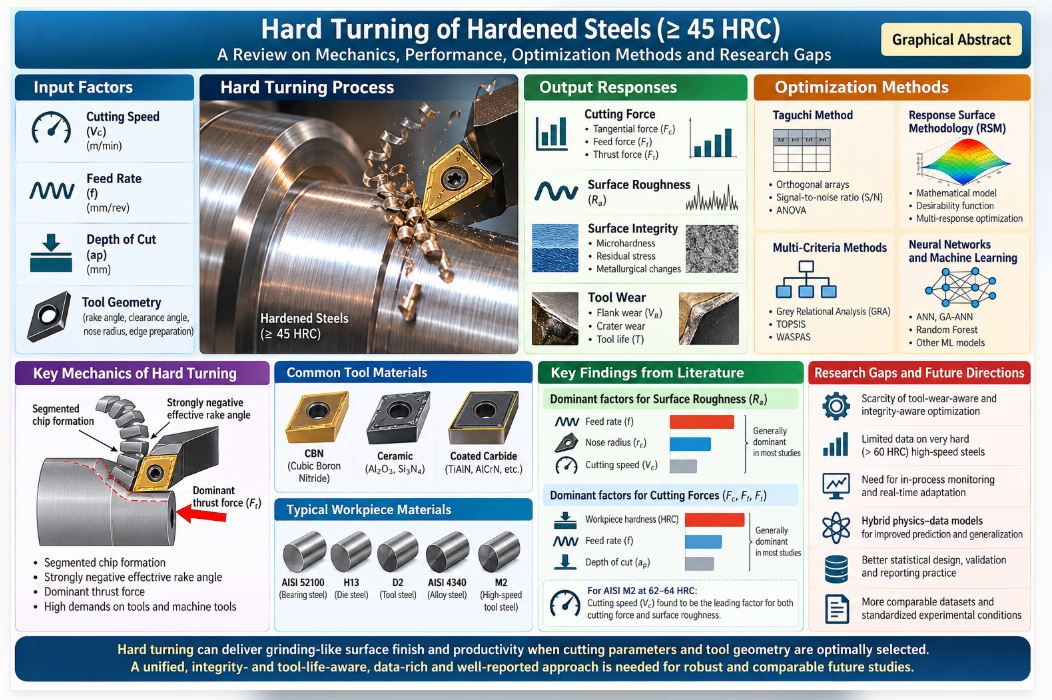
Hard turning, the single-point turning of steels hardened above about 45 HRC, is now an established alternative to grinding for finishing precision parts. Its success depends on selecting cutting speed, feed rate, depth of cut and tool geometry that balance cutting force, surface finish, surface integrity and tool life. This review first outlines the mechanics that set hard turning apart from conventional turning, namely segmented chip formation, a strongly negative effective rake and a dominant thrust force, and the demands these place on tools and machines. It then surveys experimental and statistical work on cutting force, surface roughness and integrity, and tool wear, with emphasis on CBN, ceramic and coated-carbide tools cutting bearing, die, alloy and high-speed tool steels (AISI 52100, H13, D2, 4340 and M2). The optimization methods most used in this field are compared in terms of their assumptions, data needs and limitations: Taguchi designs with signal-to-noise ratios and ANOVA, response surface methodology (RSM) with desirability functions, multi-criteria methods such as grey relational analysis, TOPSIS and WASPAS, and neural-network and other machine-learning models. Across the literature, feed rate and nose radius usually dominate surface roughness, while workpiece hardness, feed and depth of cut dominate forces; however, reported rankings vary with tool, material and the tested parameter window, and for AISI M2 at 62–64 HRC cutting speed has been found to lead for both force and roughness. A synthesis section explains why such rankings conflict and how studies can be made more comparable. The review closes with research gaps, including the scarcity of tool-wear-aware and integrity-aware optimization, limited data on very hard (above 60 HRC) high-speed steels, the need for in-process monitoring and hybrid physics–data models, and better statistical and reporting practice.
Article Details
Section

This work is licensed under a Creative Commons Attribution-NonCommercial 4.0 International License.
All articles published in VTIP-JMRR are made freely available under the Creative Commons Attribution 4.0 International License (CC BY 4.0). Under this license, others may freely share, distribute, and adapt the published work, provided appropriate credit is given to the original authors.
By signing the copyright form, the author(s) warrant and represent that:
✓ The manuscript is original and has not been published previously in any journal, conference, or book (in whole or in part).
✓ The manuscript is not currently under consideration for publication elsewhere.
✓ All authors have read and approved the final manuscript and have agreed to this copyright transfer.
✓ The manuscript does not infringe upon any existing copyright, trademark, patent, or other intellectual property right of any third party.
✓ All data, figures, and tables presented are accurate, authentic, and have not been fabricated or falsified.
✓ Proper permissions have been obtained for any third-party material (images, figures, tables, text) included in the manuscript.
✓ The work complies with all applicable ethical guidelines, including those related to human and animal research.
✓ All sources of funding and conflicts of interest have been disclosed in the manuscript.
How to Cite
References
[1] Tönshoff, H. K., Arendt, C., & Ben Amor, R. (2000). Cutting of hardened steel. CIRP Annals, 49(2), 547–566.
[2] Bartarya, G., & Choudhury, S. K. (2012). State of the art in hard turning. International Journal of Machine Tools and Manufacture, 53(1), 1–14. https://doi.org/10.1016/j.ijmachtools.2011.08.019
[3] Chinchanikar, S., & Choudhury, S. K. (2015). Machining of hardened steel — experimental investigations, performance modeling and cooling techniques: a review. International Journal of Machine Tools and Manufacture, 89, 95–109.
[4] Pawar, K., Selokar, G. R., & Deshmukh, A. (2017). Turning of hard material (62–64 HRC): research overview. National Conference MOMENTUM-17, International Journal of Research in Advent Technology (IJRAT) Special Issue, 1–11.
[5] Pawar, K. (2016). Optimization of parameters in CNC turning operation: a review. International Journal of Advance Research and Innovative Ideas in Education (IJARIIE).
[6] Pawar, K. (2017). Optimization of resultant cutting force in CNC turning process for hard (62–64 HRC) AISI M2. International Journal for Research in Applied Science and Engineering Technology (IJRASET).
[7] Pawar, K., Selokar, G. R., & Deshmukh, A. (2017). Analysis and optimization of CNC turning process parameters for hard (62–64 HRC) AISI M2 to minimize surface roughness. IJRASET.
[8] Pawar, K., Selokar, G. R., & Deshmukh, A. (2017). Experimental investigation to minimize resultant vibration signal in CNC turning operation of hard AISI M2 tool steel. IJRASET.
[9] Pawar, K. (2022). Parametric optimization of turning process for hard HSS M2 material to minimize resultant tool vibration. Research Square (preprint).
[10] Pawar, K., & Palhade, R. D. (2015). Multi-objective optimization of CNC turning process parameters for high speed steel (M2) using Taguchi and ANOVA method. International Journal of Hybrid Information Technology, 8(4), 67–80.
[11] Kumar, P., Chauhan, S. R., Pruncu, C. I., Gupta, M. K., Pimenov, D. Y., Mia, M., & Gill, H. S. (2019). Influence of different grades of CBN inserts on cutting force and surface roughness of AISI H13 die tool steel during hard turning operation. Materials, 12(1), 177. https://doi.org/10.3390/ma12010177
[12] Bouacha, K., Yallese, M. A., Mabrouki, T., & Rigal, J.-F. (2010). Statistical analysis of surface roughness and cutting forces using response surface methodology in hard turning of AISI 52100 bearing steel with CBN tool. International Journal of Refractory Metals and Hard Materials, 28(3), 349–361.
[13] Aouici, H., Yallese, M. A., Chaoui, K., Mabrouki, T., & Rigal, J.-F. (2012). Analysis of surface roughness and cutting force components in hard turning with CBN tool: prediction model and cutting conditions optimization. Measurement, 45(3), 344–353.
[14] Özel, T., Hsu, T.-K., & Zeren, E. (2005). Effects of cutting edge geometry, workpiece hardness, feed rate and cutting speed on surface roughness and forces in finish turning of hardened AISI H13 steel. International Journal of Advanced Manufacturing Technology, 25, 262–269.
[15] Poulachon, G., Moisan, A., & Jawahir, I. S. (2001). Tool-wear mechanisms in hard turning with polycrystalline cubic boron nitride tools. Wear, 250, 576–586.
[16] Özel, T., & Karpat, Y. (2005). Predictive modeling of surface roughness and tool wear in hard turning using regression and neural networks. International Journal of Machine Tools and Manufacture, 45(4), 467–479.
[17] Yang, W. H., & Tarng, Y. S. (1998). Design optimization of cutting parameters for turning operations based on the Taguchi method. Journal of Materials Processing Technology, 84, 122–129.
[18] Varadarajan, A. S., Philip, P. K., & Ramamoorthy, B. (2002). Investigations on hard turning with minimal cutting fluid application (HTMF) and its comparison with dry and wet turning. International Journal of Machine Tools and Manufacture, 42(2), 193–200.
[19] Khatai, S., Kumar, R., Panda, A., & Sahoo, A. K. (2023). WASPAS based multi response optimization in hard turning of AISI 52100 steel under ZnO nanofluid assisted dual nozzle pulse-MQL environment. Applied Sciences, 13(18), 10062. https://doi.org/10.3390/app131810062
[20] Umamaheswarrao, P., Rangaraju, D., Suman, K. N. S., & Ravisankar, B. (2021). Application of TOPSIS for multi response optimization of process parameters in dry hard turning of AISI 52100 steel. INCAS Bulletin, 13(1), 211–224. https://doi.org/10.13111/2066-8201.2021.13.1.22
[21] Tamizharasan, T., Selvaraj, T., & Haq, A. N. (2006). Analysis of tool wear and surface finish in hard turning. International Journal of Advanced Manufacturing Technology, 28(7–8), 671–679.
[22] More, A. S., Jiang, W., Brown, W. D., & Malshe, A. P. (2006). Tool wear and machining performance of cBN–TiN coated carbide inserts and PCBN compact inserts in turning AISI 4340 hardened steel. Journal of Materials Processing Technology, 180(1–3), 253–262.
[23] Hingole, R., Narasimha, K. R., & Pawar, K. (2026). Development of an AI-ML-based expert system for extrusion-based manufacturing processes: a comprehensive framework for process optimization, defect detection, and real-time control. VT International Press Journal of Multidisciplinary Research and Review, 1(1).
[24] Pawar, K. P., & Mokshanatha, P. B. (2025). Turning of AISI M2 tool steel using Taguchi technique. Journal of Information Systems Engineering and Management, 10(23s).
[25] Pawar, K. (2015). Optimization and analysis of surface roughness in CNC turning Inconel 718 using Taguchi’s and ANOVA analysis. Munich: GRIN Verlag. ISBN 9783668155268.
[26] Pawar, K. (2015). Comparative performance analysis of insert geometry by CNC turning of HSS (M2) and Taguchi method. First International Conference on Advent Trends in Engineering, Science and Technology.
[27] König, W., Berktold, A., & Koch, K.-F. (1993). Turning versus grinding – a comparison of surface integrity aspects and attainable accuracies. CIRP Annals, 42(1), 39–43.
[28] Davim, J. P. (Ed.). (2011). Machining of hard materials. London: Springer.
[29] Byrne, G., Dornfeld, D., & Denkena, B. (2003). Advancing cutting technology. CIRP Annals, 52(2), 483–507.
[30] Klocke, F. (2011). Manufacturing processes 1: Cutting. Berlin: Springer.
[31] Shaw, M. C. (2005). Metal cutting principles (2nd ed.). New York: Oxford University Press.
[32] Grzesik, W. (2008). Advanced machining processes of metallic materials: theory, modelling and applications. Amsterdam: Elsevier.
[33] Merchant, M. E. (1945). Mechanics of the metal cutting process. I. Orthogonal cutting and a type 2 chip. Journal of Applied Physics, 16(5), 267–275.
[34] Matsumoto, Y., Barash, M. M., & Liu, C. R. (1986). Effect of hardness on the surface integrity of AISI 4340 steel. Journal of Engineering for Industry, 108(3), 169–175.
[35] Huang, Y., Chou, Y. K., & Liang, S. Y. (2007). CBN tool wear in hard turning: a survey on research progresses. International Journal of Advanced Manufacturing Technology, 35(5–6), 443–453.
[36] Aslan, E., Camuşcu, N., & Birgören, B. (2007). Design optimization of cutting parameters when turning hardened AISI 4140 steel (63 HRC) with Al2O3 + TiCN mixed ceramic tool. Materials & Design, 28(5), 1618–1622.
[37] Davim, J. P., & Figueira, L. (2007). Machinability evaluation in hard turning of cold work tool steel (D2) with ceramic tools using statistical techniques. Materials & Design, 28(4), 1186–1191.
[38] Suresh, R., Basavarajappa, S., Gaitonde, V. N., & Samuel, G. L. (2012). Machinability investigations on hardened AISI 4340 steel using coated carbide insert. International Journal of Refractory Metals and Hard Materials, 33, 75–86.
[39] Özel, T. (2003). Modeling of hard part machining: effect of insert edge preparation in CBN cutting tools. Journal of Materials Processing Technology, 141(2), 284–293.
[40] Thiele, J. D., & Melkote, S. N. (1999). Effect of cutting edge geometry and workpiece hardness on surface generation in the finish hard turning of AISI 52100 steel. Journal of Materials Processing Technology, 94(2–3), 216–226.
[41] Grzesik, W., & Wanat, T. (2006). Surface finish generated in hard turning of quenched alloy steel parts using conventional and wiper ceramic inserts. International Journal of Machine Tools and Manufacture, 46(3–4), 334–342.
[42] Gaitonde, V. N., Karnik, S. R., Figueira, L., & Davim, J. P. (2009). Machinability investigations in hard turning of AISI D2 cold work tool steel with conventional and wiper ceramic inserts. International Journal of Refractory Metals and Hard Materials, 27(4), 754–763.
[43] Lalwani, D. I., Mehta, N. K., & Jain, P. K. (2008). Experimental investigations of cutting parameters influence on cutting forces and surface roughness in finish hard turning of MDN250 steel. Journal of Materials Processing Technology, 206(1–3), 167–179.
[44] Sharma, V. S., Dhiman, S., Sehgal, R., & Sharma, S. K. (2008). Estimation of cutting forces and surface roughness for hard turning using neural networks. Journal of Intelligent Manufacturing, 19(4), 473–483.
[45] Kishawy, H. A., & Elbestawi, M. A. (1999). Effects of process parameters on material side flow during hard turning. International Journal of Machine Tools and Manufacture, 39(7), 1017–1030.
[46] Benardos, P. G., & Vosniakos, G.-C. (2003). Predicting surface roughness in machining: a review. International Journal of Machine Tools and Manufacture, 43(8), 833–844.
[47] Jawahir, I. S., Brinksmeier, E., M’Saoubi, R., Aspinwall, D. K., Outeiro, J. C., Meyer, D., Umbrello, D., & Jayal, A. D. (2011). Surface integrity in material removal processes: recent advances. CIRP Annals, 60(2), 603–626.
[48] Chou, Y. K., & Evans, C. J. (1999). White layers and thermal modeling of hard turned surfaces. International Journal of Machine Tools and Manufacture, 39(12), 1863–1881.
[49] Mia, M., & Dhar, N. R. (2016). Prediction of surface roughness in hard turning under high pressure coolant using artificial neural network. Measurement, 92, 464–474.
[50] Sharma, V. S., Dogra, M., & Suri, N. M. (2009). Cooling techniques for improved productivity in turning. International Journal of Machine Tools and Manufacture, 49(6), 435–453.
[51] Barry, J., & Byrne, G. (2001). Cutting tool wear in the machining of hardened steels. Part II: cubic boron nitride cutting tool wear. Wear, 247(2), 152–160.
[52] International Organization for Standardization. (1993). ISO 3685:1993 Tool-life testing with single-point turning tools. Geneva: ISO.
[53] Taylor, F. W. (1907). On the art of cutting metals. Transactions of the American Society of Mechanical Engineers, 28, 31–350.
[54] Dimla, D. E. (2000). Sensor signals for tool-wear monitoring in metal cutting operations – a review of methods. International Journal of Machine Tools and Manufacture, 40(8), 1073–1098.
[55] Teti, R., Jemielniak, K., O’Donnell, G., & Dornfeld, D. (2010). Advanced monitoring of machining operations. CIRP Annals, 59(2), 717–739.
[56] Ross, P. J. (1996). Taguchi techniques for quality engineering (2nd ed.). New York: McGraw-Hill.
[57] Box, G. E. P., & Wilson, K. B. (1951). On the experimental attainment of optimum conditions. Journal of the Royal Statistical Society: Series B, 13(1), 1–45.
[58] Montgomery, D. C. (2017). Design and analysis of experiments (9th ed.). Hoboken, NJ: Wiley.
[59] Derringer, G., & Suich, R. (1980). Simultaneous optimization of several response variables. Journal of Quality Technology, 12(4), 214–219.
[60] Deng, J. L. (1989). Introduction to grey system theory. Journal of Grey System, 1(1), 1–24.
[61] Hwang, C. L., & Yoon, K. (1981). Multiple attribute decision making: methods and applications. Berlin: Springer.
[62] Zavadskas, E. K., Turskis, Z., Antucheviciene, J., & Zakarevicius, A. (2012). Optimization of weighted aggregated sum product assessment. Elektronika ir Elektrotechnika, 122(6), 3–6.