
Suvarna Shalaka Agnikarma in the Management of Avabahuka (Frozen Shoulder): A Case Report
Article Sidebar
Main Article Content
Abstract
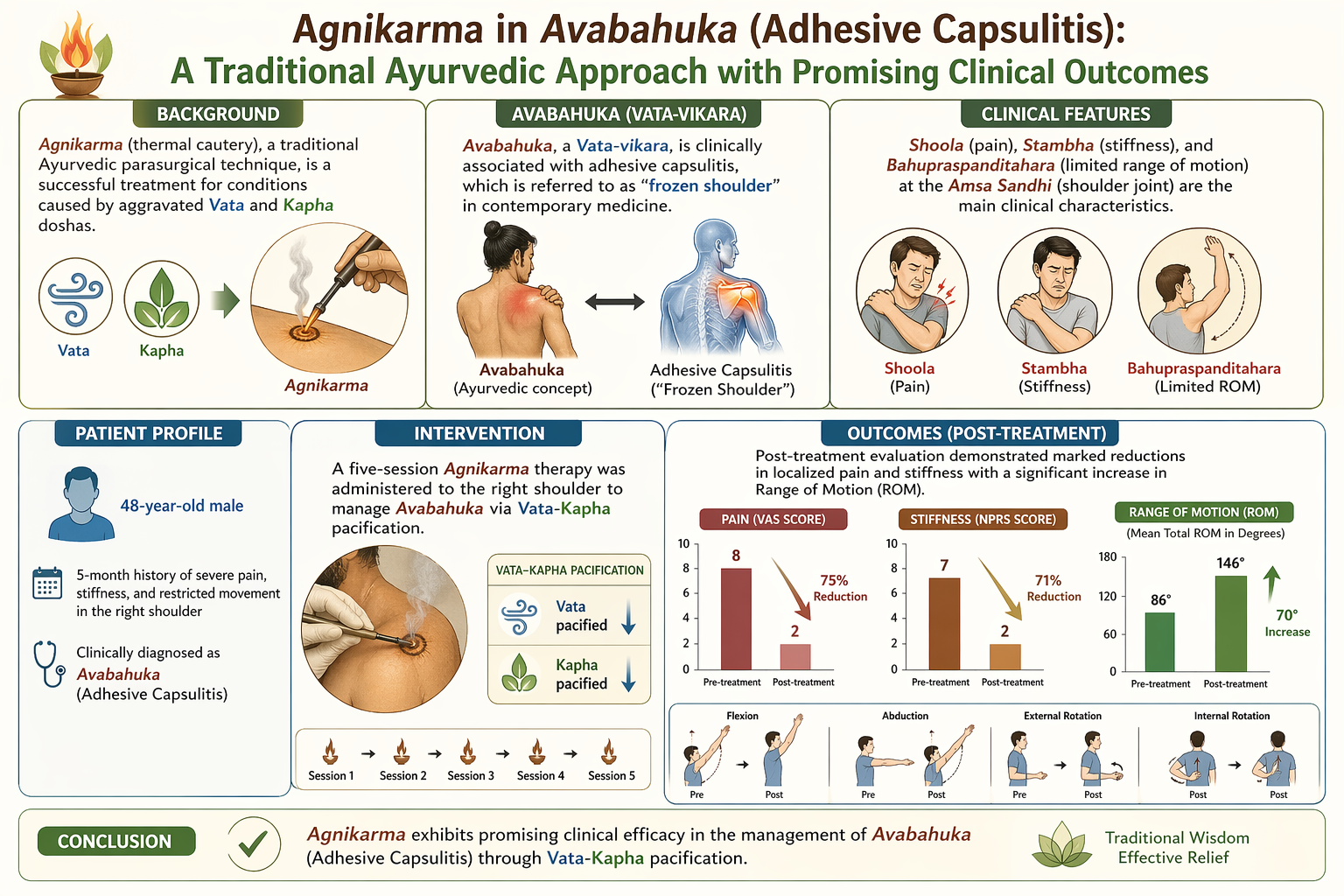
Agnikarma (thermal cautery), a traditional Ayurvedic parasurgical technique, is a successful treatment for conditions caused by aggravated Vata and Kapha doshas. Avabahuka, a Vata-vikara, is clinically associated with adhesive capsulitis, which is referred to as "frozen shoulder" in contemporary medicine. Shoola (pain), Stambha (stiffness), and Bahupraspanditahara (limited range of motion) at the Amsa Sandhi (shoulder joint) are its main clinical characteristics. Despite the existence of various conventional treatments, Agnikarma offers a unique and targeted therapeutic approach. A 48-year-old male presented with a 5-month history of severe pain, stiffness, and restricted movement in his right shoulder, clinically diagnosed as Avabahuka (adhesive capsulitis). A five-session Agnikarma therapy was administered to the right shoulder to manage Avabahuka via Vata-Kapha pacification. Post-treatment evaluation demonstrated marked reductions in localized pain and stiffness with a significant increase in Range of Motion (ROM). Agnikarma exhibits promising clinical efficacy in the management of Avabahuka.
Article Details
Section

This work is licensed under a Creative Commons Attribution-NonCommercial 4.0 International License.
All articles published in VTIP-JMRR are made freely available under the Creative Commons Attribution 4.0 International License (CC BY 4.0). Under this license, others may freely share, distribute, and adapt the published work, provided appropriate credit is given to the original authors.
By signing the copyright form, the author(s) warrant and represent that:
✓ The manuscript is original and has not been published previously in any journal, conference, or book (in whole or in part).
✓ The manuscript is not currently under consideration for publication elsewhere.
✓ All authors have read and approved the final manuscript and have agreed to this copyright transfer.
✓ The manuscript does not infringe upon any existing copyright, trademark, patent, or other intellectual property right of any third party.
✓ All data, figures, and tables presented are accurate, authentic, and have not been fabricated or falsified.
✓ Proper permissions have been obtained for any third-party material (images, figures, tables, text) included in the manuscript.
✓ The work complies with all applicable ethical guidelines, including those related to human and animal research.
✓ All sources of funding and conflicts of interest have been disclosed in the manuscript.
How to Cite
References
1. Kahi, A. (2024, June 16). Role of Agnikarma in pain management. Journal of Ayurveda and Integrated Medical Sciences, 9(4), 231–235. https://doi.org/10.21760/jaims.9.4.37
2. CCRAS, NIIMH. (2010). e-Samhita-Sushruta. National Institute of Indian Medical Heritage. https://niimh.nic.in/ebooks/esushruta/?mod=read
3. Acharya, Y. T. (Ed.). (1941). The Charakasamhita by Agnivesha with Ayurveda Dipika commentary by Chakrapanidatta (3rd ed., pp. 31–35). Nirnaya Sagar Press.
4. Vagbhata. (2015). Ashtang Hridaya (Pt. Hari Sadashiva Shastri Paradkar, Ed., p. 235). Chaukhamba Sanskrit Sansthan.
5. Arakeri, S. J., Vismaya, M., Kadegaon, M., & Hallad, A. (2023). Pain management in Avabahuka with Viddhagnikarma – A single case study. IJNRD. www.ijnrd.org
6. Das, B., Ganesh, R., Mishra, P., & Bhuyan, G. C. (2010). A study on Apabahuka (frozen shoulder) and its management by Laghumasha Taila Nasya. Ayu, 31, 488–494. https://doi.org/10.4103/0974-8520.82048
7. Agnikarma in the management of Avabahuka (frozen shoulder) – A case report. (2025, July 1). International Journal of Biological & Pharmaceutical Allied Sciences, 14(7). https://doi.org/10.31032/ijbpas/2025/14.7.9170
8. Zuckerman, J., & Rokito, A. (2010). Frozen shoulder: A consensus definition. Journal of Shoulder and Elbow Surgery, 20, 322–325. https://doi.org/10.1016/j.jse.2010.07.008
9. Cho, C. H., Bae, K. C., & Kim, D. H. (2019). Treatment strategy for frozen shoulder. Clinics in Orthopaedic Surgery, 11, 249. https://doi.org/10.4055/cios.2019.11.3.249
10. Kumar, M., Jaiswal, R., & Panigrahi, H. (n.d.). Role of Agnikarma in management of Avabahuka: A case report. International Journal of AYUSH Case Reports, 6(4), 364. www.ijacare.in
11. Kumar, M., Singh, R. K., & Jaiswal, R. (2022, July 9). Agnikarma intervention for Avabahuka (frozen shoulder): A systematic review. International Journal of Life Sciences & Pharma Research. https://doi.org/10.22376/ijpbs/lpr.2022.12.6.l1-8
12. Bhalara, B., & Dudhamal, T. (2025). Ayurvedic management of Avabahuka (frozen shoulder) – A systemic review. Asian Pacific Journal of Health Sciences. https://doi.org/10.21276/apjhs.2025.12.4.05
13. Vasava, D. B., & Raushan, R. (2025, August 10). Case study of conductive Agnikarma with Suvarna Shalaka in management of tennis elbow. Journal of Ayurveda and Integrated Medical Sciences, 10(7), 371–375. https://doi.org/10.21760/jaims.10.7.58
14. Yogiraj, M. R., & Ebnezar, J. (2021, December 30). Role of Nasya Karma (nasal instillation therapy) in Apabahuka (frozen shoulder) – A qualitative systematic review. Journal of Ayurvedic and Herbal Medicine, 7(4), 281–288. https://doi.org/10.31254/jahm.2021.7412
15. Sheth, V. (2025, January 20). Management of Apabahuka (frozen shoulder) by Ayurvedic treatment: A single case study. African Journal of Biomedical Research, 971–976. https://doi.org/10.53555/ajbr.v28i1s.6298
16. Swami, K., Sharma, K., Kumar, S., & Suresh, P. (2026, January 9). Rasnasaptaka Kwatha: An overview. International Ayurvedic Medical Journal. https://doi.org/10.46607/iamj.4409012021