
Digital Marketing Strategy Alignment and AI Adoption: Insights from Indian Organizations
Article Sidebar
Main Article Content
Abstract
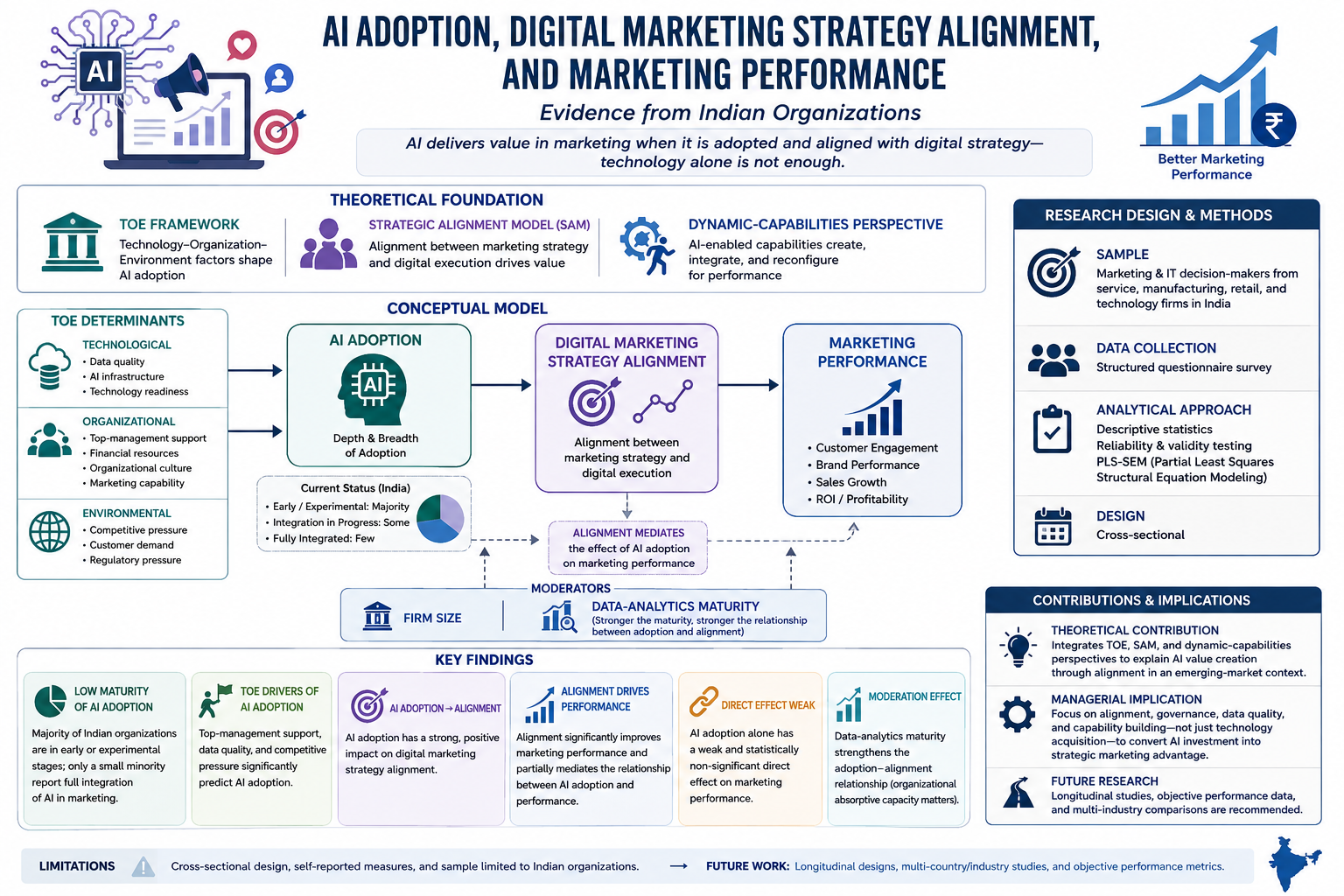
Artificial Intelligence (AI) is rapidly reshaping the practice of digital marketing, yet many organizations continue to deploy AI tools without embedding them within a coherent marketing strategy. This paper investigates the relationship between AI adoption and digital marketing strategy alignment, and the consequences of that alignment for marketing performance, using survey evidence from Indian organizations. Grounded in the Technology–Organization–Environment (TOE) framework, the Strategic Alignment Model (SAM), and the dynamic-capabilities perspective, the study develops a conceptual model in which technological, organizational, and environmental determinants drive the depth and breadth of AI adoption; AI adoption in turn shapes the degree of alignment between marketing strategy and digital execution; and alignment mediates the effect of adoption on marketing performance. Firm size and data-analytics maturity are examined as moderators. Data were collected through a structured questionnaire administered to marketing and information-technology decision-makers across service, manufacturing, retail, and technology firms operating in India, and analyzed using descriptive statistics, reliability and validity testing, and partial least squares structural equation modeling (PLS-SEM). The findings indicate that a large share of Indian organizations remain in early, experimental stages of AI adoption, with only a small minority reporting full integration of AI into marketing operations. TOE determinants particularly top-management support, data quality, and competitive pressure significantly predict AI adoption. AI adoption exerts a strong, positive effect on digital marketing strategy alignment, and alignment is a significant driver of marketing performance and a partial mediator between adoption and performance. The direct effect of AI adoption on performance, absent alignment, is weak and statistically non-significant, suggesting that technology deployment alone does not deliver returns. Data-analytics maturity strengthens the adoption–alignment relationship, indicating that organizational absorptive capacity conditions the value realized from AI. The study contributes an integrated, alignment-centred account of AI value creation in an emerging-market context and offers practical guidance for managers seeking to convert AI investment into strategic marketing advantage. Limitations relating to cross-sectional design and self-reported measures are noted, and directions for longitudinal and multi-industry research are proposed.
Article Details
Section

This work is licensed under a Creative Commons Attribution-NonCommercial 4.0 International License.
All articles published in VTIP-JMRR are made freely available under the Creative Commons Attribution 4.0 International License (CC BY 4.0). Under this license, others may freely share, distribute, and adapt the published work, provided appropriate credit is given to the original authors.
By signing the copyright form, the author(s) warrant and represent that:
✓ The manuscript is original and has not been published previously in any journal, conference, or book (in whole or in part).
✓ The manuscript is not currently under consideration for publication elsewhere.
✓ All authors have read and approved the final manuscript and have agreed to this copyright transfer.
✓ The manuscript does not infringe upon any existing copyright, trademark, patent, or other intellectual property right of any third party.
✓ All data, figures, and tables presented are accurate, authentic, and have not been fabricated or falsified.
✓ Proper permissions have been obtained for any third-party material (images, figures, tables, text) included in the manuscript.
✓ The work complies with all applicable ethical guidelines, including those related to human and animal research.
✓ All sources of funding and conflicts of interest have been disclosed in the manuscript.
How to Cite
References
[1]. Chatterjee, S., Chaudhuri, R., Vrontis, D., & Thrassou, A. (2021). Adoption of artificial intelligence-integrated CRM systems in agile organizations in India. Technological Forecasting and Social Change, 168, Article 120783. https://doi.org/10.1016/j.techfore.2021.120783
[2]. Coleman, R., & Papp, R. (2006). Strategic alignment: Analysis of perspectives. Proceedings of the Southern Association for Information Systems Conference.
[3]. Davenport, T. H., Guha, A., Grewal, D., & Bressgott, T. (2020). How artificial intelligence will change the future of marketing. Journal of the Academy of Marketing Science, 48, 24–42. https://doi.org/10.1007/s11747-019-00696-0
[4]. Du, H., & Xie, C. (2021). Paradoxes of artificial intelligence in consumer markets: Ethical challenges and opportunities. Journal of Business Research, 129, 961–974. https://doi.org/10.1016/j.jbusres.2020.08.024
[5]. Fornell, C., & Larcker, D. F. (1981). Evaluating structural equation models with unobservable variables and measurement error. Journal of Marketing Research, 18(1), 39–50.
[6]. Henderson, J. C., & Venkatraman, N. (1993). Strategic alignment: Leveraging information technology for transforming organizations. IBM Systems Journal, 32(1), 4–16. https://doi.org/10.1147/sj.382.0472
[7]. Huang, M.-H., & Rust, R. T. (2021). A strategic framework for artificial intelligence in marketing. Journal of the Academy of Marketing Science, 49, 30–50. https://doi.org/10.1007/s11747-020-00749-9
[8]. Kannan, P. K., & Li, H. A. (2017). Digital marketing: A framework, review and research agenda. International Journal of Research in Marketing, 34(1), 22–45. https://doi.org/10.1016/j.ijresmar.2016.11.006
[9]. Kumar, R., & Sharma, S. (2021). Adoption of artificial intelligence integrated CRM system: An empirical study of Indian organizations. In Handbook of research on AI and digital transformation. IGI Global.
[10].Nair, S. (2025). Artificial intelligence (AI) adoption in marketing strategies: Navigating the present and shaping the future business landscape. Journal of Economy and Technology. https://doi.org/10.1016/j.ject.2025.07.004
[11].Rahman, A. (2025). A multidimensional gap analysis of AI implementation and strategic alignment [Working paper]. Journal of Strategic Information Systems.
[12].Statista. (2023). Adoption of artificial intelligence in marketing strategies in India in 2023. https://www.statista.com/statistics/1465578/india-adoption-of-ai-in-marketing-strategies/
[13].Teece, D. J., Pisano, G., & Shuen, A. (1997). Dynamic capabilities and strategic management. Strategic Management Journal, 18(7), 509–533.
[14].Tornatzky, L. G., & Fleischer, M. (1990). The processes of technological innovation. Lexington Books.
[15].Venkatesh, V., Morris, M. G., Davis, G. B., & Davis, F. D. (2003). User acceptance of information technology: Toward a unified view. MIS Quarterly, 27(3), 425–478. https://doi.org/10.2307/30036540