Developing the AIDMCA Framework: An Integrated Model of AI-Enabled Competitive Advantage
Article Sidebar
Main Article Content
Abstract
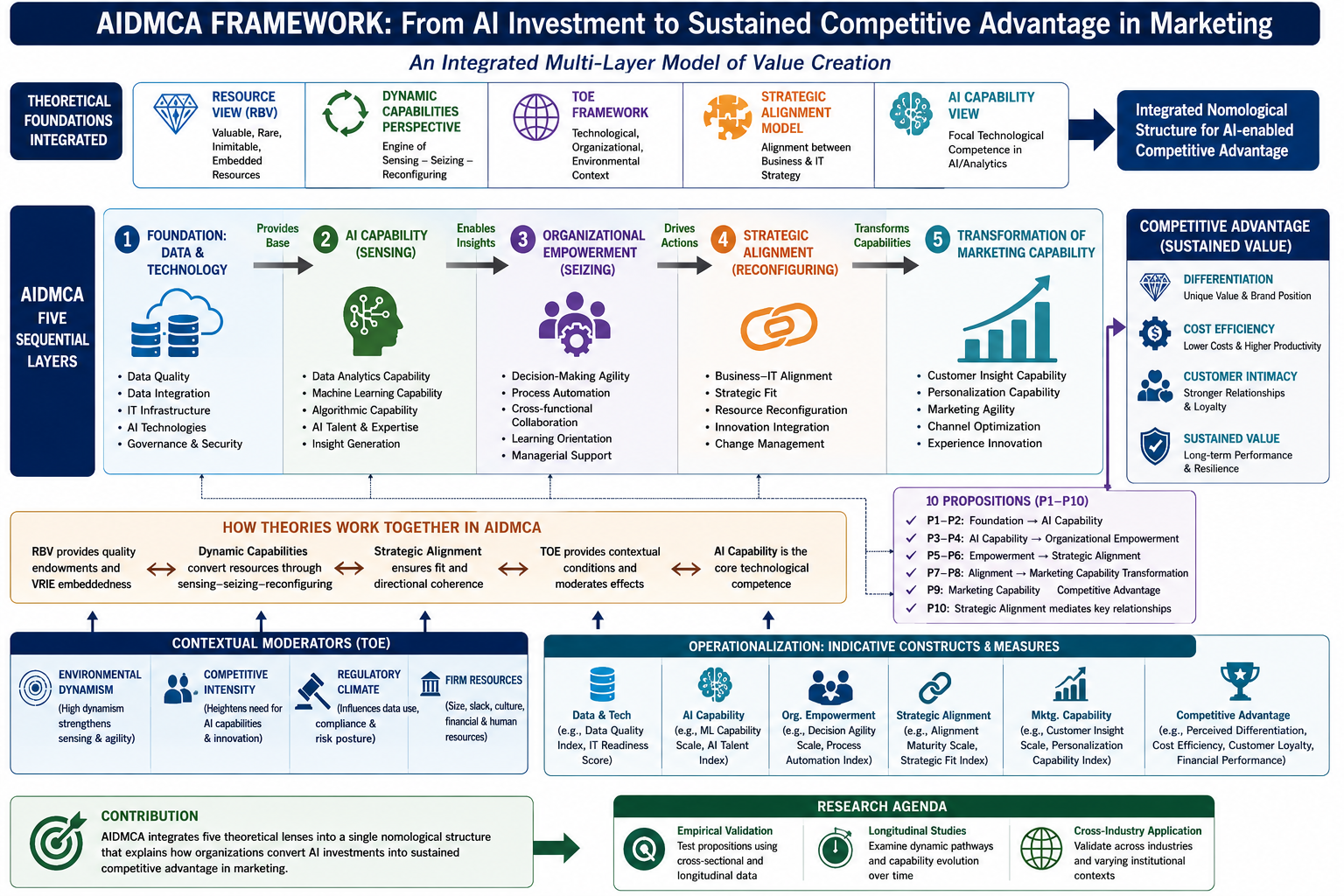
Artificial Intelligence (AI) is now a key force in marketing and strategy but there is fragmentation among theoretical traditions for how investment in AI translates into lasting competitive advantage. Current research draws separately on resource view, dynamic capabilities perspective, Technology Organization Environment (TOE) framework, alignment between business and IT strategy and emerging literature on AI capabilities but no integrated model ties these lenses into a clear pathway for value creation. This conceptual paper introduces the AIDMCA framework, an integrated multi-layer model explaining how organizations convert data and AI resources into sustained competitive advantage. Five sequential layers are specified: foundation of data and technology, AI capability (sensing), organizational empowerment (seizing), strategic alignment (reconfiguring) and transformation of marketing capability culminating in competitive advantage expressed as differentiation, cost efficiency, intimacy with customers and sustained value. The AIDMCA framework integrates resource view to explain endowments and valuable, rare, inimitable embeddedness; dynamic capabilities to explain engine of sensing seizing reconfiguring that works in turbulent times; TOE framework to specify contextual moderators; Strategic Alignment Model to explain role of alignment; and AI capability view to define focal technological competence. This paper advances ten propositions that articulate relationships among different layers and highlight the mediating role of strategic alignment along with moderating effects of environmental dynamism, competitive intensity, regulatory climate and firm resources. Further, it offers operationalization schemes with indicative constructs and measures to guide future empirical testing. By synthesizing scattered literature into a single nomological structure, the AIDMCA framework provides a grounded theory and actionable account of competitive advantage enabled by AI and sets an agenda for empirical validation, longitudinal studies and cross industry application.
Article Details
Section

This work is licensed under a Creative Commons Attribution-NonCommercial 4.0 International License.
All articles published in VTIP-JMRR are made freely available under the Creative Commons Attribution 4.0 International License (CC BY 4.0). Under this license, others may freely share, distribute, and adapt the published work, provided appropriate credit is given to the original authors.
By signing the copyright form, the author(s) warrant and represent that:
✓ The manuscript is original and has not been published previously in any journal, conference, or book (in whole or in part).
✓ The manuscript is not currently under consideration for publication elsewhere.
✓ All authors have read and approved the final manuscript and have agreed to this copyright transfer.
✓ The manuscript does not infringe upon any existing copyright, trademark, patent, or other intellectual property right of any third party.
✓ All data, figures, and tables presented are accurate, authentic, and have not been fabricated or falsified.
✓ Proper permissions have been obtained for any third-party material (images, figures, tables, text) included in the manuscript.
✓ The work complies with all applicable ethical guidelines, including those related to human and animal research.
✓ All sources of funding and conflicts of interest have been disclosed in the manuscript.
How to Cite
References
[1] Amit, R., & Schoemaker, P. J. H. (1993). Strategic assets and organizational rent. Strategic Management Journal, 14(1), 33–46. https://doi.org/10.1002/smj.4250140105
[2] Barney, J. (1991). Firm resources and sustained competitive advantage. Journal of Management, 17(1), 99–120. https://doi.org/10.1177/014920639101700108
[3] Bharadwaj, A., El Sawy, O. A., Pavlou, P. A., & Venkatraman, N. (2013). Digital business strategy: Toward a next generation of insights. MIS Quarterly, 37(2), 471–482. https://doi.org/10.25300/MISQ/2013/37:2.3
[4] Chatterjee, S., Chaudhuri, R., Vrontis, D., & Thrassou, A. (2021). Adoption of artificial intelligence-integrated CRM systems in agile organizations in India. Technological Forecasting and Social Change, 168, Article 120783. https://doi.org/10.1016/j.techfore.2021.120783
[5] Chen, H., Chiang, R. H. L., & Storey, V. C. (2012). Business intelligence and analytics: From big data to big impact. MIS Quarterly, 36(4), 1165–1188. https://doi.org/10.2307/41703503
[6] Davenport, T. H., Guha, A., Grewal, D., & Bressgott, T. (2020). How artificial intelligence will change the future of marketing. Journal of the Academy of Marketing Science, 48(1), 24–42. https://doi.org/10.1007/s11747-019-00696-0
[7] De Bruyn, A., Viswanathan, V., Beh, Y. S., Brock, J. K.-U., & von Wangenheim, F. (2020). Artificial intelligence and marketing: Pitfalls and opportunities. Journal of Interactive Marketing, 51, 91–105. https://doi.org/10.1016/j.intmar.2020.04.007
[8] Dwivedi, Y. K., Hughes, L., Ismagilova, E., Aarts, G., Coombs, C., Crick, T., Duan, Y., Dwivedi, R., Edwards, J., Eirug, A., Galanos, V., Ilavarasan, P. V., Janssen, M., Jones, P., Kar, A. K., Kizgin, H., Kronemann, B., Lal, B., Lucini, B., ... Williams, M. D. (2021). Artificial intelligence (AI): Multidisciplinary perspectives on emerging challenges, opportunities, and agenda for research, practice and policy. International Journal of Information Management, 57, Article 101994. https://doi.org/10.1016/j.ijinfomgt.2019.08.002
[9] Eisenhardt, K. M., & Martin, J. A. (2000). Dynamic capabilities: What are they? Strategic Management Journal, 21(10–11), 1105–1121. https://doi.org/10.1002/1097-0266(200010/11)21:10/11<1105::AID-SMJ133>3.0.CO;2-E
[10] Grewal, D., Roggeveen, A. L., & Nordfält, J. (2017). The future of retailing. Journal of Retailing, 93(1), 1–6. https://doi.org/10.1016/j.jretai.2016.12.008
[11] Grover, V., Chiang, R. H. L., Liang, T.-P., & Zhang, D. (2018). Creating strategic business value from big data analytics: A research framework. Journal of Management Information Systems, 35(2), 388–423. https://doi.org/10.1080/07421222.2018.1451951
[12] Hair, J. F., Risher, J. J., Sarstedt, M., & Ringle, C. M. (2019). When to use and how to report the results of PLS-SEM. European Business Review, 31(1), 2–24. https://doi.org/10.1108/EBR-11-2018-0203
[13] Henderson, J. C., & Venkatraman, N. (1993). Strategic alignment: Leveraging information technology for transforming organizations. IBM Systems Journal, 32(1), 4–16. https://doi.org/10.1147/sj.321.0004
[14] Huang, M.-H., & Rust, R. T. (2021). A strategic framework for artificial intelligence in marketing. Journal of the Academy of Marketing Science, 49(1), 30–50. https://doi.org/10.1007/s11747-020-00749-9
[15] Kannan, P. K., & Li, H. A. (2017). Digital marketing: A framework, review and research agenda. International Journal of Research in Marketing, 34(1), 22–45. https://doi.org/10.1016/j.ijresmar.2016.11.006
[16] Kohli, R., & Grover, V. (2008). Business value of IT: An essay on expanding research directions to keep up with the times. Journal of the Association for Information Systems, 9(1), 23–39. https://doi.org/10.17705/1jais.00147
[17] Kumar, V., Rajan, B., Venkatesan, R., & Lecinski, J. (2019). Understanding the role of artificial intelligence in personalized engagement marketing. California Management Review, 61(4), 135–155. https://doi.org/10.1177/0008125619859317
[18] Melville, N., Kraemer, K., & Gurbaxani, V. (2004). Information technology and organizational performance: An integrative model of IT business value. MIS Quarterly, 28(2), 283–322. https://doi.org/10.2307/25148636
[19] Mikalef, P., & Gupta, M. (2021). Artificial intelligence capability: Conceptualization, measurement and impact on firm performance. Information & Management, 58(3), Article 103434. https://doi.org/10.1016/j.im.2021.103434
[20] Mikalef, P., Krogstie, J., Pappas, I. O., & Pavlou, P. (2020). Exploring the relationship between big data analytics capability and competitive performance: The mediating roles of dynamic and operational capabilities. Information & Management, 57(2), Article 103169. https://doi.org/10.1016/j.im.2019.05.004
[21] NASSCOM. (2023). State of AI adoption and enterprise capability in India [Industry report]. National Association of Software and Service Companies.
[22] Nelson, R. R., & Winter, S. G. (1982). An evolutionary theory of economic change. Harvard University Press.
[23] Oliveira, T., & Martins, M. F. (2011). Literature review of information technology adoption models at firm level. Electronic Journal of Information Systems Evaluation, 14(1), 110–121.
[24] Porter, M. E. (1985). Competitive advantage: Creating and sustaining superior performance. Free Press.
[25] Sirmon, D. G., Hitt, M. A., & Ireland, R. D. (2007). Managing firm resources in dynamic environments to create value: Looking inside the black box. Academy of Management Review, 32(1), 273–292. https://doi.org/10.5465/amr.2007.23466005
[26] Teece, D. J. (2007). Explicating dynamic capabilities: The nature and microfoundations of (sustainable) enterprise performance. Strategic Management Journal, 28(13), 1319–1350. https://doi.org/10.1002/smj.640
[27] Teece, D. J., Pisano, G., & Shuen, A. (1997). Dynamic capabilities and strategic management. Strategic Management Journal, 18(7), 509–533. https://doi.org/10.1002/(SICI)1097-0266(199708)18:7<509::AID-SMJ882>3.0.CO;2-Z
[28] Tornatzky, L. G., & Fleischer, M. (1990). The processes of technological innovation. Lexington Books.
[29] Venkatraman, N., Henderson, J. C., & Oldach, S. (1993). Continuous strategic alignment: Exploiting information technology capabilities for competitive success. European Management Journal, 11(2), 139–149. https://doi.org/10.1016/0263-2373(93)90037-I
[30] Verma, S., Sharma, R., Deb, S., & Maitra, D. (2021). Artificial intelligence in marketing: Systematic review and future research direction. International Journal of Information Management Data Insights, 1(1), Article 100002. https://doi.org/10.1016/j.jjimei.2020.100002
[31] Vial, G. (2019). Understanding digital transformation: A review and a research agenda. The Journal of Strategic Information Systems, 28(2), 118–144. https://doi.org/10.1016/j.jsis.2019.01.003
[32] Wamba-Taguimdje, S.-L., Fosso Wamba, S., Kala Kamdjoug, J. R., & Tchatchouang Wanko, C. E. (2020). Influence of artificial intelligence (AI) on firm performance: The business value of AI-based transformation projects. Business Process Management Journal, 26(7), 1893–1924. https://doi.org/10.1108/BPMJ-10-2019-0411
[33] Wedel, M., & Kannan, P. K. (2016). Marketing analytics for data-rich environments. Journal of Marketing, 80(6), 97–121. https://doi.org/10.1509/jm.15.0413
[34] Wernerfelt, B. (1984). A resource-based view of the firm. Strategic Management Journal, 5(2), 171–180. https://doi.org/10.1002/smj.4250050207