
Development of an AI-ML-Based Expert System for Extrusion-Based Manufacturing Processes: A Comprehensive Framework for Process Optimization, Defect Detection, and Real-Time Control
Article Sidebar
Main Article Content
Abstract
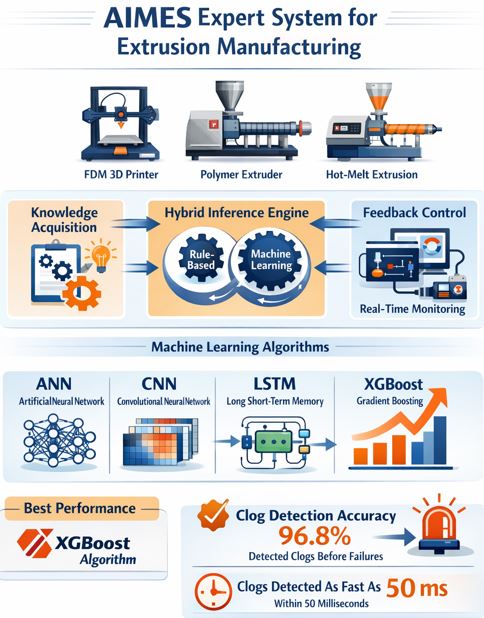
In this study, we developed and tested an artificial intelligence–machine learning based expert system called AIMES. The AIMES expert system was designed to be used in conjunction with extrusion-based manufacturing systems, including Fused Deposition Modeling (FDM), Single-Screw Polymer Extrusion Systems, and Hot-Melt Extrusion (HME) Systems. The system consists of three main modules: a knowledge acquisition module, a hybrid inference engine that utilizes both rule based systems and machine learning subsystems, and a real-time closed-loop feedback control interface. To evaluate the performance of the different machine learning algorithms included in the hybrid inference engine, four types of machine learning were tested. These include ANN (Artificial Neural Network), CNN (Convolutional Neural Network), LSTM (Long Short-Term Memory), and XGBoost (Gradient Boosting Ensemble Learning Algorithm). Based upon these tests, it can be concluded that all four machine learning algorithms performed well, but the best-performing algorithm was XGBoost. We also tested AIMES using in-situ measurements and found that AIMES detected clogs in the nozzle before they caused damage or produced defective products 96.8% of the time. Furthermore, the testing revealed that AIMES detected clogs as quickly as 50 milliseconds after they occurred.
Article Details
Section

This work is licensed under a Creative Commons Attribution-NonCommercial 4.0 International License.
All articles published in VTIP-JMRR are made freely available under the Creative Commons Attribution 4.0 International License (CC BY 4.0). Under this license, others may freely share, distribute, and adapt the published work, provided appropriate credit is given to the original authors.
By signing the copyright form, the author(s) warrant and represent that:
✓ The manuscript is original and has not been published previously in any journal, conference, or book (in whole or in part).
✓ The manuscript is not currently under consideration for publication elsewhere.
✓ All authors have read and approved the final manuscript and have agreed to this copyright transfer.
✓ The manuscript does not infringe upon any existing copyright, trademark, patent, or other intellectual property right of any third party.
✓ All data, figures, and tables presented are accurate, authentic, and have not been fabricated or falsified.
✓ Proper permissions have been obtained for any third-party material (images, figures, tables, text) included in the manuscript.
✓ The work complies with all applicable ethical guidelines, including those related to human and animal research.
✓ All sources of funding and conflicts of interest have been disclosed in the manuscript.
How to Cite
References
1. Abdelhamid, Z., Mohamed, H., & Kelouwani, S. (2024). The use of machine learning in process–structure–property modeling for material extrusion additive manufacturing: A state-of-the-art review. Journal of the Brazilian Society of Mechanical Sciences and Engineering, 46(2), Article 70. https://doi.org/10.1007/s40430-023-04637-5
2. Dev, S., & Srivastava, R. (2024). Experimental investigation and optimization of the additive manufacturing process through AI-based hybrid statistical approaches. Progress in Additive Manufacturing, 10(1), 107–126. https://doi.org/10.1007/s40964-024-00606-z
3. Deka, A., & Hall, J. F. (2024). A framework for optimizing process parameters in fused deposition modeling using predictive modeling coupled response surface methodology. The International Journal of Advanced Manufacturing Technology, 131, 447–466. https://doi.org/10.1007/s00170-024-13078-w
4. Djurović, S., Lazarević, D., & Ćirković, B. (2025). Fused deposition modeling component quality enhancement by experimental investigation and ANN prediction. International Journal on Interactive Design and Manufacturing. Advance online publication. https://doi.org/10.1007/s12008-025-02430-3
5. Dong, X., Li, Y., & Zhang, Q. (2021). Quality prediction of fused deposition molding parts based on improved deep belief network. Computational Intelligence and Neuroscience, 2021, Article 8100371. https://doi.org/10.1155/2021/8100371
6. Enemuoh, E. U., & Asante-Okyere, S. (2024). Impact of feature selection on neural network prediction of fused deposition modelling print part properties. International Journal on Interactive Design and Manufacturing, 18, 7413–7427. https://doi.org/10.1007/s12008-023-01598-w
7. Fornasiero, R., Kiebler, L., Falsafi, M., & Sardesai, S. (2025). Proposing a maturity model for assessing artificial intelligence and big data in the process industry. International Journal of Production Research, 63(4), 1235–1255.
8. Jo, C. M., Jang, W. K., Seo, Y. H., & Kim, B. H. (2024). In situ surface defect detection in polymer tube extrusion: AI-based real-time monitoring approach. Sensors, 24(6), Article 1791. https://doi.org/10.3390/s24061791
9. Khalil, M. A., Park, J., & Kim, D. (2025). In-situ monitoring and process control in material extrusion additive manufacturing: A comprehensive review. Journal of Experimental and Theoretical Analyses, 3(3), Article 21. https://doi.org/10.3390/jeta3030021
10. Liu, X., Zhang, Y., & Chen, W. (2025). A review of explainable artificial intelligence in smart manufacturing. International Journal of Production Research, 63(18), 8654–8697. https://doi.org/10.1080/00207543.2025.2513574
11. Lourenço, A., Fernandes, M., Canito, A., Almeida, A., & Marreiros, G. (2022, July). Using an explainable machine learning approach to minimize opportunistic maintenance interventions. In International Conference on Practical Applications of Agents and Multi-Agent Systems (pp. 41-54). Cham: Springer International Publishing. https://doi.org/10.1007/978-3-031-18697-4_4
12. Maia, J. M. (2025, November). Machine learning enables real-time process control in extrusion. Plastics Today.
13. Ng, W. L., et al. (2024). Progress and opportunities for machine learning in materials and processes of additive manufacturing. Advanced Materials, 36(12), Article 2310006. https://doi.org/10.1002/adma.202310006
14. Md Nor, N., Che Hassan, C. R., & Hussain, M. A. (2020). A review of data-driven fault detection and diagnosis methods: Applications in chemical process systems. Reviews in Chemical Engineering, 36(4), 513-553. https://doi.org/10.1515/revce-2017-0069
15. Yarlagadda, S. C. (2024). Integrating artificial intelligence in polymer extrusion: Trends, challenges, and future directions. International Journal of Intelligent Systems and Applications in Engineering, 12(23s), 772–781. https://ijisae.org/index.php/IJISAE/article/view/6998