
The Renegotiation Trap: Political Economy Factors Driving Opportunistic Contract Modifications in Public-Private Partnerships
Article Sidebar
Main Article Content
Abstract
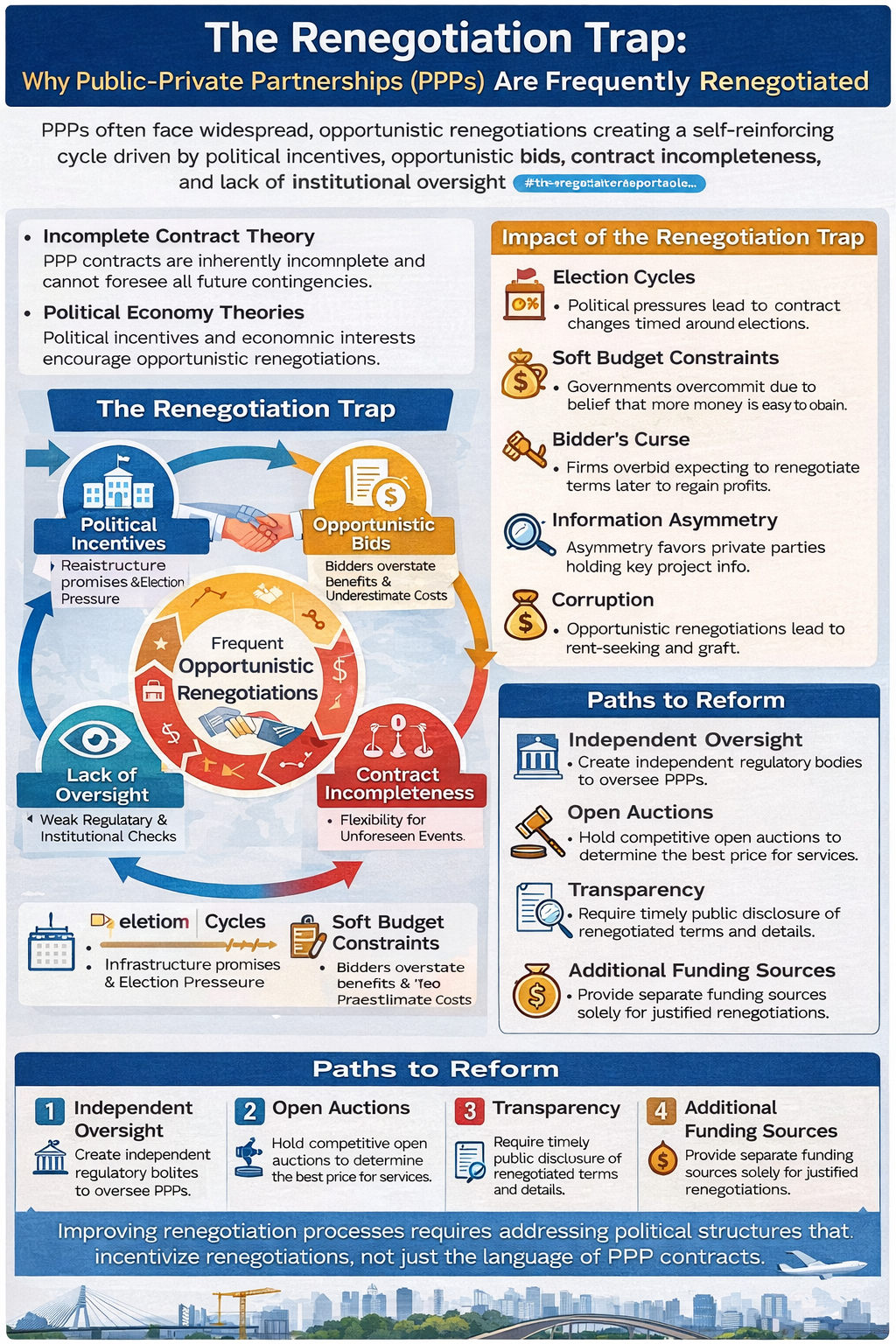
Public-Private Partnerships (PPPs), as an instrument of global infrastructure governance, have created a widespread issue among governments: the widespread renegotiation of PPP contracts. Renegotiations occur at a rate far greater than would be expected under normal circumstances; therefore, it can reasonably be concluded that most PPP renegotiations are opportunistic. This article examines why the renegotiation of PPPs occurs so frequently. The authors call this problem the “Renegotiation Trap,” because there exists a self-reinforcing cycle of political incentives, opportunistic bids, contract incompleteness, and lack of institutional oversight that makes renegotiating PPP contracts both possible and strategically rational. The authors draw upon three bodies of literature to explain why renegotiating PPPs occurs. First, incomplete contract theory is utilized to understand why renegotiating PPPs is necessary. Second, political economy frameworks are used to understand who benefits from the renegotiation of PPPs. Third, data collected from over 1,000 Latin American concession agreements are analyzed to identify when and how renegotiations occurred. Using these three approaches, the authors found that the primary causes of renegotiating PPPs were: (i) election cycles; (ii) soft budget constraints; (iii) bidder’s curse; (iv) information asymmetry; and (v) corruption. The authors also evaluate different reform options to improve the renegotiation process. These reform options include creating an independent regulatory body to oversee the renegotiation process, holding open auctions to determine the best price for services, requiring public disclosure of renegotiated terms, and providing additional funding sources for renegotiation. The authors conclude that improving the renegotiation process requires changing the political structure that provides the incentives for renegotiating PPP contracts rather than just changing the language contained within those contracts.
Article Details
Section

This work is licensed under a Creative Commons Attribution-NonCommercial 4.0 International License.
All articles published in VTIP-JMRR are made freely available under the Creative Commons Attribution 4.0 International License (CC BY 4.0). Under this license, others may freely share, distribute, and adapt the published work, provided appropriate credit is given to the original authors.
By signing the copyright form, the author(s) warrant and represent that:
✓ The manuscript is original and has not been published previously in any journal, conference, or book (in whole or in part).
✓ The manuscript is not currently under consideration for publication elsewhere.
✓ All authors have read and approved the final manuscript and have agreed to this copyright transfer.
✓ The manuscript does not infringe upon any existing copyright, trademark, patent, or other intellectual property right of any third party.
✓ All data, figures, and tables presented are accurate, authentic, and have not been fabricated or falsified.
✓ Proper permissions have been obtained for any third-party material (images, figures, tables, text) included in the manuscript.
✓ The work complies with all applicable ethical guidelines, including those related to human and animal research.
✓ All sources of funding and conflicts of interest have been disclosed in the manuscript.
How to Cite
References
1. Athias, L., & Nuñez, A. (2009). The more the merrier? Number of bidders, information dispersion, renegotiation and winner’s curse in toll road concessions (Working Paper 2009/7). Chaire EPPP, Paris.
2. Athias, L., & Saussier, S. (2010). Contractual flexibility or rigidity for public-private partnerships? Theory and evidence from infrastructure concession contracts (Working Paper 2010/3). Chaire EPPP, Paris.
3. Casady, C. B., & Baxter, D. (2020). Examining the (ir)relevance of transaction cost theory to public-private partnership (PPP) renegotiations. Journal of Management in Engineering, 36(4), 04020033.
4. Cruz, C. O., & Marques, R. C. (2013). Endogenous determinants for renegotiating concessions: Evidence from local infrastructure. Local Government Studies, 39(3), 352–374.
5. Dewatripont, M., & Maskin, E. (1995). Credit and efficiency in centralized and decentralized economies. Review of Economic Studies, 62(4), 541–555.
6. Engel, E., Fischer, R., & Galetovic, A. (2009). Soft budgets and renegotiations in public-private partnerships (NBER Working Paper No. 15300). National Bureau of Economic Research.
7. Engel, E., Fischer, R., & Galetovic, A. (2014). Renegotiations in public-private partnerships: Theory and evidence (OECD/ITF Discussion Paper No. 2014-17). International Transport Forum, OECD.
8. Flyvbjerg, B., Holm, M. K. S., & Buhl, S. L. (2002). Underestimating costs in public works projects: Error or lie? Journal of the American Planning Association, 68(3), 279–295.
9. Guasch, J. L. (2004). Granting and renegotiating infrastructure concessions: Doing it right. World Bank.
10. Guasch, J. L., Laffont, J.-J., & Straub, S. (2003). Renegotiation of concession contracts in Latin America (World Bank Policy Research Working Paper No. 3011). World Bank.
11. Guasch, J. L., Laffont, J.-J., & Straub, S. (2007). Concessions of infrastructure in Latin America: Government-led renegotiation. Journal of Applied Econometrics, 22(7), 1267–1294.
12. Guasch, J. L., Laffont, J.-J., & Straub, S. (2008). Renegotiation of concession contracts in Latin America: Evidence from the water and transport sectors. International Journal of Industrial Organization, 26(2), 421–442.
13. Guasch, J. L., & Straub, S. (2009). Corruption and concession renegotiations: Evidence from the water and transport sectors in Latin America. Utilities Policy, 17(2), 185–190.
14. Hart, O., & Moore, J. (1988). Incomplete contracts and renegotiation. Econometrica, 56(4), 755–785.
15. Iossa, E., & Martimort, D. (2015). The simple microeconomics of public-private partnerships. Journal of Public Economic Theory, 17(1), 4–48.
16. Maskin, E., & Tirole, J. (2008). Public-private partnerships and government spending limits. International Journal of Industrial Organization, 26(2), 412–420.
17. Saussier, S., Staropoli, C., & Yvrande-Billon, A. (2009). Public-private agreements, institutions and competition: When economic theory meets facts. Review of Industrial Organization, 35(1–2), 1–18.
18. Williamson, O. E. (1985). The economic institutions of capitalism: Firms, markets, relational contracting. Free Press.