
AI-Integrated Mechanical Systems for Real-Time Industrial Emission Monitoring and Control: A Comprehensive Review
Article Sidebar
Main Article Content
Abstract
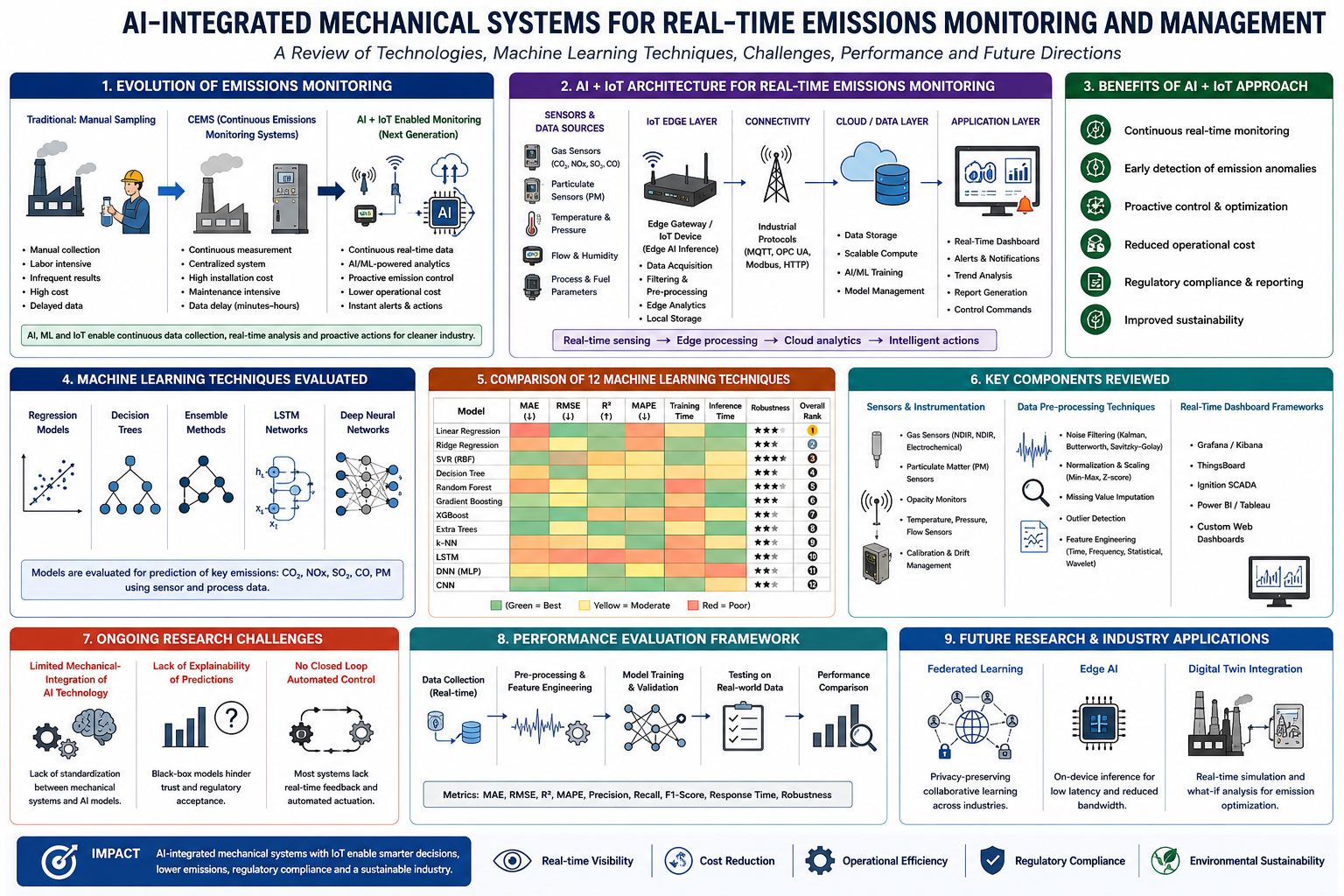
In this study we are reviewing how fast the development of artificial intelligence integrated mechanical systems in real time emissions can be used to monitor and manage emissions in industry. Traditional ways of collecting emissions have been by using manual samples, or sampling at intervals with use of Continuous Emissions Monitoring Systems (CEMS). Manual sampling and CEMS both provide delay in obtaining data and require high operational cost. Use of Artificial Intelligence (AI), Machine Learning (ML) and IoT technology allows for continuous collection of data, real-time analysis of collected data and proactive measures to reduce emissions. In addition to reviewing the progression of emissions monitoring from traditional methods through CEMS to current hybrid architectures combining AI and IoT technologies, this study evaluates machine learning techniques as follows: Regression Models; Decision Trees; Ensemble Methods; LSTM Networks; Deep Neural Networks. Additionally, this study identifies ongoing research issues: Limited Mechanical-Integration of AI Technology; Lack of Explainability of Predictions; No Closed Loop Automated Control. Lastly, the study provides a comparison of the performance of 12 different Machine Learning Techniques along with an evaluation of sensor technology, data pre-processing techniques, and Real-Time Dashboard Frameworks. Finally, this study suggests potential futures uses for Industry Applications such as Federated Learning; Edge AI; Digital Twin Integration.
Article Details
Section

This work is licensed under a Creative Commons Attribution-NonCommercial 4.0 International License.
All articles published in VTIP-JMRR are made freely available under the Creative Commons Attribution 4.0 International License (CC BY 4.0). Under this license, others may freely share, distribute, and adapt the published work, provided appropriate credit is given to the original authors.
By signing the copyright form, the author(s) warrant and represent that:
✓ The manuscript is original and has not been published previously in any journal, conference, or book (in whole or in part).
✓ The manuscript is not currently under consideration for publication elsewhere.
✓ All authors have read and approved the final manuscript and have agreed to this copyright transfer.
✓ The manuscript does not infringe upon any existing copyright, trademark, patent, or other intellectual property right of any third party.
✓ All data, figures, and tables presented are accurate, authentic, and have not been fabricated or falsified.
✓ Proper permissions have been obtained for any third-party material (images, figures, tables, text) included in the manuscript.
✓ The work complies with all applicable ethical guidelines, including those related to human and animal research.
✓ All sources of funding and conflicts of interest have been disclosed in the manuscript.
How to Cite
References
[1] Minassian, R., et al. (2025). Optimizing indoor environmental prediction in smart buildings: A comparative analysis of deep learning models. Energy & Buildings, Elsevier. https://doi.org/10.1016/j.enbuild.2024.115086
[2] Ramadan, M. N. A., et al. (2024). Real-time IoT-powered AI system for monitoring and forecasting of air pollution in industrial environment. Ecotoxicology and Environmental Safety, Elsevier.
[3] Fan, K., et al. (2024). Harnessing the power of AI and IoT for real-time CO2 emission monitoring. Heliyon. https://doi.org/10.1016/j.heliyon.2024.e36612
[4] Giannelos, S., et al. (2024). Machine learning approaches for predictions of CO2 emissions in the building sector. Electric Power Systems Research, Elsevier. https://doi.org/10.1016/j.epsr.2024.110735
[5] Ali, A. O., et al. (2024). Optimized smart home energy management system: Reducing grid consumption and costs through real-time pricing and hybrid architecture. Case Studies in Thermal Engineering, Elsevier.
[6] Barsanti, M., et al. (2024). Informing targeted demand-side management: Leveraging appliance usage patterns to model residential energy demand heterogeneity. Energy & Buildings, Elsevier. https://doi.org/10.1016/j.enbuild.2024.114639
[7] Jemeljanova, M., et al. (2024). Adapting machine learning for environmental spatial data: A review. Ecological Informatics, Elsevier. https://doi.org/10.1016/j.ecoinf.2024.102634
[8] Eddaoudi, Z., et al. (2024). Brief review of energy consumption forecasting using machine learning models. ScienceDirect, Elsevier.
[9] Ruan, G., et al. (2024). Data-driven energy management of virtual power plants: A review. Advances in Applied Energy, Elsevier. https://doi.org/10.1016/j.adapen.2024.100170
[10] Huang, R., et al. (2024). Carbon footprint management in global supply chains: A data-driven approach utilizing artificial intelligence algorithms. IEEE Access.
[11] Husom, E. J., et al. (2024). Engineering carbon emission-aware machine learning pipelines. IEEE Access.
[12] McGookin, C., et al. (2024). Advancing participatory energy systems modelling. Energy Strategy Reviews, Elsevier. https://doi.org/10.1016/j.esr.2024.101319
[13] Jia, Y., et al. (2024). Towards sustainable consumption: Factors influencing energy-efficient appliance adoption in haze-affected environments. Energy Strategy Reviews, Elsevier. https://doi.org/10.1016/j.esr.2024.101416
[14] Bhatt, H., et al. (2023). Forecasting and mitigation of global environmental carbon dioxide emission using machine learning techniques. Cleaner Chemical Engineering, Elsevier. https://doi.org/10.1016/j.clce.2023.100095
[15] Farahzadi, L., et al. (2023). Application of machine learning initiatives and intelligent perspectives for CO2 emissions reduction in construction. Journal of Cleaner Production, Elsevier. https://doi.org/10.1016/j.jclepro.2022.135504
[16] Shapi, M. K. M., et al. (2021). Energy consumption prediction by using machine learning for smart building: Case study in Malaysia. Developments in the Built Environment, Elsevier. https://doi.org/10.1016/j.dibe.2020.100037
[17] Alpan, K., et al. (2020). Design and simulation of global model for carbon emission reduction using IoT and artificial intelligence. ScienceDirect, Elsevier.
[18] Adenuga, O. T., et al. (2020). Exploring energy efficiency prediction method for Industry 4.0: A reconfigurable vibrating screen case study. ScienceDirect, Elsevier.
[19] Fattahi, A., et al. (2020). A systemic approach to analyze integrated energy system modeling tools: Review of national models. Renewable and Sustainable Energy Reviews, Elsevier. https://doi.org/10.1016/j.rser.2020.110195
[20] Hischier, R., et al. (2020). Environmental impacts of household appliances in Europe and scenarios for their impact reduction. Journal of Cleaner Production, Elsevier. https://doi.org/10.1016/j.jclepro.2020.121952
[21] Abubakar, I., et al. (2017). Application of load monitoring in appliances' energy management: Review. Renewable and Sustainable Energy Reviews, Elsevier. http://dx.doi.org/10.1016/j.rser.2016.09.064
[22] Lyu, Q., et al. (2023). Deep learning-based air quality prediction using IoT sensor networks: A systematic review. Sensors, MDPI. https://doi.org/10.3390/s23052695
[23] Chen, Z., et al. (2022). A review of recurrent neural networks for time-series emission forecasting in industrial environments. Journal of Cleaner Production, Elsevier. https://doi.org/10.1016/j.jclepro.2022.131855
[24] Zhang, Y., et al. (2023). Explainable AI for industrial emission monitoring: Methods, challenges, and future directions. Expert Systems with Applications, Elsevier. https://doi.org/10.1016/j.eswa.2023.119841
[25] Wang, X., & Li, J. (2023). Federated learning for distributed environmental monitoring: Privacy-preserving approaches and challenges. IEEE Internet of Things Journal. https://doi.org/10.1109/JIOT.2023.3241567