
Navigating Modern Volatility: The Renewed Importance of aHolistic PESTLE and All-Hazards Risk Framework forMega-Projects
Article Sidebar
Main Article Content
Abstract
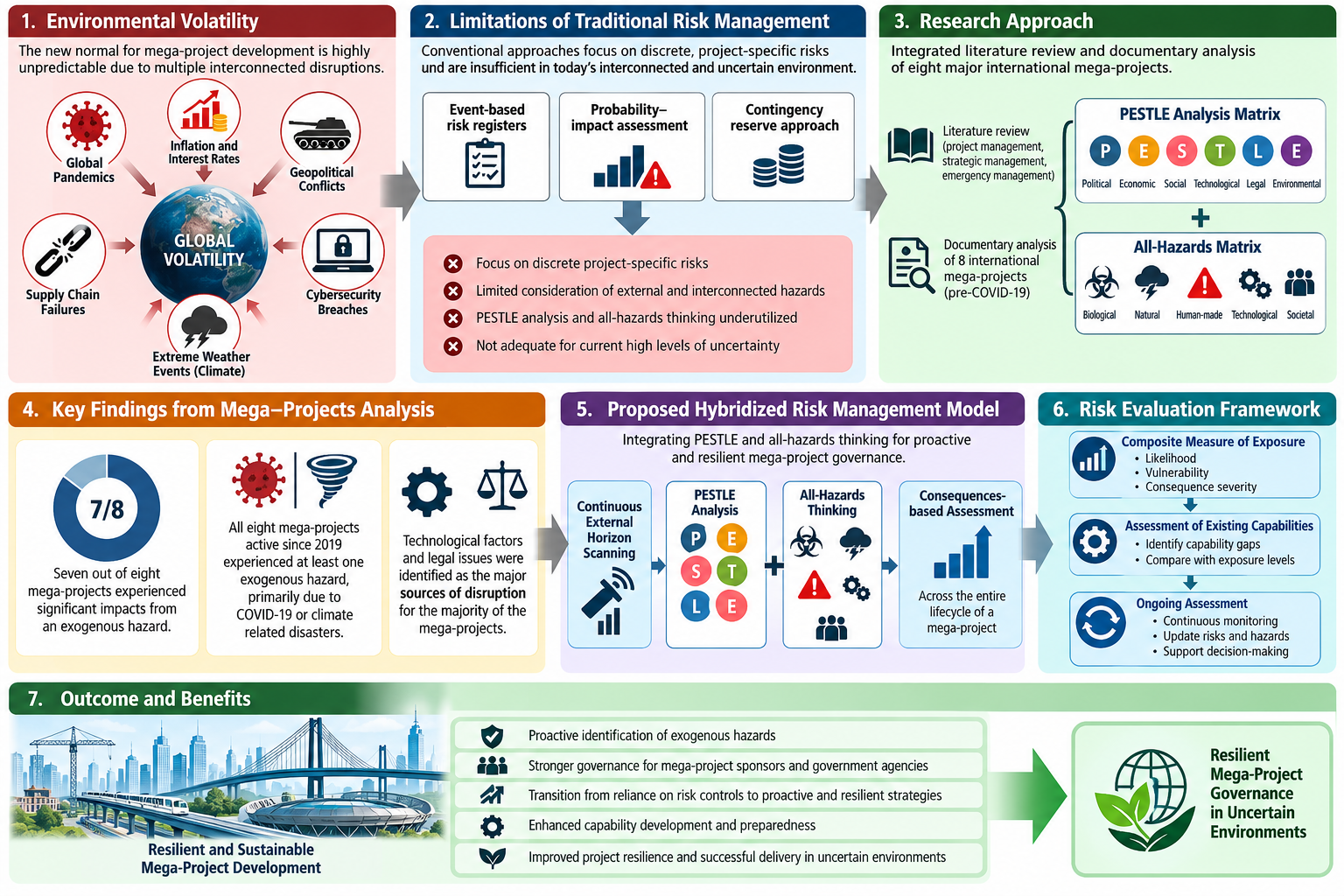
The new normal for mega-project development is now highly unpredictable due to the current environmental volatility. Volatility includes, inter alia, global pandemics; shock waves from inflation and interest rates; geopolitical conflicts; supply chain failures; cybersecurity breaches; and extreme weather events (climate). A common characteristic of these disruptions is their interconnectedness and ability to build on top of each other. However, traditional project risk management strategies based on discrete, internal to the project eventbased registers, and/or probability–impact assessments of individual risks and contingency reserve approaches remain focused on discrete project-specific risks. In addition, while both PESTLE analysis and all-hazards thinking have been available for decades as tools to help address project specific risks they have received relatively little attention until recently. Under the present circumstances of high levels of uncertainty, it seems likely that both will gain renewed attention and be used together. As such, the authors conducted an integrated review of the literature concerning project management, strategic management, and emergency management, and a documentary analysis of eight major international mega-projects that were documented prior to the emergence of COVID-19. They applied the PESTLE analysis matrix and an additional matrix for hazards outside of the PESTLE categories. Technological factors and legal issues were identified as the source of disruption for the majority of the mega-projects studied, with seven out of eight experiencing significant impacts resulting from an exogenous hazard. All eight mega-projects active since 2019 experienced at least one exogenous hazard, primarily caused by either COVID-19 or climate related disasters. Based upon this data, the study recommends that a hybridized model combining PESTLE and allhazards thinking be developed for use by sponsors of mega-projects and government agencies. The proposed model would allow for ongoing assessment of potential exogenous hazards through continuous external horizon scanning along with an evaluation of existing capabilities using a consequences-based approach across the entire lifecycle of a mega-project. Additionally, the model would include a composite measure of exposure (a combination of three measures) and an estimate of any gaps in capabilities that exist relative to the exposures faced by the mega-project. The recommended hybridized model should provide sponsors of mega-projects and government agencies a means to transition from reliance on risk controls toward developing proactive and resilient mega-project governance models in uncertain environments.
Article Details
Section

This work is licensed under a Creative Commons Attribution-NonCommercial 4.0 International License.
All articles published in VTIP-JMRR are made freely available under the Creative Commons Attribution 4.0 International License (CC BY 4.0). Under this license, others may freely share, distribute, and adapt the published work, provided appropriate credit is given to the original authors.
By signing the copyright form, the author(s) warrant and represent that:
✓ The manuscript is original and has not been published previously in any journal, conference, or book (in whole or in part).
✓ The manuscript is not currently under consideration for publication elsewhere.
✓ All authors have read and approved the final manuscript and have agreed to this copyright transfer.
✓ The manuscript does not infringe upon any existing copyright, trademark, patent, or other intellectual property right of any third party.
✓ All data, figures, and tables presented are accurate, authentic, and have not been fabricated or falsified.
✓ Proper permissions have been obtained for any third-party material (images, figures, tables, text) included in the manuscript.
✓ The work complies with all applicable ethical guidelines, including those related to human and animal research.
✓ All sources of funding and conflicts of interest have been disclosed in the manuscript.
How to Cite
References
[1] Flyvbjerg, B. (2014). What you should know about megaprojects and why: An overview. Project Management Journal, 45(2), 6–19. https://doi.org/10.1002/pmj.21409
[2] Flyvbjerg, B., Bruzelius, N., & Rothengatter, W. (2003). Megaprojects and risk: An anatomy of ambition. Cambridge University Press.
[3] Flyvbjerg, B., & Gardner, D. (2023). How big things get done: The surprising factors that determine the fate of every project, from home renovations to space exploration and everything in between. Currency.
[4] Love, P. E. D., & Ahiaga-Dagbui, D. D. (2018). Debunking fake news in a post-truth era: The plausible untruths of cost underestimation in transport infrastructure projects. Transportation Research Part A: Policy and Practice, 113, 357–368. https://doi.org/10.1016/j.tra.2018.04.019
[5] International Organization for Standardization. (2018). Risk management — Guidelines (ISO Standard No. 31000:2018). ISO.
[6] Project Management Institute. (2021). A guide to the project management body of knowledge (PMBOK guide) (7th ed.). Project Management Institute.
[7] Project Management Institute. (2019). The standard for risk management in portfolios, programs, and projects. Project Management Institute.
[8] World Economic Forum. (2024). The global risks report 2024 (19th ed.). World Economic Forum.
[9] Lawrence, M., Homer-Dixon, T., Janzwood, S., Rockström, J., Renn, O., & Donges, J. F. (2024). Global polycrisis: The causal mechanisms of crisis entanglement. Global Sustainability, 7, e6.
[10] Aguilar, F. J. (1967). Scanning the business environment. Macmillan.
[11] Federal Emergency Management Agency. (2021). Developing and maintaining emergency operations plans: Comprehensive preparedness guide (CPG) 101 (Version 3.0). U.S. Department of Homeland Security.
[12] The White House. (2011). Presidential policy directive/PPD-8: National preparedness. U.S. Government.
[13] Committee of Sponsoring Organizations of the Treadway Commission. (2017). Enterprise risk management — Integrating with strategy and performance. COSO.
[14] Hopkin, P. (2018). Fundamentals of risk management: Understanding, evaluating and implementing effective risk management (5th ed.). Kogan Page.
[15] Cagliano, A. C., Grimaldi, S., & Rafele, C. (2015). Choosing project risk management techniques. A theoretical framework. Journal of Risk Research, 18(2), 232–248. https://doi.org/10.1080/13669877.2014.896398
[16] Siraj, N. B., & Fayek, A. R. (2019). Risk identification and common risks in construction: Literature review and content analysis. Journal of Construction Engineering and Management, 145(9), 03119004. https://doi.org/10.1061/(ASCE)CO.1943-7862.0001685
[17] Zou, P. X. W., Zhang, G., & Wang, J. (2007). Understanding the key risks in construction projects in China. International Journal of Project Management, 25(6), 601–614. https://doi.org/10.1016/j.ijproman.2007.03.001
[18] Ward, S., & Chapman, C. (2003). Transforming project risk management into project uncertainty management. International Journal of Project Management, 21(2), 97–105. https://doi.org/10.1016/S0263-7863(01)00080-1
[19] Perminova, O., Gustafsson, M., & Wikström, K. (2008). Defining uncertainty in projects – A new perspective. International Journal of Project Management, 26(1), 73–79. https://doi.org/10.1016/j.ijproman.2007.08.005
[20] Aven, T. (2016). Risk assessment and risk management: Review of recent advances on their foundation. European Journal of Operational Research, 253(1), 1–13. https://doi.org/10.1016/j.ejor.2015.12.023
[21] Miller, R., & Lessard, D. R. (2000). The strategic management of large engineering projects: Shaping institutions, risks, and governance. MIT Press.
[22] Floricel, S., & Miller, R. (2001). Strategizing for anticipated risks and turbulence in large-scale engineering projects. International Journal of Project Management, 19(8), 445–455. https://doi.org/10.1016/S0263-7863(01)00047-3
[23] Sanderson, J. (2012). Risk, uncertainty and governance in megaprojects: A critical discussion of alternative explanations. International Journal of Project Management, 30(4), 432–443. https://doi.org/10.1016/j.ijproman.2011.11.002
[24] Kardes, I., Ozturk, A., Cavusgil, S. T., & Cavusgil, E. (2013). Managing global megaprojects: Complexity and risk management. International Business Review, 22(6), 905–917. https://doi.org/10.1016/j.ibusrev.2013.01.003
[25] Mok, K. Y., Shen, G. Q., & Yang, J. (2015). Stakeholder management studies in mega construction projects: A review and future directions. International Journal of Project Management, 33(2), 446–457. https://doi.org/10.1016/j.ijproman.2014.08.007
[26] Taleb, N. N. (2007). The black swan: The impact of the highly improbable. Random House.
[27] Wucker, M. (2016). The gray rhino: How to recognize and act on the obvious dangers we ignore. St. Martin’s Press.
[28] Weick, K. E., & Sutcliffe, K. M. (2015). Managing the unexpected: Sustained performance in a complex world (3rd ed.). Wiley.
[29] Hollnagel, E., Woods, D. D., & Leveson, N. (Eds.). (2006). Resilience engineering: Concepts and precepts. Ashgate.
[30] Locatelli, G., Mikic, M., Kovacevic, M., Brookes, N. J., & Ivanišević, N. (2017). The successful delivery of megaprojects: A novel research method. Project Management Journal, 48(5), 78–94. https://doi.org/10.1177/875697281704800506
[31] Rastogi, N., & Trivedi, M. K. (2016). PESTLE technique – A tool to identify external risks in construction projects. International Research Journal of Engineering and Technology, 3(1), 384–388.
[32] Ansar, A., Flyvbjerg, B., Budzier, A., & Lunn, D. (2016). Does infrastructure investment lead to economic growth or economic fragility? Evidence from China. Oxford Review of Economic Policy, 32(3), 360–390. https://doi.org/10.1093/oxrep/grw022
[33] United Nations Office for Disaster Risk Reduction. (2015). Sendai framework for disaster risk reduction 2015–2030. United Nations.
[34] HM Government. (2023). National risk register 2023 edition. Cabinet Office.
[35] National Disaster Management Authority. (2016). National disaster management plan, 2016. Government of India.
[36] Bennett, N., & Lemoine, G. J. (2014). What VUCA really means for you. Harvard Business Review, 92(1/2), 27.
[37] Organisation for Economic Co-operation and Development. (2003). Emerging risks in the 21st century: An agenda for action. OECD Publishing.
[38] Intergovernmental Panel on Climate Change. (2023). Climate change 2023: Synthesis report. Contribution of Working Groups I, II and III to the sixth assessment report of the Intergovernmental Panel on Climate Change. IPCC.
[39] Bureau International des Expositions. (2020). BIE General Assembly officially approves Expo 2020 Dubai date change. BIE. https://bie-paris.org/site/en/news-announcements/world-expo/bie-general-assembly-officially-approves-expo-2020-dubai-date-change
[40] Africanews. (2025, April 17). Egypt’s revenue from the Suez Canal plunged sharply in 2024. Africanews/Associated Press. https://www.africanews.com/2025/04/17/egypts-revenue-from-the-suez-canal-plunged-sharply-in-2024/
[41] Congressional Research Service. (2026). The Arab Gulf States, the Iran conflict, and U.S. relations: In brief (CRS Report R48971). https://www.everycrsreport.com/reports/R48971.html
[42] Stimson Center. (2026). Iran conflict hits foundations of Gulf economies. https://www.stimson.org/2026/iran-conflict-hits-foundations-of-gulf-economies/
[43] Pipeline & Gas Journal. (2026, September). Pipelines and ports: Iran war spurs Gulf infrastructure investment [Reuters report]. https://pgjonline.com/news/2026/september/pipelines-and-ports-iran-war-spurs-gulf-infrastructure-investment
[44] Agence France-Presse. (2025, January 13). Power outages in Sudan after drone attack on major dam. The Defense Post. https://thedefensepost.com/2025/01/13/power-outages-sudan/
[45] Sudan Tribune. (2025, April 6). Power outages hit Sudan areas after drone attack on Merowe Dam. https://sudantribune.com/?p=299398
[46] Arabian Business. (2026, March 12). Force majeure is becoming a live risk for Gulf megaprojects. https://www.arabianbusiness.com/finance/economy/force-majeure-is-becoming-a-live-risk-for-gulf-megaprojects
[47] World Bank. (2025, October 21). Syria’s post-conflict reconstruction costs estimated at $216 billion [Press release]. https://www.worldbank.org/en/news/press-release/2025/10/21/syria-s-post-conflict-reconstruction-costs-estimated-at-216-billion
[48] Lucas, R. (2022, October 18). French cement giant Lafarge pleads guilty in U.S. court to paying millions to ISIS. NPR. https://www.opb.org/article/2022/10/18/french-cement-giant-larfage-pleads-guilty-in-us-court-to-paying-millions-to-isis/
[49] Avdaliani, E. (2026, September 11). With the Strait of Hormuz blocked, Turkey eyes quicker completion of the Development Road. Turkey Analyst. Central Asia-Caucasus Institute & Silk Road Studies Program. https://www.turkeyanalyst.org/publications/turkey-analyst-articles/item/748-with-the-strait-of-hormuz-blocked-turkey-eyes-quicker-completion-of-the-development-road.html
[50] Arabian Gulf Business Insight. (2026, May). Iraq’s oil exports via Hormuz drop to 10m barrels in April. AGBI. https://www.agbi.com/oil-and-gas/2026/05/iraqs-oil-exports-via-hormuz-drop-to-10m-barrels-in-april/
[51] Bloomberg. (2026, April 10). Top Gulf aluminum maker declares force majeure on some contracts. https://www.bloomberg.com/news/articles/2026-04-10/top-gulf-aluminum-maker-declares-force-majeure-on-some-contracts
[52] Arabian Gulf Business Insight. (2026, August). Iran war disrupts Gulf construction contracts. AGBI. https://www.agbi.com/analysis/construction/2026/08/iran-war-disrupts-gulf-construction-contracts/
[53] New Civil Engineer. (2026, June 1). Further doubts over Saudi Arabia’s Neom gigaproject. https://www.newcivilengineer.com/latest/further-doubts-over-saudi-arabias-neom-gigaproject-01-06-2026/
[54] The National. (2026, October 4). Iraq transports its oil past Hormuz for first time in decades as war with Iran chokes exports. https://www.thenationalnews.com/business/energy/2026/10/04/iraq-transports-its-oil-past-hormuz-for-first-time-in-decades-as-war-with-iran-chokes-exports/