
Transfer of Microplastics from River Systems to Underground Water Resources: Mechanisms, Impacts, and Research Needs
Article Sidebar
Main Article Content
Abstract
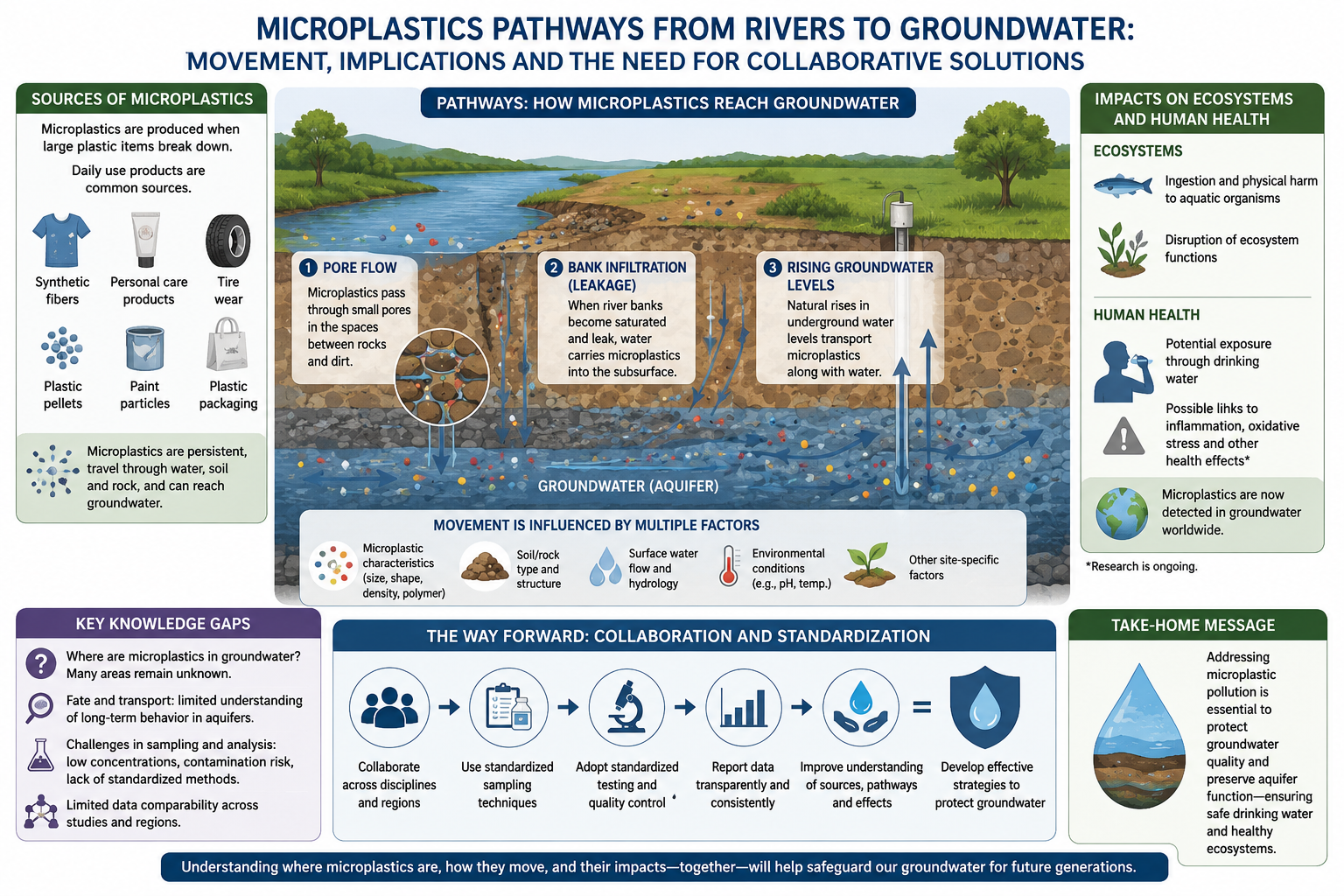
This study investigated the ways that microplastics move from rivers to groundwater. Microplastics occur when large pieces of plastics break down. We have a number of daily uses for products made with microplastics. Microplastics last forever and travel through water, soil and rock to find their way into groundwater. There are several ways in which microplastics get into the groundwater. Microplastics can pass through small pores in the space between rocks and dirt. When the river banks become saturated with water and start to leak out they carry microplastics with them. Also, when underground water levels rise due to natural means, microplastics will be carried along too. Movement of microplastics is dependent upon the characteristics of the microplastic itself, the type of dirt/soil, how much water flows over the surface and other factors related to the environment around it. A major concern in studying this topic is to determine where microplastics are in groundwater, because if we don't know where they exist we cannot protect against them contaminating our aquifers. In addition to identifying areas of contamination, there are many challenges associated with collecting and analyzing sample data. Microplastics have negative impacts on both the ecosystems and human health and are now found in the world's groundwater. This review article identifies gaps in the scientific knowledge of how microplastics travel through groundwater and what happens to them once they are in the environment. It also emphasizes the need for researchers to collaborate together to develop standard practices (e.g. use of standardized sampling techniques, testing, and reporting) so that researchers can understand all aspects of microplastic pollution (sources, pathways, effects) and develop effective strategies to protect our water supply. As such, addressing microplastic pollution will help protect groundwater quality and preserve aquifer function as an essential provider of ecosystem functions and safe drinking water.
Article Details
Section

This work is licensed under a Creative Commons Attribution-NonCommercial 4.0 International License.
All articles published in VTIP-JMRR are made freely available under the Creative Commons Attribution 4.0 International License (CC BY 4.0). Under this license, others may freely share, distribute, and adapt the published work, provided appropriate credit is given to the original authors.
By signing the copyright form, the author(s) warrant and represent that:
✓ The manuscript is original and has not been published previously in any journal, conference, or book (in whole or in part).
✓ The manuscript is not currently under consideration for publication elsewhere.
✓ All authors have read and approved the final manuscript and have agreed to this copyright transfer.
✓ The manuscript does not infringe upon any existing copyright, trademark, patent, or other intellectual property right of any third party.
✓ All data, figures, and tables presented are accurate, authentic, and have not been fabricated or falsified.
✓ Proper permissions have been obtained for any third-party material (images, figures, tables, text) included in the manuscript.
✓ The work complies with all applicable ethical guidelines, including those related to human and animal research.
✓ All sources of funding and conflicts of interest have been disclosed in the manuscript.
How to Cite
References
[1] Abaroa-Pérez, B., Ortiz-Montosa, S., Hernández-Brito, J. J., & Vega-Moreno, D. (2022). Yellowing, Weathering and Degradation of Marine Pellets and Their Influence on the Adsorption of Chemical Pollutants. Polymers, 14(7), 1305. https://doi.org/10.3390/polym14071305
[2] Acarer, S. (2023). A review of microplastic removal from water andwastewater by membrane technologies. Water Science & Technology, 88(1), 199–219. https://doi.org/10.2166/wst.2023.186
[3] Adjornor, B. Y., Han, B., Zahran, E. M., Pichtel, J., & Wood, R. (2024). Transport and Deposition of Microplastics at the Water–Sediment Interface: A Case Study of the White River near Muncie, Indiana. Hydrology, 11(9), 141. https://doi.org/10.3390/hydrology11090141
[4] Agboola, O. D., & Benson, N. U. (2021). Physisorption and Chemisorption Mechanisms Influencing Micro (Nano) Plastics-Organic Chemical Contaminants Interactions: A Review. Frontiers in Environmental Science, 9. https://doi.org/10.3389/fenvs.2021.678574
[5] Almeida, C. M. R., Sáez-Zamacona, I., Silva, D. M., Rodrigues, S. M., Pereira, R., & Ramos, S. (2023). The Role of Estuarine Wetlands (Saltmarshes) in Sediment Microplastics Retention. Water, 15(7), 1382. https://doi.org/10.3390/w15071382
[6] Andrady, A. L. (2011). Microplastics in the marine environment. Marine Pollution Bulletin, 62(8), 1596-1605. https://doi.org/10.1016/j.marpolbul.2011.05.030
[7] Arab, M., Yu, J., & Nayebi, B. (2024). Microplastics in Sludges and Soils: A Comprehensive Review on Distribution, Characteristics, and Effects. ChemEngineering, 8(5), 86. https://doi.org/10.3390/chemengineering8050086
[8] Bai, M., Lin, Y., Hurley, R. R., Zhu, L., & Li, D. (2021). Controlling Factors of Microplastic Riverine Flux and Implications for Reliable Monitoring Strategy. Environmental Science & Technology, 56(1), 48-61. https://doi.org/10.1021/acs.est.1c04957
[9] Beaumont, H., Ockelford, A., & Morris-Simpson, P. (2024). Sand bed river dynamics controlling microplastic flux. Scientific Reports, 14(1). https://doi.org/10.1038/s41598-024-80892-3
[10] Belioka, M.-P., & Achilias, D. S. (2024). The Effect of Weathering Conditions in Combination with Natural Phenomena/Disasters on Microplastics’ Transport from Aquatic Environments to Agricultural Soils. Microplastics, 3(3), 518–538. https://doi.org/10.3390/microplastics3030033
[11] Bhardwaj, L. K., Rath, P., Yadav, P., & Gupta, U. (2024). Microplastic contamination, an emerging threat to the freshwater environment: a systematic review. Environmental Systems Research, 13(1). https://doi.org/10.1186/s40068-024-00338-7
[12] Boano, F., Harvey, J. W., Marion, A., Packman, A. I., Revelli, R., Ridolfi, L., & Wörman, A. (2014). Hyporheic flow and transport processes: Mechanisms, models, and biogeochemical implications. Reviews of Geophysics, 52(4), 603–679. https://doi.org/10.1002/2012rg000417
[13] Boano, F., Revelli, R., & Ridolfi, L. (2008). Reduction of the hyporheic zone volume due to the streamaquifer interaction. Geophysical Research Letters, 35(9). https://doi.org/10.1029/2008gl033554
[14] Brits, M., Van Poelgeest, B., Nijenhuis, W., Van Velzen, M. J. M., Béen, F. M., Gruter, G. J. M., Brandsma, S. H., & Lamoree, M. H. (2024). Quantitation of polystyrene by pyrolysis-GC-MS: The impact of polymer standards on micro and nanoplastic analysis. Polymer Testing, 137, 108511.
https://doi.org/10.1016/j.polymertesting.2024.108511
[15] Brožová, K., Heviánková, S., Halfar, J., Čabanová, K., & Valigůrová, A. (2025). Plastic degradation in aquatic environments: a review of challenges and the need for standardized experimental approaches. Frontiers in Environmental Science, 13. https://doi.org/10.3389/fenvs.2025.1677793
[16] Buchmann, C., & Schaumann, G. E. (2018). The contribution of various organic matter fractions to soilwater interactions and structural stability of an agriculturally cultivated soil. Journal of Plant Nutrition and
Soil Science, 181(4), 586–599. https://doi.org/10.1002/jpln.201700437
[17] Cai, Y., Li, C., & Zhao, Y. (2021). A Review of the Migration and Transformation of Microplastics in Inland Water Systems. International Journal of Environmental Research and Public Health, 19(1), 148.
https://doi.org/10.3390/ijerph19010148
[18] Cardoso De Salis, H. H., Monteiro Da Costa, A., Moreira Vianna, J. H., Azeneth Schuler, M., Künne, A., Sanches Fernandes, L. F., & Leal Pacheco, F. A. (2019). Hydrologic Modeling for Sustainable Water Resources Management in Urbanized Karst Areas. International Journal of Environmental Research and
Public Health, 16(14), 2542. https://doi.org/10.3390/ijerph16142542
[19] Caruso, A., Boano, F., Ridolfi, L., Chopp, D. L., & Packman, A. (2017). Biofilm‐induced bioclogging produces sharp interfaces in hyporheic flow, redox conditions, and microbial community structure. Geophysical Research Letters, 44(10), 4917–4925. https://doi.org/10.1002/2017gl073651
[20] Castañeda, R. A., Avlijas, S., Simard, M. A., & Ricciardi, A. (2014). Microplastic pollution in St. Lawrence River sediments. Canadian Journal of Fisheries and Aquatic Sciences, 71(12), 1767–1771. https://doi.org/10.1139/cjfas-2014-0281
[21] Chia, R. W., Lee, J.-Y., Kim, H., & Jang, J. (2021). Microplastic pollution in soil and groundwater: a review. Environmental Chemistry Letters, 19(6), 4211–4224. https://doi.org/10.1007/s10311-021-01297-6
[22] Chifflard, P., Nather, T., & Weber, C. J. (2024). Transport of (Micro)plastic Within a River Cross-Section—Spatio-Temporal Variations and Loads.Microplastics, 3(4), 755–770. https://doi.org/10.3390/microplastics3040047
[23] Cole, M., Lindeque, P., Halsband, C., & Galloway, T. S. (2011). Microplastics as contaminants in the marine environment: A review. Marine Pollution Bulletin,
62(12), 2588–2597. https://doi.org/10.1016/j.marpolbul.2011.09.025
[24] Concha-Graña, E., Moscoso-Pérez, C. M., López-Mahía, P., & Muniategui-Lorenzo, S. (2022). Adsorption of pesticides and personal care products on pristine and weathered microplastics in the marine environment.
Comparison between bio-based and conventional plastics. Science of The Total Environment, 848, 157703. https://doi.org/10.1016/j.scitotenv.2022.157703
[25] Cook, S., Chan, H.-L., Abolfathi, S., Bending, G. D., Schäfer, H., & Pearson, J. M. (2019). Longitudinal dispersion of microplastics in aquatic flows using fluorometric techniques. Water Research, 170, 115337.
https://doi.org/10.1016/j.watres.2019.115337
[26] Corcoran, P. L., Belontz, S. L., Ryan, K., & Walzak, M. J. (2019). Factors Controlling the Distribution of Microplastic Particles in Benthic Sediment of the Thames River, Canada. Environmental Science &
Technology, 54(2), 818–825. https://doi.org/10.1021/acs.est.9b04896
[27] De Souza Machado, A. A., Kloas, W., Zarfl, C., Hempel, S., & Rillig, M. C. (2018). Microplastics as an emerging threat to terrestrial ecosystems. Global Change Biology, 24(4), 1405–1416. https://doi.org/10.1111/gcb.14020
[28] Deng, X., Gui, Y., & Zhao, L. (2025). The micro(nano)plastics perspective: exploring cancer development and therapy. Molecular Cancer, 24(1). https://doi.org/10.1186/s12943-025-02230-z
[29] Drummond, J. D., Schneidewind, U., Li, A., Hoellein, T. J., Krause, S., & Packman, A. I. (2022). Microplastic accumulation in riverbed sediment via hyporheic exchange from headwaters to mainstems. Science
Advances, 8(2). https://doi.org/10.1126/sciadv.abi9305
[30] Duis, K., & Coors, A. (2016). Microplastics in the aquatic and terrestrial environment: sources (with a specific focus on personal care products), fate and effects. Environmental Sciences Europe, 28(1). https://doi.org/10.1186/s12302-015-0069-y
[31] Dumont, G., Rodrigues, A., Velimirovic, M., Lievens, S., Jordens, J., Focant, J.-F., & Stefanuto, P.-H. (2025). Microplastic and Nanoplastic Analysis: From Pyrolysis Gas Chromatography-Mass Spectrometry to Pyrolysis Two-dimensional Gas Chromatography-Mass Spectrometry-A Critical Review. Journal of Separation Science, 48(10). https://doi.org/10.1002/jssc.70287
[32] Enyoh, C. E., Devi, A., Maduka, T. O., Tyagi, L., Rana, S., Akuwudike, I. S., & Wang, Q. (2025). A Review of Materials for the Removal of Micro- and Nanoplastics from Different Environments. Micro, 5(2), 17. https://doi.org/10.3390/micro5020017
[33] Erni-Cassola, G., Gibson, M. I., Thompson, R. C., & Christie-Oleza, J. A. (2017). Lost, but Found with Nile Red: A Novel Method for Detecting and Quantifying Small Microplastics (1 mm to 20 μm) in Environmental Samples. Environmental Science & Technology,
51(23), 13641–13648. https://doi.org/10.1021/acs.est.7b04512
[34] Fayshal, M. A. (2024). Current practices of plastic waste management, environmental impacts, and potential alternatives for reducing pollution and improving management. Heliyon, 10(23), e40838.
https://doi.org/10.1016/j.heliyon.2024.e40838
[35] Gateuille, D., & Naffrechoux, E. (2022). Transport of persistent organic pollutants: Another effect of microplastic pollution? WIREs Water, 9(5). https://doi.org/10.1002/wat2.1600
[36] Geyer, R., Jambeck, J. R., & Law, K. L. (2017). Production, use, and fate of all plastics ever made. Science Advances, 3(7). https://doi.org/10.1126/sciadv.1700782
[37] Ghasemizadeh, R., Hellweger, F., Butscher, C., Padilla, I., Vesper, D., Field, M., & Alshawabkeh, A. (2012). Review: Groundwater flow and transport modeling of karst aquifers, with particular reference to the North Coast Limestone aquifer system of Puerto Rico. Hydrogeology Journal, 20(8), 1441–1461. https://doi.org/10.1007/s10040-012-0897-4
[38] Goldscheider, N., Chen, Z., Auler, A. S., Bakalowicz, M., Broda, S., Drew, D., Hartmann, J., Jiang, G., Moosdorf, N., Stevanovic, Z., & Veni, G. (2020). Global distribution of carbonate rocks and karst water resources. Hydrogeology Journal, 28(5), 1661–1677. https://doi.org/10.1007/s10040-020-02139-5
[39] Gonzalez-Saldias, F., Sabater, F., & Gomà, J. (2024). Microplastic distribution and their abundance along rivers are determined by land uses and sediment granulometry. Science of the Total Environment, 933, 173165. https://doi.org/10.1016/j.scitotenv.2024.173165
[40] Goswami, P., & Bhadury, P. (2024). Characteristics of microplastics in tributaries of the upper Brahmaputra River along the Himalayan foothills, India. Environmental Research Communications, 6(7), 075013. https://doi.org/10.1088/2515-7620/ad54a2
[41] Guo, M., Noori, R., & Abolfathi, S. (2024). Microplastics in freshwater systems: Dynamic behaviour and transport Resources, Conservation and Recycling, 205, 107578. https://doi.org/10.1016/j.resconrec.2024.107578
[42] Hermsen, E., Mintenig, S. M., Besseling, E., & Koelmans, A. A. (2018). Quality Criteria for the Analysis of Microplastic in Biota Samples: A Critical Review. Environmental Science & Technology, 52(18), 10230–10240. https://doi.org/10.1021/acs.est.8b01611
[43] Haney, J., Zhu, X., Long, M., Schwenk, B. A., Hoellein, T. J., Wollheim, W. M., Lammers, R. B., Zuidema, S., & Rochman, C. M. (2025). The influence of flow on the amount, retention and loss of plastic pollution in an urban river. Philosophical Transactions. Series A, Mathematical, Physical, and Engineering Sciences, 383(2307). https://doi.org/10.1098/rsta.2023.0023
[44] Harvey, J., & Gooseff, M. (2015). River corridor science: Hydrologic exchange and ecological consequences from to basins. Water Resources Research, 51(9), 6893–6922. https://doi.org/10.1002/2015wr017617
[45] Hidalgo-Ruz, V., Gutow, L., Thompson, R. C., & Thiel, M. (2012). Microplastics in the Marine Environment: A Review of the Methods Used for Identification and Quantification. Environmental Science & Technology, 46(6), 3060–3075. https://doi.org/10.1021/es2031505
[46] Hong, A. R., & Kim, J. S. (2024). Biological hazards of micro- and nanoplastic with adsorbents and additives. Frontiers in Public Health, 12. https://doi.org/10.3389/fpubh.2024.1458727
[47] Hossain, M., & Engelhardt, I. (2025). Global plastic footprint: unveiling property trends, environmental fate, and emerging threats of microplastic and nanoplastics pollution across ecosystems. Energy, Ecology and Environment, 10(6), 637–674. https://doi.org/10.1007/s40974-025-00383-7
[48] Jiang, Y., Cao, M., Yuan, D., Zhang, Y., & He, Q. (2018). Hydrogeological characterization and environmental effects of the deteriorating urban karst groundwater in a karst trough valley: Nanshan, SW China. Hydrogeology Journal, 26(5), 1487–1497. https://doi.org/10.1007/s10040-018-1729-y
[49] Jin, G., Zhang, Z., Tang, H., Xiaoquan, Y., Li, L., & Barry, D. A. (2019). Colloid transport and distribution in the hyporheic zone. Hydrological Processes, 33(6), 932–944. https://doi.org/10.1002/hyp.13375
[50] Jin, T., Tang, J., Lyu, H., Wang, L., Gillmore, A. B., & Schaeffer, S. M. (2022). Activities of Microplastics (MPs) in Agricultural Soil: A Review of MPs Pollution from the Perspective of Agricultural Ecosystems. Journal of Agricultural and Food Chemistry, 70(14), 4182–4201. https://doi.org/10.1021/acs.jafc.1c07849
[51] Kalangutkar, N., Mhapsekar, S., Redkar, P., Valsan, G., & Warrier, A. K. (2024). Microplastic pollution in the Chapora River, Goa, Southwest India: spatial distribution and risk assessment. Environmental Monitoring and Assessment, 196(5). https://doi.org/10.1007/s10661-024-12587-1
[52] Karatzas, G. P. (2017). Developments on Modeling of Groundwater Flow and Contaminant Transport. Water Resources Management, 31(10), 3235–3244. https://doi.org/10.1007/s11269-017-1729-z
[53] Khant, N. A., & Kim, H. (2022). Review of Current Issues and Management Strategies of Microplastics in Groundwater Environments. Water, 14(7), 1020. https://doi.org/10.3390/w14071020
[54] Klein, S., Worch, E., & Knepper, T. P. (2015). Occurrence and Spatial Distribution of Microplastics in River Shore Sediments of the Rhine-Main Area in Germany. Environmental Science & Technology, 49(10), 6070–6076. https://doi.org/10.1021/acs.est.5b00492
[55] Koelmans, A. A., Mohamed Nor, N. H., Hermsen, E., Kooi, M., Mintenig, S. M., & De France, J. (2019). Microplastics in freshwaters and drinking water: Critical review and assessment of data quality. Water Research, 155(8), 410–422. https://doi.org/10.1016/j.watres.2019.02.054
[56] Kosuth, M., Simmerman, C. B., & Simcik, M. (2023). Quality Assurance and Quality Control in Microplastics Processing and Enumeration. Environmental Engineering Science, 40(11), 605–613. https://doi.org/10.1089/ees.2023.0063
[57] Kumar, R., Sharma, P., Verma, A., Jha, P. K., Singh, P., Gupta, P. K., Chandra, R., & Prasad, P. V. V. (2021). Effect of Physical Characteristics and Hydrodynamic Conditions on Transport and Deposition of Microplastics in Riverine Ecosystem. Water, 13(19), 2710. https://doi.org/10.3390/w13192710
[58] La Cecilia, D., Philipp, M., Kaegi, R., Schirmer, M., & Moeck, C. (2023). Microplastics attenuation from surface water to drinking water: Impact of treatment and managed aquifer recharge – and identification uncertainties.
Science of The Total Environment, 908, 168378. https://doi.org/10.1016/j.scitotenv.2023.168378
[59] Lebreton, L. C. M., Van Der Zwet, J., Damsteeg, J.-W., Slat, B., Andrady, A., & Reisser, J. (2017). River plastic emissions to the worldu2019s oceans. Nature
Communications, 8(1). https://doi.org/10.1038/ncomms15611
[60] Li, X., Bao, L., Wei, Y., Zhao, W., Wang, F., Liu, X., Su, H., & Zhang, R. (2023). Occurrence, Bioaccumulation, and Risk Assessment of Microplastics in the Aquatic Environment: A Review. Water, 15(9), 1768. https://doi.org/10.3390/w15091768
[61] Li, Z., Yang, Y., Chen, X., He, Y., Bolan, N., Rinklebe, J., Lam, S. S., Peng, W., & Sonne, C. (2022). A discussion of microplastics in soil and risks for ecosystems andfoodchains.Chemosphere,313,137637.https://doi.org/10.1016/j.chemosphere.2022.137637
[62] Likpalimor, O. N., Zhang, S., Adagba, F. I., Fatoye, S., Adega, K. J., & Njue, J. (2025). Mechanisms of microplastics sorption of antibiotics and impacts on aquatic ecosystems for sustainable development goals. Discover Environment, 3(1). https://doi.org/10.1007/s44274-025-00431-3
[63] Liu, F., Vianello, A., & Vollertsen, J. (2019). Retention of microplastics in sediments of urban and highway stormwater ponds. Environmental Pollution, 255(Pt 2), 113335. https://doi.org/10.1016/j.envpol.2019.113335
[64] Lobera, G., Muñoz, I., López-Tarazón, J. A., Vericat, D., & Batalla, R. J. (2016). Effects of flow regulation on river bed dynamics and invertebrate communities in a Mediterranean river. Hydrobiologia, 784(1), 283304. https://doi.org/10.1007/s10750-016-2884-6
[65] Long, B., Li, Q., Hu, C., Chen, Y., Zeng, Y., Li, W., Pearson, S., Liu, M., Fei, C., Yuan, J. S., & Dai, S. Y. (2025). Remediation and upcycling of microplastics by algae with wastewater nutrient removal and bioproduction potential. Nature Communications, 16(1). https://doi.org/10.1038/s41467-025-67543-5
[66] Lozano, Y. M., Lehnert, T., Linck, L. T., Lehmann, A., & Rillig, M. C. (2021). Microplastic Shape, Polymer Type, and Concentration Affect Soil Properties and Plant Biomass. Frontiers in Plant Science, 12(1257). https://doi.org/10.3389/fpls.2021.616645
[67] Mani, T., Hauk, A., Walter, U., & Burkhardt-Holm, P. (2015). Microplastics profile along the Rhine River. Scientific Reports, 5(1). https://doi.org/10.1038/srep17988
[68] Mao, X., Xu, Y., Cheng, Z., Yang, Y., Guan, Z., Jiang, L., & Tang, K. (2022). The impact of microplastic pollution on ecological environment: a review. Frontiers in Bioscience-Landmark, 27(2), 046. https://doi.org/10.31083/j.fbl2702046
[69] Marszalek, A., Marzec, W. Z., Łakoma, A., Marzec, M. T., Choiński, M., Wasiewicz-Ciach, P., Kuczyński, P., Wydra-Rojek, A., Kutyła, K., & Mokot, W. J. (2024). Impact of microplastics on human health: exposure mechanisms
and potential health implications. Quality in Sport, 19, 54024.
https://doi.org/10.12775/qs.2024.19.54024
[70] Mbachu, O., Jenkins, G., Pratt, C., & Kaparaju, P. (2020). A New Contaminant Superhighway? A Review of Sources, Measurement Techniques and Fate of Atmospheric Microplastics. Water, Air, & Soil Pollution, 231(2). https://doi.org/10.1007/s11270-020-4459-4
[71] Mishra, S., Swain, S., Sahoo, M., Mishra, S., & Das, A. P. (2021). Microbial Colonization and Degradation of Microplastics in Aquatic Ecosystem: A Review. Geomicrobiology Journal, ahead-of-print(ahead-of-print), 259–269. https://doi.org/10.1080/01490451.2021.1983670
[72] Moeck, C., Davies, G., Krause, S., & Schneidewind, U. (2022). Microplastics and nanoplastics in agriculture—A potential source of soil and groundwater contamination? Grundwasser, 28(1), 23–35.
https://doi.org/10.1007/s00767-022-00533-2
[73] Müller, Y. K., Wernicke, T., Pittroff, M., Witzig, C. S., Storck, F. R., Klinger, J., & Zumbülte, N. (2019). Microplastic analysis-are we measuring the same? Results on the first global comparative study for microplastic analysis in a water sample. Analytical and Bioanalytical Chemistry, 412(3), 555–560.
https://doi.org/10.1007/s00216-019-02311-1
[74] Naqash, N., Prakash, S., Kapoor, D., & Singh, R. (2020). Interaction of freshwater microplastics with biota and heavy metals: a review. Environmental Chemistry Letters, 18(6), 1813–1824. https://doi.org/10.1007/s10311-020-01044-3
[75] Negrete Velasco, A., Ramseier Gentile, S., Zimmermann, S., & Stoll, S. (2022). Contamination and Removal Efficiency of Microplastics and Synthetic Fibres in a Conventional Drinking Water Treatment Plant. Frontiers in Water, 4. https://doi.org/10.3389/frwa.2022.835451
[76] Nkosi, M. S., Cuthbert, R. N., Wu, N., Shikwambana, P., & Dalu, T. (2023). Microplastic abundance, distribution, and diversity in water and sediments along a subtropical river system. Environmental Science and Pollution Research International, 30(39), 91440–91452. https://doi.org/10.1007/s11356-023-28842-w
[77] Ojha, P. C., Satpathy, S. S., Ojha, R., Dash, J., & Pradhan, D. (2025). A brief concept on the physical remediation of microplastics and nanoplastics from water environment. Environmental Technology Reviews, 14(1), 933–950. https://doi.org/10.1080/21622515.2025.2559651
[78] Onink, V., Kaandorp, M. L. A., Van Sebille, E., & Laufkötter, C. (2022). Influence of ParticleSize and Fragmentation on Large-ScaleMicroplastic Transport in the Mediterranean Sea. Environmental Science & Technology, 56(22), 15528–15540. https://doi.org/10.1021/acs.est.2c03363
[79] Panno, S. V., Kelly, W. R., Scott, J., Zheng, W., Mcneish, R. E., Holm, N., Hoellein, T. J., & Baranski, E. L. (2019). Microplastic Contamination in Karst Groundwater Systems. Groundwater, 57(2), 189–196. https://doi.org/10.1111/gwat.12862
[80] Park, H.-J., Oh, M.-J., Kim, P.-G., Kim, G., Jeong, D.-H., Ju, B.-K., Lee, W.-S., Chung, H.-M., Kang, H.-J., & Kwon, J.-H. (2020). National Reconnaissance Survey of Microplastics in Municipal Wastewater Treatment Plants Korea. Environmental Science & Technology, 54(3), 1503–1512.
https://doi.org/10.1021/acs.est.9b04929
[81] Pittroff, M., Loui, C., Oswald, S. E., Bochow, M., Kamp, J., Dierkes, G., Lensing, H.-J., & Munz, M. (2024). Riverbed depth-specific microplastics distribution and potential use as process marker. Environmental
Science and Pollution Research, 31(32), 45326–45340. https://doi.org/10.1007/s11356-024-34094-z
[82] Primpke, S., Fischer, M., Lorenz, C., Gerdts, G., & Scholz-Böttcher, B. M. (2020). Comparison of pyrolysis gas chromatography/mass spectrometry and hyperspectral FTIR imaging spectroscopy for the analysis of microplastics. Analytical and Bioanalytical Chemistry, 412(30), 8283–8298. https://doi.org/10.1007/s00216020-02979-w
[83] Qafoku, O., Andersen, A., Zhao, Q., Mergelsberg, S. T., Kew, W. R., Eder, E. K., Resch, C. T., Graham, E. B., & Qafoku, N. P. (2024). Synergetic Effects of Soil Organic Matter Components During Interactions with Minerals. Environmental
Science & Technology, 58(52), 23018–23030. https://doi.org/10.1021/acs.est.4c07380
[84] Quadroni, S., Cesarini, G., De Santis, V., & Galafassi, S. (2024). Interconnected impacts of water resource management and climate change on microplastic pollution and riverine biocoenosis: A review by freshwaterecologists. Journal of Environmental Management, 372, 123363.
https://doi.org/10.1016/j.jenvman.2024.123363
[85] Quichimbo, E. A., Singer, M. B., & Cuthbert, M. O. (2020). Characterising groundwater–surface water interactions in idealised ephemeral stream systems. Hydrological Processes, 34(18), 3792–3806. https://doi.org/10.1002/hyp.13847
[86] Ramirez Arenas, L., Ramseier Gentile, S., Zimmermann, S., & Stoll, S. (2021). Fate and removal efficiency of polystyrene nanoplastics in a pilot drinking water treatment plant. Science of the Total Environment, 813,
152623. https://doi.org/10.1016/j.scitotenv.2021.152623
[87] Reineccius, J., Schönke, M., & Waniek, J. J. (2022). Abiotic Long-Term Simulation of Microplastic Weathering Pathways under Different Aqueous Conditions. Environmental Science & Technology, 57(2), 963–975. https://doi.org/10.1021/acs.est.2c05746
[88] Ren, J., Cheng, J., Yang, J., & Zhou, Y. (2018). A review on using heat as a tool for studying groundwatersurface water interactions. Environmental Earth Sciences, 77(22). https://doi.org/10.1007/s12665-018-79594
[89] Robinson, C., Gibbes, B., & Li, L. (2006). Driving mechanisms for groundwater flow and salt transport in a subterranean estuary. Geophysical Research Letters, 33(3). https://doi.org/10.1029/2005gl025247
[90] Rochman, C. M., Hoh, E., Hentschel, B. T., & Kaye, S. (2013). Long-Term Field Measurement of Sorption of Organic Contaminants to Five Types of Plastic Pellets: Implications for Plastic Marine Debris. Environmental Science & Technology, 47(3), 130109073312009. https://doi.org/10.1021/es303700s
[91] Rummel, C. D., Jahnke, A., Gorokhova, E., Kühnel, D., & Schmitt-Jansen, M. (2017). Impacts of Biofilm Formation on the Fate and Potential Effects of Microplastic in the Aquatic Environment. Environmental Science & Technology Letters, 4(7), 258–267. https://doi.org/10.1021/acs.estlett.7b00164
[92] Saeedi, M. (2023). How microplastics interact with food chain: a short overview of fate and impacts. Journal of Food Science and Technology, 61(3), 403–413. https://doi.org/10.1007/s13197-023-05720-4
[93] Schiperski, F., Zirlewagen, J., & Scheytt, T. (2016). Transport and Attenuation of Particles of Different Density and Surface Charge: A Karst Aquifer Field Study. Environmental Science & Technology, 50(15), 8028–8035. https://doi.org/10.1021/acs.est.6b00335
[94] Seeley, M. E., & Lynch, J. M. (2023). Previous successes and untapped potential of pyrolysis-GC/MS for the analysis of plastic pollution. Analytical and Bioanalytical Chemistry, 415(15), 2873–2890. https://doi.org/10.1007/s00216-023-04671-1
[95] Seidensticker, S., Grathwohl, P., Lamprecht, J., & Zarfl, C. (2018). A combined experimental and modeling study to evaluate pH-dependent sorption of polar and non-polar compounds to polyethylene and polystyrene microplastics. Environmental Sciences Europe, 30(1). https://doi.org/10.1186/s12302-018-0155-z
[96] Severini, E., Ducci, L., Sutti, A., Robottom, S., Sutti, S., & Celico, F. (2022). River–Groundwater Interaction and Recharge Effects on Microplastics Contamination of Groundwater in Confined Alluvial Aquifers. Water,
14(12), 1913. https://doi.org/10.3390/w14121913
[97] Song, J., Beule, L., Jongmans-Hochschulz, E., Wichels, A., & Gerdts, G. (2022). The travelling particles: community dynamics of biofilms on microplastics transferred along a salinity gradient. ISME Communications, 2(1). https://doi.org/10.1038/s43705-022-00117-4
[98] Sørensen, L., Groven, A. S., Hovsbakken, I. A., Del Puerto, O., Krause, D. F., Sarno, A., & Booth, A. M. (2020). UV degradation of natural and synthetic microfibers causes fragmentation and release of polymer degradation products and chemical additives. Science of The Total Environment, 755(Pt 2), 143170.
https://doi.org/10.1016/j.scitotenv.2020.143170
[99] Stride, B., Abolfathi, S., Bending, G. D., & Pearson, J. (2025). Hyporheic exchange processes of pore-scale microplastics. The Science of the Total Environment, 982, 179573. https://doi.org/10.1016/j.scitotenv.2025.179573
[100] Strokal, V., Kuiper, E. J., Bak, M. P., Vriend, P., Wang, M., Van Wijnen, J., & Strokal, M. (2022). Future microplastics in the Black Sea: River exports and reduction options for zero pollution. Marine Pollution Bulletin, 178, 113633. https://doi.org/10.1016/j.marpolbul.2022.113633
[101] Swain, P. R., Parida, P. K., Majhi, P. J., Behera, B. K., & Das, B. K. (2025). Microplastics as Emerging Contaminants: Challenges in Inland Aquatic Food Web. Water, 17(2), 201. https://doi.org/10.3390/w17020201
[102] Tang, K. H. D. (2025). Counteracting the Harms of Microplastics on Humans: An Overview from the Perspective of Exposure. Microplastics, 4(3), 47. https://doi.org/10.3390/microplastics4030047
[103] Thompson, R. C., Olsen, Y., Mitchell, R. P., Davis, A., Rowland, S. J., John, A. W. G., Mcgonigle, D., & Russell, A. E. (2004). Lost at sea: where is all the plastic? Science, 304(5672), 838. https://doi.org/10.1126/science.1094559
[104] Tibbetts, J., Krause, S., Lynch, I., & Sambrook Smith, G. H. (2018). Abundance, Distribution, and Drivers of Contamination in Urban River Environments. Water, 10(11), 1597. https://doi.org/10.3390/w10111597
[105] Waldschläger, K., & Schüttrumpf, H. (2019). Effects of Particle Properties on the Settling and Rise Velocities of Microplastics in Freshwater under Laboratory Conditions. Environmental Science & Technology, 53(4), 1958–1966. https://doi.org/10.1021/acs.est.8b06794
[106] Wilson, G. V., Wells, R., Kuhnle, R., Fox, G., & Nieber, J. (2017). Sediment detachment and transport processes associated with internal erosion of soil pipes. Earth Surface Processes and Landforms, 43(1), 4563. https://doi.org/10.1002/esp.4147 Plastics
[107] Woo, H., Seo, K., Choi, Y., Kim, J., Tanaka, M., Lee, K., & Choi, J. (2021). Methods of Analyzing Microsized in the Environment. Applied Sciences,
11(22), 10640. https://doi.org/10.3390/app112210640
[108] Wright, S. L., & Kelly, F. J. (2017). Plastic and Human Health: A Micro Issue? Environmental Science & Technology, 51(12), 6634–6647. https://doi.org/10.1021/acs.est.7b00423
[109] Wright, S. L., Thompson, R. C., & Galloway, T. S. (2013). The physical impacts of microplastics on marine organisms: A review. Environmental Pollution, 178, 483–492. https://doi.org/10.1016/j.envpol.2013.02.031
[110] Wu, N., Zhang, Y., Zhang, X., Zhao, Z., He, J., Li, W., Ma, Y., & Niu, Z. (2019). Occurrence and distribution of microplastics in the surface water and sediment of two typical estuaries in Bohai Bay, China. Environmental Science: Processes & Impacts, 21(7), 1143–1152. https://doi.org/10.1039/c9em00148d
[111] Xu, B., Liu, F., Cryder, Z., Huang, D., Lu, Z., He, Y., Wang, H., Lu, Z., Brookes, P. C., Tang, C., Gan, J., & Xu, J. (2019). Microplastics in the soil environment: Occurrence, risks, interactions and fate – A review. Critical Reviews in
Environmental Science and Technology, 50(21), 2175–2222.
https://doi.org/10.1080/10643389.2019.1694822
[112] Xu, H., Hu, Z., Sun, Y., Xu, J., Huang, L., Yao, W., Yu, Z., & Xie, Y. (2024). Microplastics supply contaminants in food chain: non-negligible threat to health safety. Environmental Geochemistry and Health, 46(8). https://doi.org/10.1007/s10653-024-02076-2
[113] Yan, M., Wang, L., Dai, Y., Sun, H., & Liu, C. (2021). Behavior of Microplastics in Inland Waters: Aggregation, Settlement, and Transport. Bulletin of Environmental Contamination and Toxicology, 107(4), 700–709. https://doi.org/10.1007/s00128-020-03087-2
[114] Yu, R.-S., & Singh, S. (2023). Microplastic Pollution: Threats and Impacts on Global Marine Ecosystems. Sustainability, 15(17), 13252.https://doi.org/10.3390/su151713252
[115] Zachara, J., Brantley, S., Chorover, J., Ewing, R., Kerisit, S., Liu, C., Perfect, E., Rother, G., & Stack, A. G. (2016). Internal Domains of Natural Porous Media Revealed: Critical Locations for Transport, Storage, and Reaction.
Environmental. https://doi.org/10.1021/acs.est.5b05015
[116] Zbyszewski, M., & Corcoran, P. L. (2011). Distribution and Degradation of Fresh Water Plastic Particles Along the Beaches of Lake Huron, Canada. Water, Air, & Soil Pollution, 220(1–4), 365–372. https://doi.org/10.1007/s11270-011-0760-6
[117] Zhang, K., Xiong, X., Hu, H., Wu, C., Bi, Y., Wu, Y., Zhou, B., Lam, P. K. S., & Liu, J. (2017). Occurrence and Characteristics of Microplastic Pollution in Xiangxi Bay of Three Gorges Reservoir, China. Environmental Science & Technology, 51(7), 3794–3801. https://doi.org/10.1021/acs.est.7b00369
[118] Zhang, Y., Wang, H., Xu, J., Su, X., Lu, M., Wang, Z., & Zhang, Y. (2021). Occurrence and Characteristics of Microplastics in a Wastewater Treatment Plant. Bulletin of Environmental Contamination and Toxicology,
107(4), 677–683. https://doi.org/10.1007/s00128-021-03142-6
[119] Zhang, Z., Guo, H., Zhao, W., Liu, S., Cao, Y., & Jia, Y. (2018). Influences of groundwater extraction on flow dynamics and arsenic levels in the western Hetao Basin, Inner Mongolia, China. Hydrogeology Journal, 26(5), 1499–1512. https://doi.org/10.1007/s10040-018-1763-9
[120] Zou, Y., Ye, C., & Pan, Y. (2020). Abundance and characteristics of microplastics in municipal wastewater treatment plant effluent: a case study of Guangzhou, China. Environmental Science and Pollution Research,
28(9), 11572–11585. https://doi.org/10.1007/s11356-020-11431-6