
Artificial Intelligence-Based Spectrum Sensing for Beyond 5G and 6G Cognitive Radio Networks: A Comprehensive Survey
Article Sidebar
Main Article Content
Abstract
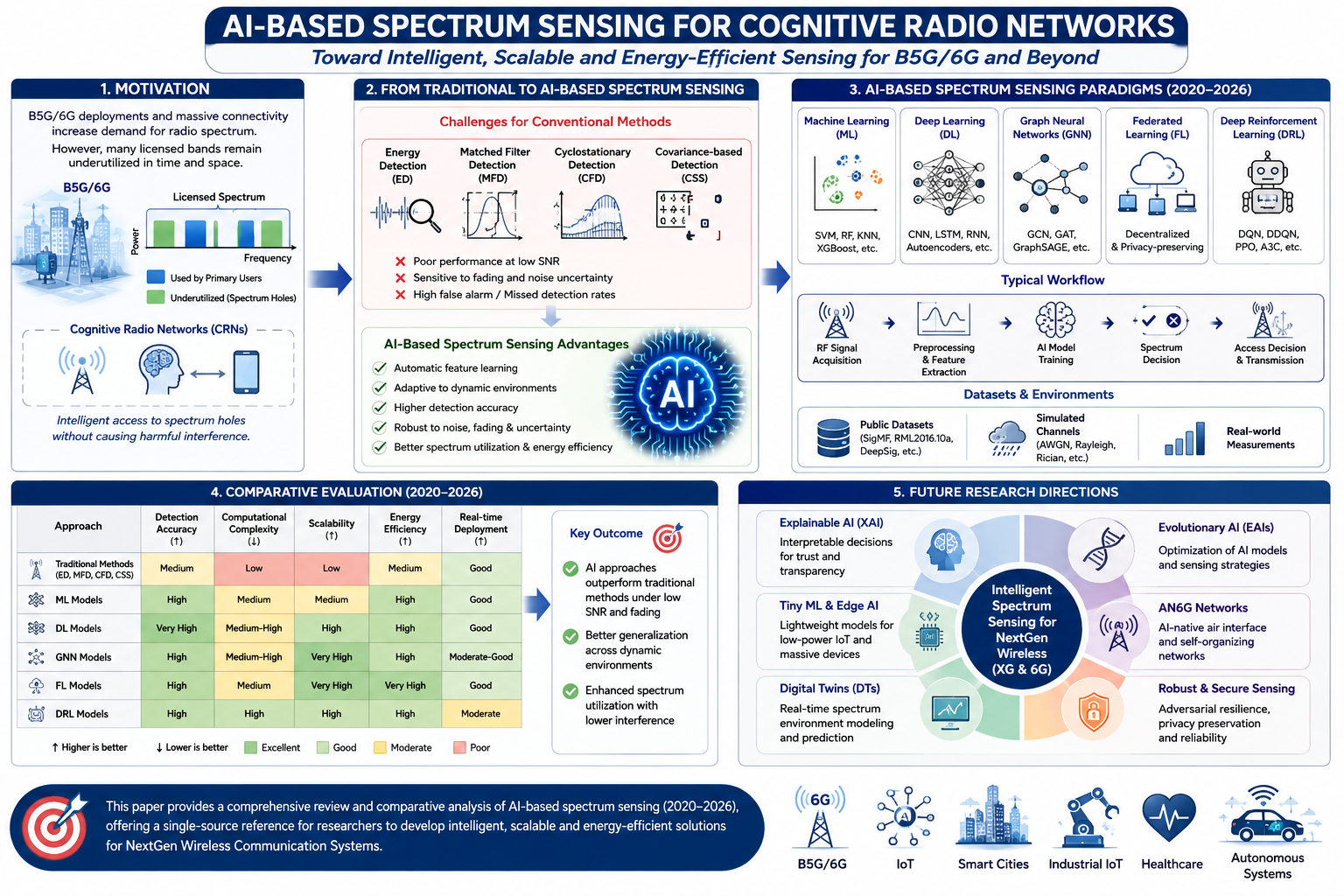
The B5G and 6G wireless communication system deployments have been expanding rapidly, increasing the need for better radio spectrum use. Despite being overwhelmed with applications for licenses to use specific frequency ranges of the radio spectrum, recent studies demonstrate that many of these licensees leave unused portions of their assigned frequencies available at various times and locations. Cognitive Radio Networks (CRNs) provide an intelligent way to utilize more efficiently existing unlicensed radio spectrum while minimizing interference to licensed users. To enable this type of operation, spectrum sensing has become the essential enabling technology of CRNs. However, due to numerous factors, the conventional methods for conducting spectrum sensing, i.e., ED, MFD, CFD, and CSS are subject to reduced performance when operating under low SNRs, fading channel conditions, and other characteristics typical of dynamic wireless communications. Advances in artificial intelligence (AI) have enabled new forms of machine-based spectrum sensing technologies which allow for advanced features to be extracted automatically, adapt to changing environments, and make decisions autonomously. In addition to improvements in detection accuracy, AI-based spectrum sensing solutions can also increase the robustness and overall usage of wireless spectrum compared to traditional approaches. As a result, this paper provides an overview of AI-based spectrum sensing solutions for future CRN systems. State-of-the art ML, DL, GNN, FL, and DRL models developed between 2020-2026 were reviewed and analyzed using comparative evaluations regarding detection accuracy, computational complexity, scalability, energy efficiency, and ability for real time deployment. Additionally, several open research topics and potential future directions for the development of intelligent AI-based spectrum sensing solutions for NextGen Wireless Communications Systems including XAI, Tiny ML, DTs, EAIs and AN6G Networks will be described. Therefore, this paper provides researchers a single source reference for developing intelligent, scalable and energy efficient spectrum sensing solutions for NextGen wireless communication systems.
Article Details
Section

This work is licensed under a Creative Commons Attribution-NonCommercial 4.0 International License.
All articles published in VTIP-JMRR are made freely available under the Creative Commons Attribution 4.0 International License (CC BY 4.0). Under this license, others may freely share, distribute, and adapt the published work, provided appropriate credit is given to the original authors.
By signing the copyright form, the author(s) warrant and represent that:
✓ The manuscript is original and has not been published previously in any journal, conference, or book (in whole or in part).
✓ The manuscript is not currently under consideration for publication elsewhere.
✓ All authors have read and approved the final manuscript and have agreed to this copyright transfer.
✓ The manuscript does not infringe upon any existing copyright, trademark, patent, or other intellectual property right of any third party.
✓ All data, figures, and tables presented are accurate, authentic, and have not been fabricated or falsified.
✓ Proper permissions have been obtained for any third-party material (images, figures, tables, text) included in the manuscript.
✓ The work complies with all applicable ethical guidelines, including those related to human and animal research.
✓ All sources of funding and conflicts of interest have been disclosed in the manuscript.
How to Cite
References
[1] Mitola, J., III, & Maguire, G. Q., Jr. (1999). Cognitive radio: Making software radios more personal. IEEE Personal Communications, 6(4), 13–18. https://doi.org/10.1109/98.788210
[2] Haykin, S. (2005). Cognitive radio: Brain-empowered wireless communications. IEEE Journal on Selected Areas in Communications, 23(2), 201–220. https://doi.org/10.1109/JSAC.2004.839380
[3] Axell, E., Leus, G., Larsson, E. G., & Poor, H. V. (2012). Spectrum sensing for cognitive radio: State-of-the-art and recent advances. IEEE Signal Processing Magazine, 29(3), 101–116. https://doi.org/10.1109/MSP.2012.2183771
[4] Bkassiny, M., Li, Y., & Jayaweera, S. K. (2013). A survey on machine-learning techniques in cognitive radios. IEEE Communications Surveys & Tutorials, 15(3), 1136–1159. https://doi.org/10.1109/SURV.2012.100412.00017
[5] Ali, A., & Hamouda, W. (2017). Advances on spectrum sensing for cognitive radio networks: Theory and applications. IEEE Communications Surveys & Tutorials, 19(2), 1277–1304. https://doi.org/10.1109/COMST.2016.2631080
[6] Falco, M., Pagano, A., & Croce, D. (2026). AI-driven spectrum sensing: An in-depth meta-analysis of trends, challenges and opportunities. Computer Networks, 275, Article 111789. https://doi.org/10.1016/j.comnet.2025.111789
[7] Falco, M., Scarvaglieri, A., Busacca, F., Nosrati, F., & Croce, D. (2026). The evolution of dynamic spectrum sensing: A two-decade survey from foundations to frontiers. Computer Networks, 278, Article 112095.
[8] Pant, P., & Srivastava, N. (2025). AI-enhanced spectrum sensing cognitive radio networks: Revolutionizing 5G and beyond. IETE Journal of Research. Advance online publication. https://doi.org/10.1080/03772063.2025.2547995
[9] Raji, A. A., & Olwal, T. O. (2025). Spectrum sensing in cognitive radio Internet of Things: State-of-the-art, applications, challenges, and future prospects. Journal of Sensors and Actuator Networks, 14(6), Article 109. https://doi.org/10.3390/jsan14060109
[10] Yi, P., & Liang, Y.-C. (2026). Collaborative spectrum sensing in cognitive and intelligent wireless networks: An artificial intelligence perspective [Preprint]. arXiv. https://arxiv.org/abs/2602.09615
[11] Guimarães, D. A. (2025). A survey of performance metrics for spectrum sensing and spectrum hole geolocation for wireless spectrum access. Sensors, 25(12), Article 3770. https://doi.org/10.3390/s25123770
[12] Syed, S. N., Lazaridis, P. I., Khan, F. A., Ahmed, Q. Z., Hafeez, M., Ivanov, A., Poulkov, V., & Zaharis, Z. D. (2023). Deep neural networks for spectrum sensing: A review. IEEE Access, 11, 89591–89615.
[13] Arianti, R., Ariananda, D. D., & Wibowo, S. B. (2025). Machine learning-based spectrum sensing in cognitive radio networks: A systematic review. In 2025 International Conference on Information Technology and Computing (ICITCOM) (pp. 134–139). IEEE.
[14] Gbenga-Ilori, A., Imoize, A. L., Noor, K., & Adebolu-Ololade, P. O. (2025). Artificial intelligence empowering dynamic spectrum access in advanced wireless communications: A comprehensive overview. AI, 6(6), Article 126. https://doi.org/10.3390/ai6060126
[15] Sun, H., Nallanathan, A., Wang, C.-X., & Chen, Y. (2013). Wideband spectrum sensing for cognitive radio networks: A survey. IEEE Wireless Communications, 20(2), 74–81. https://doi.org/10.1109/MWC.2013.6507397
[16] Song, Z., Gao, Y., & Tafazolli, R. (2021). A survey on spectrum sensing and learning technologies for 6G. IEICE Transactions on Communications, E104.B(10), 1207–1216.
[17] Manco, J., Dayoub, I., Nafkha, A., Alibakhshikenari, M., & Ben Thameur, H. (2022). Spectrum sensing using software defined radio for cognitive radio networks: A survey. IEEE Access, 10, 36397–36437.
[18] Soni, B., Patel, D. K., & López-Benítez, M. (2020). Long short-term memory based spectrum sensing scheme for cognitive radio using primary activity statistics. IEEE Access, 8, 97437–97451. https://doi.org/10.1109/ACCESS.2020.2995633
[19] Shi, Z., Gao, W., Zhang, S., Liu, J., & Kato, N. (2020). Machine learning-enabled cooperative spectrum sensing for non-orthogonal multiple access. IEEE Transactions on Wireless Communications, 19(9), 5692–5702.
[20] Hirzallah, M., Krunz, M., & Kecicioglu, B. (2020). 5G New Radio unlicensed: Challenges and evaluation. IEEE Transactions on Cognitive Communications and Networking.
[21] Arjoune, Y., & Kaabouch, N. (2019). A comprehensive survey on spectrum sensing in cognitive radio networks: Recent advances, new challenges, and future research directions. Sensors, 19(1), Article 126. https://doi.org/10.3390/s19010126
[22] Nasser, A., Al Haj Hassan, H., Abou Chaaya, J., Mansour, A., & Yao, K.-C. (2021). Spectrum sensing for cognitive radio: Recent advances and future challenge. Sensors, 21(7), Article 2408. https://doi.org/10.3390/s21072408
[23] Upadhye, A., Saravanan, P., Chandra, S. S., & Gurugopinath, S. (2021). A survey on machine learning algorithms for applications in cognitive radio networks. In 2021 IEEE International Conference on Electronics, Computing and Communication Technologies (CONECCT) (pp. 1–6). IEEE.
[24] Liang, Y.-C., Zeng, Y., Peh, E. C. Y., & Hoang, A. T. (2008). Sensing-throughput tradeoff for cognitive radio networks. IEEE Transactions on Wireless Communications, 7(4), 1326–1337. https://doi.org/10.1109/TWC.2008.060869
[25] Yücek, T., & Arslan, H. (2009). A survey of spectrum sensing algorithms for cognitive radio applications. IEEE Communications Surveys & Tutorials, 11(1), 116–130. https://doi.org/10.1109/SURV.2009.090109
[26] Kim, H., & Shin, K. G. (2008). Efficient discovery of spectrum opportunities with MAC-layer sensing in cognitive radio networks. IEEE Transactions on Mobile Computing, 7(5), 533–545. https://doi.org/10.1109/TMC.2007.70751
[27] Liang, Y.-C., Chen, K.-C., Li, G. Y., & Mähönen, P. (2011). Cognitive radio networking and communications: An overview. IEEE Transactions on Vehicular Technology, 60(7), 3386–3407. https://doi.org/10.1109/TVT.2011.2158673
[28] Akyildiz, I. F., Lee, W.-Y., Vuran, M. C., & Mohanty, S. (2006). NeXt generation/dynamic spectrum access/cognitive radio wireless networks: A survey. Computer Networks, 50(13), 2127–2159. https://doi.org/10.1016/j.comnet.2006.05.001
[29] Haykin, S., Thomson, D. J., & Reed, J. H. (2009). Spectrum sensing for cognitive radio. Proceedings of the IEEE, 97(5), 849–877. https://doi.org/10.1109/JPROC.2009.2015711