
AI-SMIS: An Explainable, Evidence-Grounded Framework for Stock Market Intelligence — System Architecture and Pre-Specified Evaluation Protocol
Article Sidebar
Main Article Content
Abstract
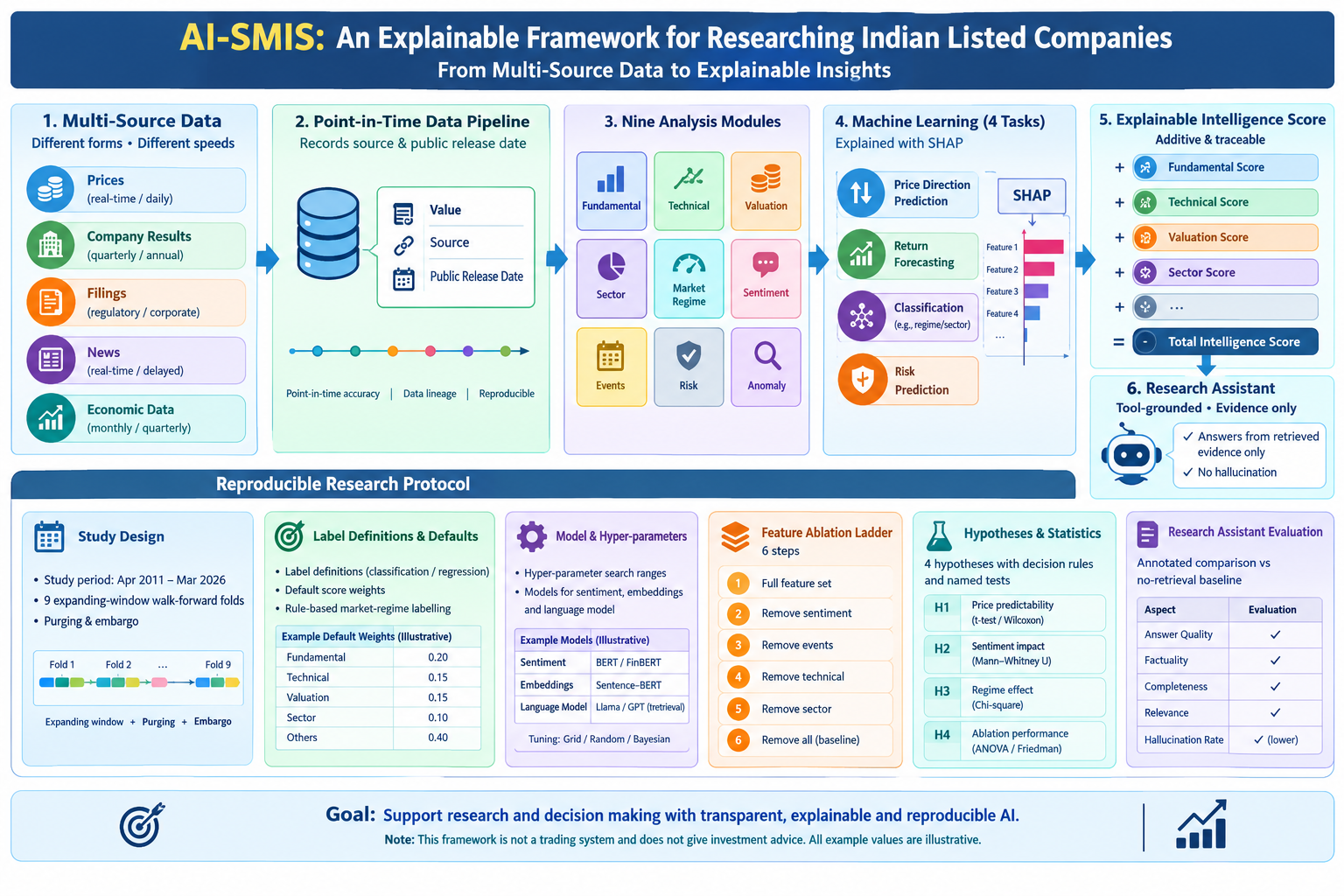
Investors and researchers must combine prices, company results, filings, news and economic data that arrive in different forms and at different speeds. Simple screeners apply a few fixed filters, and many machine-learning tools predict prices without explaining their answers. This paper describes the architecture of AI-SMIS, an explainable framework for researching Indian listed companies, and fixes in advance the protocol by which it will be tested. The framework combines a point-in-time data pipeline that records the source and public-release date of every value; nine analysis modules (fundamental, technical, valuation, sector, market regime, sentiment, events, risk and anomaly); four machine-learning tasks explained with SHAP; an additive intelligence score whose changes can be traced exactly to its components; and a tool-grounded research assistant that answers only from retrieved evidence. For reproducibility, the paper specifies the study period (April 2011 to March 2026), nine expanding-window walk-forward folds with purging and embargo, label definitions, default score weights, rule-based market-regime labelling, hyper-parameter search ranges, and the models used for sentiment, embeddings and the language model. It also pre-specifies a six-step feature-ablation ladder, four hypotheses with quantitative decision rules and named statistical tests, and an annotated evaluation of the research assistant against a no-retrieval baseline. No empirical results are reported here; all example values are illustrative and are labelled as such. The framework supports research and decision making; it is not a trading system and does not give investment advice.
Article Details
Section

This work is licensed under a Creative Commons Attribution-NonCommercial 4.0 International License.
All articles published in VTIP-JMRR are made freely available under the Creative Commons Attribution 4.0 International License (CC BY 4.0). Under this license, others may freely share, distribute, and adapt the published work, provided appropriate credit is given to the original authors.
By signing the copyright form, the author(s) warrant and represent that:
✓ The manuscript is original and has not been published previously in any journal, conference, or book (in whole or in part).
✓ The manuscript is not currently under consideration for publication elsewhere.
✓ All authors have read and approved the final manuscript and have agreed to this copyright transfer.
✓ The manuscript does not infringe upon any existing copyright, trademark, patent, or other intellectual property right of any third party.
✓ All data, figures, and tables presented are accurate, authentic, and have not been fabricated or falsified.
✓ Proper permissions have been obtained for any third-party material (images, figures, tables, text) included in the manuscript.
✓ The work complies with all applicable ethical guidelines, including those related to human and animal research.
✓ All sources of funding and conflicts of interest have been disclosed in the manuscript.
How to Cite
References
[1] S. Gu, B. Kelly, and D. Xiu, "Empirical asset pricing via machine learning," Rev. Financ. Stud., vol. 33, no. 5, pp. 2223–2273, 2020, doi: 10.1093/rfs/hhaa009.
[2] W. Jiang, "Applications of deep learning in stock market prediction: Recent progress," Expert Syst. Appl., vol. 184, Art. no. 115537, 2021, doi: 10.1016/j.eswa.2021.115537.
[3] J. Patel, S. Shah, P. Thakkar, and K. Kotecha, "Predicting stock and stock price index movement using trend deterministic data preparation and machine learning techniques," Expert Syst. Appl., vol. 42, no. 1, pp. 259–268, 2015, doi: 10.1016/j.eswa.2014.07.040.
[4] S. Selvin, R. Vinayakumar, E. A. Gopalakrishnan, V. K. Menon, and K. P. Soman, "Stock price prediction using LSTM, RNN and CNN-sliding window model," in Proc. Int. Conf. Adv. Comput., Commun. Informat. (ICACCI), Manipal, India, 2017, pp. 1643–1647, doi: 10.1109/ICACCI.2017.8126078.
[5] C. Rudin, "Stop explaining black box machine learning models for high stakes decisions and use interpretable models instead," Nat. Mach. Intell., vol. 1, no. 5, pp. 206–215, 2019, doi: 10.1038/s42256-019-0048-x.
[6] F. Doshi-Velez and B. Kim, "Towards a rigorous science of interpretable machine learning," arXiv:1702.08608, 2017.
[7] M. López de Prado, Advances in Financial Machine Learning. Hoboken, NJ, USA: Wiley, 2018.
[8] D. H. Bailey, J. M. Borwein, M. López de Prado, and Q. J. Zhu, "Pseudo-mathematics and financial charlatanism: The effects of backtest overfitting on out-of-sample performance," Notices Amer. Math. Soc., vol. 61, no. 5, pp. 458–471, 2014.
[9] S. J. Brown, W. N. Goetzmann, R. G. Ibbotson, and S. A. Ross, "Survivorship bias in performance studies," Rev. Financ. Stud., vol. 5, no. 4, pp. 553–580, 1992, doi: 10.1093/rfs/5.4.553.
[10] Z. Ji et al., "Survey of hallucination in natural language generation," ACM Comput. Surv., vol. 55, no. 12, pp. 1–38, 2023, doi: 10.1145/3571730.
[11] P. Islam, A. Kannappan, D. Kiela, R. Qian, N. Scherrer, and B. Vidgen, "FinanceBench: A new benchmark for financial question answering," arXiv:2311.11944, 2023.
[12] H. Kang and X.-Y. Liu, "Deficiency of large language models in finance: An empirical examination of hallucination," in NeurIPS 2023 Workshop on I Can't Believe It's Not Better (ICBINB), 2023, arXiv:2311.15548.
[13] E. F. Fama and K. R. French, "Common risk factors in the returns on stocks and bonds," J. Financ. Econ., vol. 33, no. 1, pp. 3–56, 1993, doi: 10.1016/0304-405X(93)90023-5.
[14] N. Jegadeesh and S. Titman, "Returns to buying winners and selling losers: Implications for stock market efficiency," J. Finance, vol. 48, no. 1, pp. 65–91, 1993, doi: 10.1111/j.1540-6261.1993.tb04702.x.
[15] C. R. Harvey, Y. Liu, and H. Zhu, "… and the cross-section of expected returns," Rev. Financ. Stud., vol. 29, no. 1, pp. 5–68, 2016, doi: 10.1093/rfs/hhv059.
[16] T. Fischer and C. Krauss, "Deep learning with long short-term memory networks for financial market predictions," Eur. J. Oper. Res., vol. 270, no. 2, pp. 654–669, 2018, doi: 10.1016/j.ejor.2017.11.054.
[17] L. Breiman, "Random forests," Mach. Learn., vol. 45, no. 1, pp. 5–32, 2001, doi: 10.1023/A:1010933404324.
[18] T. Chen and C. Guestrin, "XGBoost: A scalable tree boosting system," in Proc. 22nd ACM SIGKDD Int. Conf. Knowl. Discov. Data Min., 2016, pp. 785–794, doi: 10.1145/2939672.2939785.
[19] G. Ke et al., "LightGBM: A highly efficient gradient boosting decision tree," in Adv. Neural Inf. Process. Syst., vol. 30, 2017, pp. 3146–3154.
[20] P. C. Tetlock, "Giving content to investor sentiment: The role of media in the stock market," J. Finance, vol. 62, no. 3, pp. 1139–1168, 2007, doi: 10.1111/j.1540-6261.2007.01232.x.
[21] D. Araci, "FinBERT: Financial sentiment analysis with pre-trained language models," arXiv:1908.10063, 2019.
[22] S. Wu et al., "BloombergGPT: A large language model for finance," arXiv:2303.17564, 2023.
[23] H. Yang, X.-Y. Liu, and C. D. Wang, "FinGPT: Open-source financial large language models," arXiv:2306.06031, 2023.
[24] S. M. Lundberg and S.-I. Lee, "A unified approach to interpreting model predictions," in Adv. Neural Inf. Process. Syst., vol. 30, 2017, pp. 4765–4774.
[25] C. Guo, G. Pleiss, Y. Sun, and K. Q. Weinberger, "On calibration of modern neural networks," in Proc. 34th Int. Conf. Mach. Learn. (ICML), PMLR vol. 70, 2017, pp. 1321–1330.
[26] J. D. Hamilton, "A new approach to the economic analysis of nonstationary time series and the business cycle," Econometrica, vol. 57, no. 2, pp. 357–384, 1989, doi: 10.2307/1912559.
[27] A. R. Pagan and K. A. Sossounov, "A simple framework for analysing bull and bear markets," J. Appl. Econometrics, vol. 18, no. 1, pp. 23–46, 2003, doi: 10.1002/jae.664.
[28] A. Lunde and A. Timmermann, "Duration dependence in stock prices: An analysis of bull and bear markets," J. Bus. Econ. Statist., vol. 22, no. 3, pp. 253–273, 2004.
[29] P. Lewis et al., "Retrieval-augmented generation for knowledge-intensive NLP tasks," in Adv. Neural Inf. Process. Syst., vol. 33, 2020, pp. 9459–9474.
[30] S. Yao et al., "ReAct: Synergizing reasoning and acting in language models," in Proc. Int. Conf. Learn. Represent. (ICLR), 2023, arXiv:2210.03629.
[31] Y. Yu et al., "FinMem: A performance-enhanced LLM trading agent with layered memory and character design," IEEE Trans. Big Data, vol. 11, no. 6, 2025 (preprint arXiv:2311.13743).
[32] Y. Xiao, E. Sun, D. Luo, and W. Wang, "TradingAgents: Multi-agents LLM financial trading framework," arXiv:2412.20138, 2024.
[33] Q. Xie et al., "FinBen: A holistic financial benchmark for large language models," in Adv. Neural Inf. Process. Syst. (Datasets and Benchmarks Track), vol. 37, 2024, doi: 10.52202/079017-3033.
[34] S. Es, J. James, L. Espinosa-Anke, and S. Schockaert, "RAGAs: Automated evaluation of retrieval augmented generation," in Proc. 18th Conf. Eur. Chapter Assoc. Comput. Linguist.: Syst. Demonstrations, St. Julians, Malta, 2024, pp. 150–158.
[35] R. R. Varghese and B. R. Mohan, "The causal effect of financial news on Indian stock market," in Proc. IEEE Region 10 Conf. (TENCON), 2022, doi: 10.1109/TENCON55691.2022.9977706.
[36] R. R. Varghese and B. R. Mohan, "Dynamics of nonlinear causality: Exploring the influence of positive and negative financial news on the Indian equity market," in Proc. Annu. Int. Conf. Emerg. Res. Areas: Int. Conf. Intell. Syst. (AICERA/ICIS), IEEE, 2023.
[37] S. A. Balasubramanian, J. N. Christina, and P. Sridevi, "Financial sentiment analysis of news articles with long text corpus for equity portfolio construction," Int. J. Indian Cult. Bus. Manag., vol. 34, no. 3, pp. 389–407, 2025.
[38] Chaithra, K. Kadimisetty, and B. R. Mohan, "Adaptive financial sentiment analysis for NIFTY 50 via instruction-tuned LLMs, RAG and reinforcement learning approaches," arXiv:2512.20082, 2025.
[39] Upstox, "Upstox developer API documentation." [Online]. Available: https://upstox.com/developer/api-documentation/
[40] National Stock Exchange of India, "NSE India." [Online]. Available: https://www.nseindia.com
[41] Securities and Exchange Board of India, "SEBI." [Online]. Available: https://www.sebi.gov.in
[42] F. Pedregosa et al., "Scikit-learn: Machine learning in Python," J. Mach. Learn. Res., vol. 12, pp. 2825–2830, 2011.
[43] A. Damodaran, Investment Valuation: Tools and Techniques for Determining the Value of Any Asset, 3rd ed. Hoboken, NJ, USA: Wiley, 2012.
[44] F. T. Liu, K. M. Ting, and Z.-H. Zhou, "Isolation forest," in Proc. 8th IEEE Int. Conf. Data Min. (ICDM), 2008, pp. 413–422, doi: 10.1109/ICDM.2008.17.
[45] A. Grattafiori et al., "The Llama 3 herd of models," arXiv:2407.21783, 2024.
[46] S. Xiao, Z. Liu, P. Zhang, N. Muennighoff, D. Lian, and J.-Y. Nie, "C-Pack: Packed resources for general Chinese embeddings," in Proc. 47th Int. ACM SIGIR Conf. Res. Develop. Inf. Retr., 2024, doi: 10.1145/3626772.3657878.
[47] K. Järvelin and J. Kekäläinen, "Cumulated gain-based evaluation of IR techniques," ACM Trans. Inf. Syst., vol. 20, no. 4, pp. 422–446, 2002.
[48] D. N. Politis and J. P. Romano, "The stationary bootstrap," J. Amer. Statist. Assoc., vol. 89, no. 428, pp. 1303–1313, 1994.
[49] F. Wilcoxon, "Individual comparisons by ranking methods," Biometrics Bull., vol. 1, no. 6, pp. 80–83, 1945.
[50] S. Holm, "A simple sequentially rejective multiple test procedure," Scand. J. Statist., vol. 6, no. 2, pp. 65–70, 1979.
[51] Y. Benjamini and Y. Hochberg, "Controlling the false discovery rate: A practical and powerful approach to multiple testing," J. Roy. Statist. Soc. B, vol. 57, no. 1, pp. 289–300, 1995.
[52] J. Cohen, "A coefficient of agreement for nominal scales," Educ. Psychol. Meas., vol. 20, no. 1, pp. 37–46, 1960.
[53] Securities and Exchange Board of India, SEBI (Investment Advisers) Regulations, 2013. [Online]. Available: https://www.sebi.gov.in/legal/regulations/jan-2013/sebi-investment-advisors-regulations-2013_26872.html
[54] B. A. Nosek, C. R. Ebersole, A. C. DeHaven, and D. T. Mellor, "The preregistration revolution," Proc. Natl. Acad. Sci. USA, vol. 115, no. 11, pp. 2600–2606, 2018, doi: 10.1073/pnas.1708274114.