Formulation and Evaluation of Herbal Transdermal Patch for Treatment of Rheumatoid Arthritis
Article Sidebar
Main Article Content
Abstract
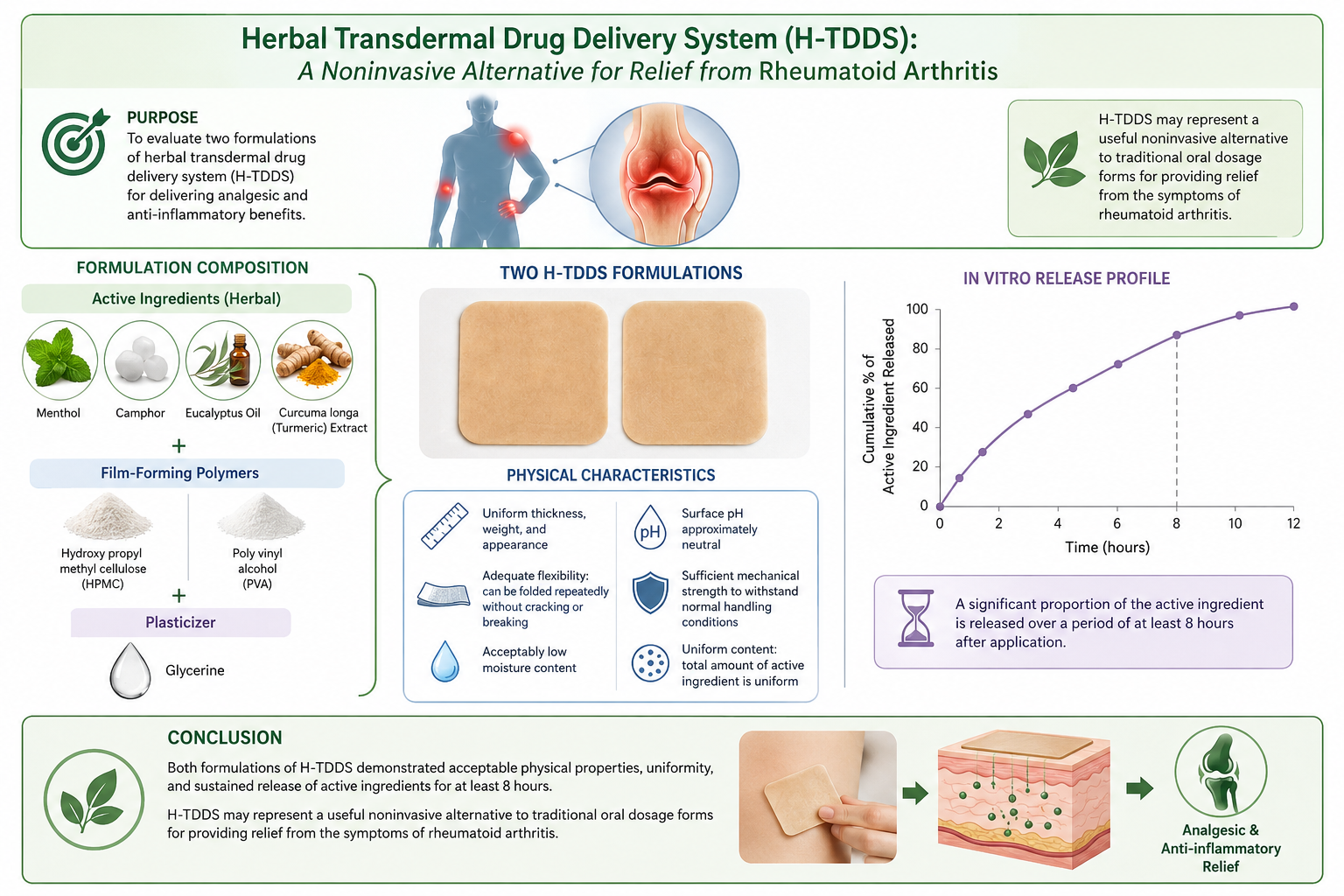
The purpose of this study was to evaluate two formulations of herbal transdermal drug delivery system (H-TDDS). Each H-TDDS contains; Menthol, Camphor, Eucalyptus Oil and Curcuma longa (Turmeric) extract as active ingredients which are known for its analgesic and anti-inflammatory properties. These ingredients are combined within hydroxy propyl methyl cellulose (HPMC) and poly vinyl alcohol (PVA) films, along with glycerine as a plasticizer. Physically each H-TDDS has a uniform thickness, weight, and appearance. They both have adequate flexibility so they can be folded repeatedly without cracking or breaking apart. Each patch has an acceptably low moisture content. The surface pH of each H-TDDS is approximately neutral. Each H-TDDS has sufficient mechanical strength to withstand normal handling conditions. The total amount of active ingredient contained in each H-TDDS is uniform. A significant proportion of the active ingredient is released over a period of at least 8 hours after application. Therefore it appears that H-TDDS may represent a useful noninvasive alternative to traditional oral dosage forms for providing relief from the symptoms of rheumatoid arthritis.
Article Details
Section

This work is licensed under a Creative Commons Attribution-NonCommercial 4.0 International License.
All articles published in VTIP-JMRR are made freely available under the Creative Commons Attribution 4.0 International License (CC BY 4.0). Under this license, others may freely share, distribute, and adapt the published work, provided appropriate credit is given to the original authors.
By signing the copyright form, the author(s) warrant and represent that:
✓ The manuscript is original and has not been published previously in any journal, conference, or book (in whole or in part).
✓ The manuscript is not currently under consideration for publication elsewhere.
✓ All authors have read and approved the final manuscript and have agreed to this copyright transfer.
✓ The manuscript does not infringe upon any existing copyright, trademark, patent, or other intellectual property right of any third party.
✓ All data, figures, and tables presented are accurate, authentic, and have not been fabricated or falsified.
✓ Proper permissions have been obtained for any third-party material (images, figures, tables, text) included in the manuscript.
✓ The work complies with all applicable ethical guidelines, including those related to human and animal research.
✓ All sources of funding and conflicts of interest have been disclosed in the manuscript.
How to Cite
References
[1] Smolen, J. S., Aletaha, D., & McInnes, I. B. (2016). Rheumatoid arthritis. The Lancet, 388(10055), 2023–2038. https://doi.org/10.1016/S0140-6736(16)30173-8
[2] Aletaha, D., Neogi, T., Silman, A. J., Funovits, J., Felson, D. T., Bingham, C. O., III, Birnbaum, N. S., Burmester, G. R., Bykerk, V. P., Cohen, M. D., Combe, B., Costenbader, K. H., Dougados, M., Emery, P., Ferraccioli, G., Hazes, J. M. W., Hobbs, K., Huizinga, T. W. J., Kavanaugh, A., … Hawker, G. (2010). 2010 Rheumatoid arthritis classification criteria: An American College of Rheumatology/European League Against Rheumatism collaborative initiative. Arthritis & Rheumatism, 62(9), 2569–2581. https://doi.org/10.1002/art.27584
[3] Firestein, G. S. (2003). Evolving concepts of rheumatoid arthritis. Nature, 423(6937), 356–361. https://doi.org/10.1038/nature01661
[4] Wolfe, M. M., Lichtenstein, D. R., & Singh, G. (1999). Gastrointestinal toxicity of nonsteroidal antiinflammatory drugs. New England Journal of Medicine, 340(24), 1888–1899. https://doi.org/10.1056/NEJM199906173402407
[5] Ansel, H. C., Popovich, N. G., & Allen, L. V. (2021). Ansel's pharmaceutical dosage forms and drug delivery systems (11th ed.). Wolters Kluwer Health.
[6] Patel, D., Chaudhary, S. A., Parmar, B., & Bhura, N. (2012). Transdermal drug delivery system: A review. The Pharma Innovation Journal, 1(4), 66–75.
[7] Prausnitz, M. R., & Langer, R. (2008). Transdermal drug delivery. Nature Biotechnology, 26(11), 1261–1268. https://doi.org/10.1038/nbt.1504
[8] Gupta, R., Badhe, Y., & Rai, J. (2019). Herbal formulations used in pain management and inflammation. International Journal of Pharmaceutical Sciences Review and Research, 58(1), 45–52.
[9] Aggarwal, B. B., & Harikumar, K. B. (2009). Potential therapeutic effects of curcumin, the anti-inflammatory agent, against neurodegenerative, cardiovascular, pulmonary, metabolic, autoimmune and neoplastic diseases. International Journal of Biochemistry & Cell Biology, 41(1), 40–59. https://doi.org/10.1016/j.biocel.2008.06.010
[10] Grzanna, R., Lindmark, L., & Frondoza, C. G. (2005). Ginger: An herbal medicinal product with broad anti-inflammatory actions. Journal of Medicinal Food, 8(2), 125–132. https://doi.org/10.1089/jmf.2005.8.125
[11] Chien, Y. W. (2019). Novel drug delivery systems (2nd ed.). Marcel Dekker.
[12] Barry, B. W. (2001). Novel mechanisms and devices to enable successful transdermal drug delivery. European Journal of Pharmaceutical Sciences, 14(2), 101–114. https://doi.org/10.1016/S0928-0987(01)00167-1
[13] Kalia, Y. N., & Guy, R. H. (2001). Modeling transdermal drug release. Advanced Drug Delivery Reviews, 48(2–3), 159–172. https://doi.org/10.1016/S0169-409X(01)00113-2
[14] Prausnitz, M. R., Mitragotri, S., & Langer, R. (2004). Current status and future potential of transdermal drug delivery. Nature Reviews Drug Discovery, 3(2), 115–124. https://doi.org/10.1038/nrd1304
[15] Singh, J., Tripathi, K. T., & Sakia, T. R. (1993). Effect of penetration enhancers on the in vitro permeation of ephedrine through rat skin from matrix-based transdermal formulations. Drug Development and Industrial Pharmacy, 19(13), 1623–1628. https://doi.org/10.3109/03639049309069304
[16] Aggarwal, B. B., Kumar, A., & Bharti, A. C. (2003). Anticancer potential of curcumin: Preclinical and clinical studies. Anticancer Research, 23(1A), 363–398.
[17] Anand, P., Kunnumakkara, A. B., Newman, R. A., & Aggarwal, B. B. (2007). Bioavailability of curcumin: Problems and promises. Molecular Pharmaceutics, 4(6), 807–818. https://doi.org/10.1021/mp700113r
[18] Altman, R. D., & Marcussen, K. C. (2001). Effects of a ginger extract on knee pain in patients with osteoarthritis. Arthritis & Rheumatism, 44(11), 2531–2538. https://doi.org/10.1002/1529-0131(200111)44:11<2531::AID-ART433>3.0.CO;2-J
[19] Patel, T., Ishiuji, Y., & Yosipovitch, G. (2007). Menthol: A refreshing look at this ancient compound. Journal of the American Academy of Dermatology, 57(5), 873–878. https://doi.org/10.1016/j.jaad.2007.04.008
[20] Jain, N. K. (2019). Controlled and novel drug delivery (1st ed.). CBS Publishers and Distributors.
[21] Indian Pharmacopoeia Commission. (2022). Indian pharmacopoeia. Ministry of Health and Family Welfare.