
Progress in Ferrocement-Confinement Techniques for Self-Compacting Concrete: Structural Insights
Article Sidebar
Main Article Content
Abstract
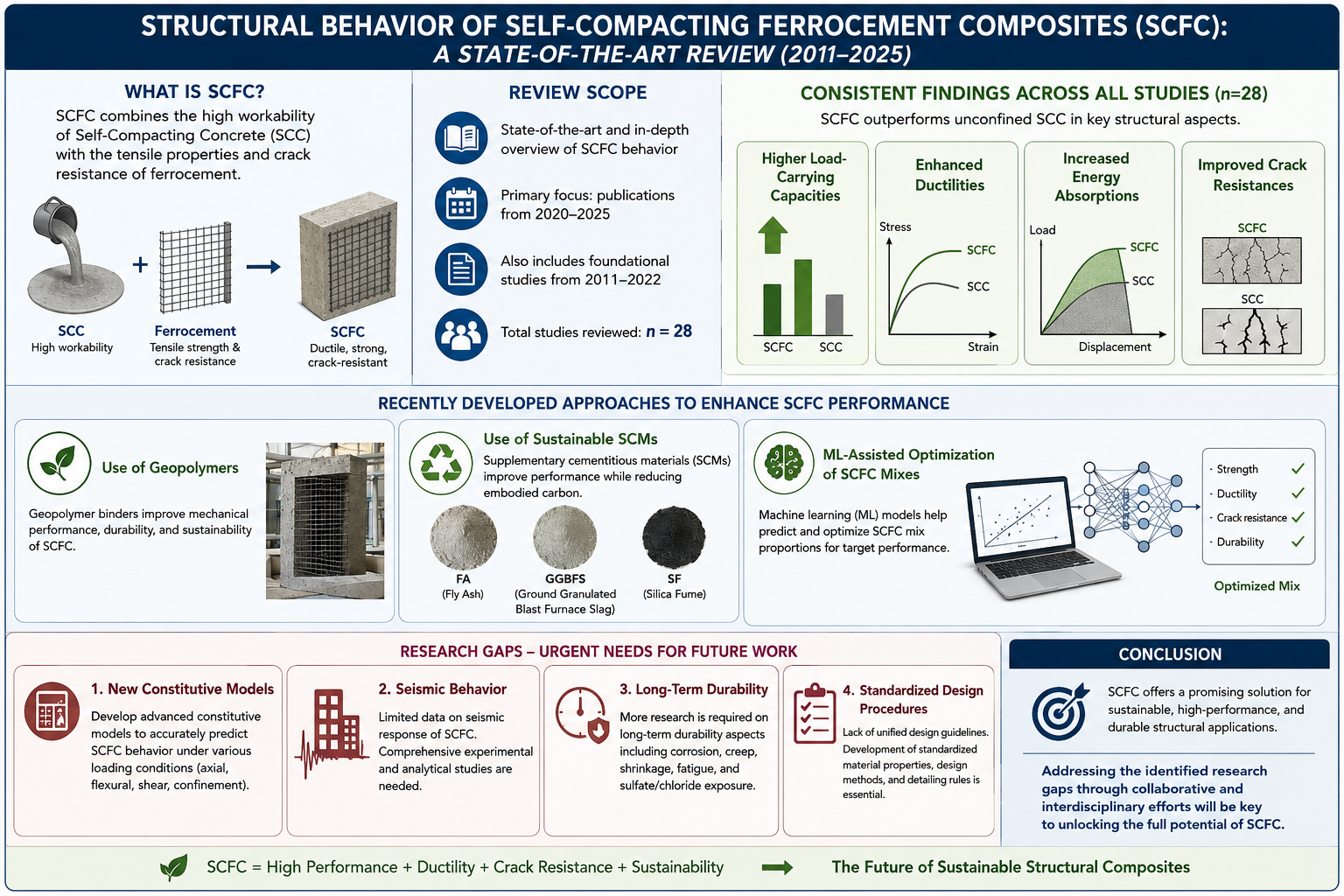
This review paper offers a state-of-the-art, and in-depth overview of how SCFC behaves structurally. SCFC combines the high workability of SCC with the tensile properties and crack resistance of ferrocement. The review primarily includes publications between 2020–2025. In addition to these recent studies, it also includes some foundational studies conducted in 2011–2022. Across all studies reviewed (n=28), there was consistency in terms of what is known about the effects of confining ferrocement on SCC. Specifically, the results show that SCC confined with ferrocement can provide higher load-carrying capacities, enhanced ductilities, increased energy absorptions, and improved crack resistances than unconfined SCC. Some examples of more recently developed approaches for enhancing the performance of SCFC include using geopolymers; the use of sustainable SCM's (e.g., FA, GGBFS, SF); and ML-assisted optimization of SCFC mixes. Finally, the Review Paper includes a separate discussion on research gaps which identifies those problems most urgently requiring resolution. These include developing new constitutive models for predicting SCFC behavior under various loading conditions; assessing seismic behavior; evaluating long-term durability; and establishing standardized design procedures.
Article Details
Section

This work is licensed under a Creative Commons Attribution-NonCommercial 4.0 International License.
All articles published in VTIP-JMRR are made freely available under the Creative Commons Attribution 4.0 International License (CC BY 4.0). Under this license, others may freely share, distribute, and adapt the published work, provided appropriate credit is given to the original authors.
By signing the copyright form, the author(s) warrant and represent that:
✓ The manuscript is original and has not been published previously in any journal, conference, or book (in whole or in part).
✓ The manuscript is not currently under consideration for publication elsewhere.
✓ All authors have read and approved the final manuscript and have agreed to this copyright transfer.
✓ The manuscript does not infringe upon any existing copyright, trademark, patent, or other intellectual property right of any third party.
✓ All data, figures, and tables presented are accurate, authentic, and have not been fabricated or falsified.
✓ Proper permissions have been obtained for any third-party material (images, figures, tables, text) included in the manuscript.
✓ The work complies with all applicable ethical guidelines, including those related to human and animal research.
✓ All sources of funding and conflicts of interest have been disclosed in the manuscript.
How to Cite
References
[1]. Okamura, H., & Ouchi, M. (2003). Self-compacting concrete. Journal of Advanced Concrete Technology, 1(1), 5–15.
[2]. Sonebi, M., & Abdalqader, A. (2022). Recent development and future trends in self-compacting concrete. ResearchGate. https://www.researchgate.net/publication/361763162
[3]. Ashefali, M. K. P., & George, S. (2022). Study of performance of prefabricated ferrocement in-filled and hollow beams. International Journal of Creative Research Thoughts, 10(8).
[4]. Hinge, R. D. (2019). Experimental study on behavior of self-compacting concrete confined with ferrocement. IOSR Journal of Engineering, 85–93.
[5]. Tanawade, A. G., & Modhera, C. D. (2019). Experimental study on self-compacting ferrocrete slab under axial compression load. Materials Today: Proceedings, 11, 1066–1072.
[6]. Shaabana, I. G., & Shaheen, Y. B. I. (2018). Flexural behaviour and theoretical prediction of lightweight ferrocement composite beams. Case Studies in Construction Materials, 9, e00204.
[7]. Shaheen, Y. B. I., & Eltehawy, E. A. (2017). Structural behaviour of ferrocement channel slabs for low-cost housing. Journal of Concrete Research Letters, 8(2), 48–64.
[8]. Dass, G., & Talwar, M. (2017). Review paper on ferrocement in construction. International Journal of Advanced Research in Computer Science, 8(4), 384–386.
[9]. Mohammed, A. A., & Assi, D. K. (2017). Tensile stress–strain relationship for ferrocement structures. ResearchGate. https://www.researchgate.net/publication/319483342
[10]. Shukla, K., & Tiwari, A. (2017). Self-compacting concrete mix design for M30. International Research Journal of Engineering and Technology, 4(7).
[11]. Kumar, K. K., & Kumar, S. K. (2016). Structural behaviour of ferrocement confined reinforced self-compacting concrete under axial compression. International Journal of Innovative Technology and Research, 4(5), 3721–3723.
[12]. Hajeri, S., & Halhalli, V. (2015). Structural behaviour of SCC confined with ferrocement under axial compression. International Journal of Research & Development in Technology, 4(4).
[13]. Deepika, K. N., & Srichandana, P. (2015). Experimental study on effects of ferrocement. ResearchGate.
[14]. Naaman, A. E. (2011). Evolution in ferrocement and thin reinforced cementitious composites. Arabian Journal for Science and Engineering. https://doi.org/10.1007/s13369-012-0187-4
[15]. Sood, D., Kumbhar, D., & Rao, P. N. (2015). An experimental study on fly-ash-based self-compacting ferrocement concrete. In Proceedings of AAICSET 2015.
[16]. Kulkarni, N. M., & Gaidhankar, D. G. (2013). Analysis and design of ferrocement panels: An experimental study. International Journal of Innovative Engineering Sciences, 1(5).
[17]. Nandhinisree, M., & Kumar, N. S. (2014). Structural behaviour of self-compacting concrete confined with ferrocement under axial compression. SSRG International Journal of Civil Engineering, 1(1).
[18]. Khatuja, V., Thakur, V. S., Singhania, A., & Rao, C. B. K. (2013). Toughness of ferrocement confined reinforced self-compacting concrete under axial compression. International Journal of Engineering Sciences & Research Technology, 4(5).
[19]. Ashraf, M., & Halhalli, V. (2013). Flexural behaviour of SCC ferrocement slabs incorporating steel fibers. International Journal of Engineering Research & Technology, 2(10).
[20]. Khan, S. U., Rafeeqi, S. F. A., & Ayub, T. (2013). Strengthening of RC beams in flexure using ferrocement. Iranian Journal of Science and Technology, Transactions of Civil Engineering, 37(C+), 353–365.
[21]. Gautam, K. R., & Kumar, S. (2022). An experimental analysis on ferrocement widely used in lighter, low-cost housing and insulation projects. Journal of Advanced Cement & Concrete Technology, 5(3).
[22]. Deepa Shri, S., & Thenmozhi, R. (2012). Experimental investigation on the flexural behavior of SCC ferrocement slabs incorporating fibers. International Journal of Engineering Science and Technology, 4(5).
[23]. Sasiekalaa, K., & Malathy, R. (2012). Review report on mechanical properties of ferrocement with cementitious materials. International Journal of Engineering Research & Technology, 1(9).
[24]. Chonratana, Y., & Chatpattananan, V. (2023). Seismic resistance analysis of frame structures and wall structures using ferrocement and expanded metal. Applied Sciences, 13(8), 4704. https://doi.org/10.3390/app13084704
[25]. Sun, Z., Guo, X., Shan, X., & Wang, S. (2021). Study on the seismic performance of strengthened reinforced concrete columns. Geofluids, 2021, Article 6663745. https://doi.org/10.1155/2021/6663745
[26]. Elsayed, T., & Deifalla, A. F. (2024). Review on the behavior of ferrocement in construction technology. In Civil Engineering, Material and Smart Buildings (ICATH 2023). Springer. https://doi.org/10.1007/978-3-031-76557-5_9
[27]. Onyelowe, K. C., & Kontoni, D. P. N. (2023). A critical review of rheological models in self-compacting concrete for sustainable structures. Scientific Reports, 13, 20966. https://doi.org/10.1038/s41598-023-48673-6
[28]. Self-compacting concrete with fly ash and silica fume: Experimental evaluation, microstructural analysis, and machine learning modelling. (2025). Scientific Reports. https://doi.org/10.1038/s41598-025-33180-7